Veerman J Lennert, Zapata-Diomedi Belen, Gunn Lucy, McCormack Gavin R, Cobiac Linda J, Mantilla Herrera Ana Maria, Giles-Corti Billie, Shiell Alan
The University of Queensland, School of Public Health, Herston, Queensland, Australia.
McCaughey Centre, Melbourne School of Population and Global Health, The University of Melbourne, Parkville, Victoria, Australia Centre for Excellence in Intervention Prevention Science, Carlton South, Victoria, Australia.
BMJ Open. 2016 Sep 20;6(9):e011617. doi: 10.1136/bmjopen-2016-011617.
Studies consistently find that supportive neighbourhood built environments increase physical activity by encouraging walking and cycling. However, evidence on the cost-effectiveness of investing in built environment interventions as a means of promoting physical activity is lacking. In this study, we assess the cost-effectiveness of increasing sidewalk availability as one means of encouraging walking.
Using data from the RESIDE study in Perth, Australia, we modelled the cost impact and change in health-adjusted life years (HALYs) of installing additional sidewalks in established neighbourhoods. Estimates of the relationship between sidewalk availability and walking were taken from a previous study. Multistate life table models were used to estimate HALYs associated with changes in walking frequency and duration. Sensitivity analyses were used to explore the impact of variations in population density, discount rates, sidewalk costs and the inclusion of unrelated healthcare costs in added life years.
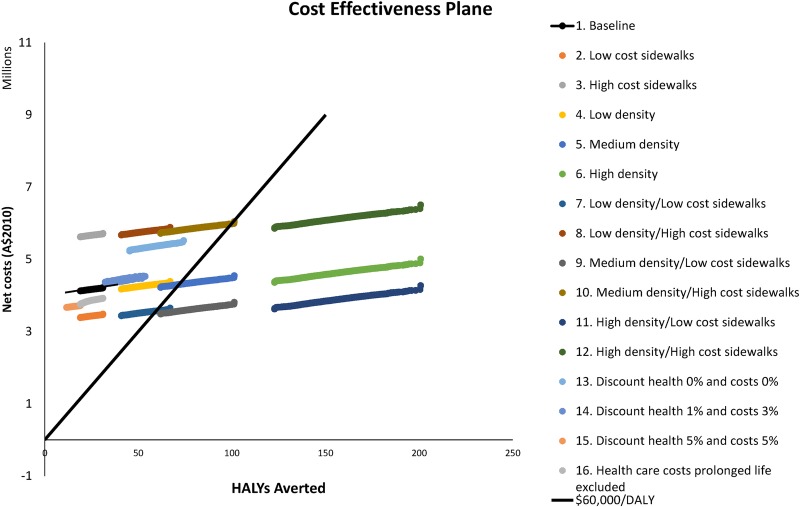
Installing and maintaining an additional 10 km of sidewalk in an average neighbourhood with 19 000 adult residents was estimated to cost A$4.2 million over 30 years and gain 24 HALYs over the lifetime of an average neighbourhood adult resident population. The incremental cost-effectiveness ratio was A$176 000/HALY. However, sensitivity results indicated that increasing population densities improves cost-effectiveness.
In low-density cities such as in Australia, installing sidewalks in established neighbourhoods as a single intervention is unlikely to cost-effectively improve health. Sidewalks must be considered alongside other complementary elements of walkability, such as density, land use mix and street connectivity. Population density is particularly important because at higher densities, more residents are exposed and this improves the cost-effectiveness. Health gain is one of many benefits of enhancing neighbourhood walkability and future studies might consider a more comprehensive assessment of its social value (eg, social cohesion, safety and air quality).
研究一致发现,支持性的邻里建成环境通过鼓励步行和骑自行车来增加身体活动。然而,缺乏关于投资建成环境干预措施作为促进身体活动手段的成本效益的证据。在本研究中,我们评估增加人行道可用性作为鼓励步行的一种手段的成本效益。
利用澳大利亚珀斯RESIDE研究的数据,我们对在现有社区安装额外人行道的成本影响和健康调整生命年(HALYs)变化进行了建模。人行道可用性与步行之间关系的估计取自先前的一项研究。多状态生命表模型用于估计与步行频率和持续时间变化相关的HALYs。敏感性分析用于探讨人口密度、贴现率、人行道成本以及在增加的生命年中纳入无关医疗成本的变化的影响。
在一个有19000名成年居民的普通社区安装和维护额外10公里的人行道,估计在30年内成本为420万澳元,在普通社区成年居民人口的一生中可获得24个HALYs。增量成本效益比为176000澳元/HALY。然而,敏感性结果表明,提高人口密度可改善成本效益。
在澳大利亚这样的低密度城市,在现有社区单独安装人行道不太可能以具有成本效益的方式改善健康。人行道必须与其他步行适宜性的补充要素一起考虑,如密度、土地利用混合和街道连通性。人口密度尤为重要,因为在较高密度下,更多居民会受到影响,这会提高成本效益。健康收益是增强邻里步行适宜性的诸多益处之一,未来的研究可能会考虑对其社会价值(如社会凝聚力、安全性和空气质量)进行更全面的评估。