Samy Abdallah M, Thomas Stephanie M, Wahed Ahmed Abd El, Cohoon Kevin P, Peterson A Townsend
Ain Shams University, Faculty of Science, Cairo, Egypt.
University of Kansas, Biodiversity Institute, Lawrence, KS, USA.
Mem Inst Oswaldo Cruz. 2016 Sep;111(9):559-60. doi: 10.1590/0074-02760160149.
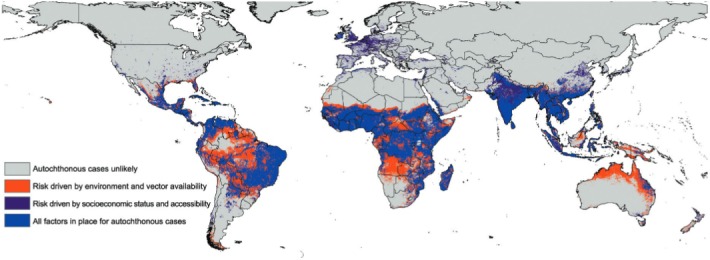
The Americas are presently experiencing the most serious known outbreak of Zika virus (ZIKV). Here, we present a novel set of analyses using environmental characteristics, vector mosquito distributions, and socioeconomic risk factors to develop the first map to detail global ZIKV transmission risk in multiple dimensions based on ecological niche models. Our model predictions were tested against independent evaluation data sets, and all models had predictive ability significantly better than random expectations. The study addresses urgent knowledge gaps regarding (1) the potential geographic scope of the current ZIKV epidemic, (2) the global potential for spread of ZIKV, and (3) drivers of ZIKV transmission. Our analysis of potential drivers of ZIKV distributions globally identified areas vulnerable in terms of some drivers, but not for others. The results of these analyses can guide regional education and preparedness efforts, such that medical personnel will be better prepared for diagnosis of potential ZIKV cases as they appear.
美洲目前正在经历已知最严重的寨卡病毒(ZIKV)疫情。在此,我们利用环境特征、媒介蚊子分布和社会经济风险因素进行了一系列新颖的分析,以基于生态位模型绘制出首张从多个维度详细展示全球寨卡病毒传播风险的地图。我们的模型预测通过独立评估数据集进行了检验,所有模型的预测能力均显著优于随机预期。该研究填补了有关以下方面的紧迫知识空白:(1)当前寨卡病毒疫情的潜在地理范围;(2)寨卡病毒在全球传播的可能性;(3)寨卡病毒传播的驱动因素。我们对全球寨卡病毒分布潜在驱动因素的分析确定了在某些驱动因素方面易受影响但在其他方面并非如此的地区。这些分析结果可指导区域教育和防范工作,以便医务人员在潜在寨卡病毒病例出现时能更好地做好诊断准备。