Department of Chemistry, The University of Warwick, Coventry, CV4 7AL, UK.
Department of Polymer Science, The University of Akron, Akron, OH, 44325, USA.
Angew Chem Int Ed Engl. 2016 Oct 10;55(42):13076-13080. doi: 10.1002/anie.201606750.
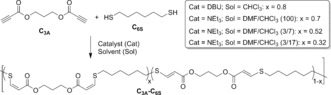
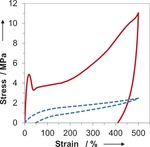
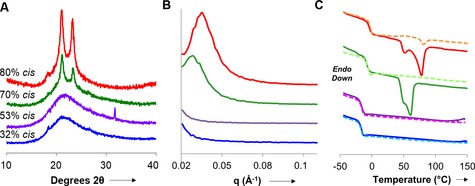
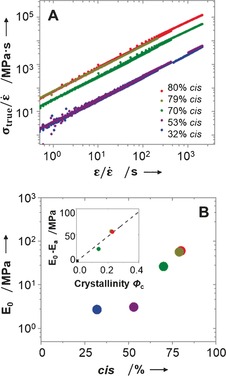
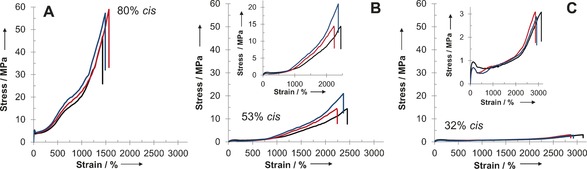
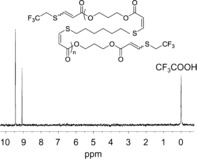
In most synthetic elastomers, changing the physical properties by monomer choice also results in a change to the crystallinity of the material, which manifests through alteration of its mechanical performance. Using organocatalyzed stereospecific additions of thiols to activated alkynes, high-molar-mass elastomers were isolated via step-growth polymerization. The resulting controllable double-bond stereochemistry defines the crystallinity and the concomitant mechanical properties as well as enabling the synthesis of materials that retain their excellent mechanical properties through changing monomer composition. Using this approach to elastomer synthesis, further end group modification and toughening through vulcanization strategies are also possible. The organocatalytic control of stereochemistry opens the realm to a new and easily scalable class of elastomers that will have unique chemical handles for functionalization and post synthetic processing.
在大多数合成弹性体中,通过单体选择改变物理性质也会导致材料结晶度的变化,这表现为其机械性能的改变。通过有机催化的硫醇对活化炔烃的立体特异性加成,可以通过逐步增长聚合来分离高分子量弹性体。所得可控的双键立体化学定义了结晶度和相应的机械性能,并能够合成通过改变单体组成来保持其优异机械性能的材料。通过这种弹性体合成方法,还可以通过硫化策略进一步进行端基改性和增韧。立体化学的有机催化控制为一类新型的、易于规模化的弹性体开辟了领域,这些弹性体将具有独特的化学处理功能和后合成处理功能。