Ulusoy Seckin, Dinc Mehmet Emre, Dalgic Abdullah, Topak Murat, Dizdar Denizhan, İs Abdulhalim
Turkish Ministry of Health, Gaziosmanpasa Taksim Education and Research Hospital, Department of Otorhinolaryngology, Istanbul, Turkey.
Turkish Ministry of Health, Gaziosmanpasa Taksim Education and Research Hospital, Department of Otorhinolaryngology, Istanbul, Turkey.
Braz J Otorhinolaryngol. 2017 Nov-Dec;83(6):640-645. doi: 10.1016/j.bjorl.2016.08.011. Epub 2016 Sep 12.
The olfactory system is affected by the nutritional balance and chemical state of the body, serving as an internal sensor. All bodily functions are affected by energy loss, including olfaction; hunger can alter odour perception.
In this study, we investigated the effect of fasting on olfactory perception in humans, and also assessed perceptual changes during satiation.
The "Sniffin' Sticks" olfactory test was applied after 16h of fasting, and again at least 1h after Ramadan supper during periods of satiation. All participants were informed about the study procedure and provided informed consent. The study protocol was approved by the local Ethics Committee of Gaziosmanpaşa Taksim Education and Research Hospital (09/07/2014 no: 60). The study was conducted in accordance with the basic principles of the Declaration of Helsinki.
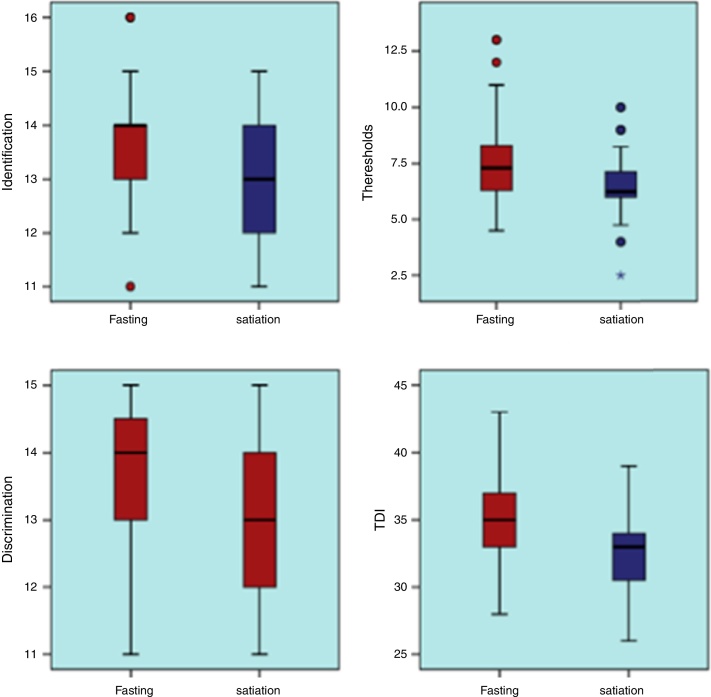
This prospective study included 48 subjects (20 males, 28 females) with a mean age of 33.6±9.7 (range 20-72) years; their mean height was 169.1±7.6 (range 150.0-185.0)cm, mean weight was 71.2±17.6 (range 50.0-85.0)kg, and average BMI was 24.8±5.3 (range 19.5-55.9). Scores were higher on all items pertaining to olfactory identification, thresholds and discrimination during fasting vs. satiation (p<0.05). Identification (I) results: Identification scores were significantly higher during the fasting (median=14.0) vs. satiation period (median=13.0). Threshold (T) results: Threshold scores were significantly higher during the fasting (median=7.3) vs. satiation period (median=6.2). Discrimination (D) results: Discrimination scores were significantly higher during the fasting (median=14.0) vs. satiation period (median=13.0). The total TDI scores were 35.2 (fasting) vs. 32.6 (satiation). When we compared fasting threshold value of >9 and ≤9, the gap between the fasting and satiety thresholds was significantly greater in >9 (p<0.05).
Olfactory function improved during fasting and declined during satiation. The olfactory system is more sensitive, and more reactive to odours, under starvation conditions, and is characterised by reduced activity during satiation. This situation was more pronounced in patients with a better sense of smell. Olfaction-related neurotransmitters should be the target of further study.
嗅觉系统受身体营养平衡和化学状态的影响,充当内部传感器。所有身体功能都受能量损失的影响,包括嗅觉;饥饿会改变气味感知。
在本研究中,我们调查了禁食对人类嗅觉感知的影响,并评估了饱腹感期间的感知变化。
在禁食16小时后应用“嗅觉棒”嗅觉测试,并在斋月晚餐后至少1小时饱腹感期间再次进行测试。所有参与者均被告知研究程序并提供了知情同意书。该研究方案已获得加济奥斯曼帕夏塔克西姆教育与研究医院当地伦理委员会的批准(2014年7月9日,编号:60)。该研究是根据《赫尔辛基宣言》的基本原则进行的。
这项前瞻性研究包括48名受试者(20名男性,28名女性),平均年龄为33.6±9.7(范围20 - 72)岁;他们的平均身高为169.1±7.6(范围150.0 - 185.0)厘米,平均体重为71.2±17.6(范围50.0 - 85.0)千克,平均BMI为24.8±5.3(范围19.5 - 55.9)。与饱腹感相比,禁食期间所有与嗅觉识别、阈值和辨别相关的项目得分更高(p<0.05)。识别(I)结果:禁食期间的识别得分(中位数 = 14.0)显著高于饱腹感期间(中位数 = 13.0)。阈值(T)结果:禁食期间的阈值得分(中位数 = 7.3)显著高于饱腹感期间(中位数 = 6.2)。辨别(D)结果:禁食期间的辨别得分(中位数 = 14.0)显著高于饱腹感期间(中位数 = 13.0)。总TDI得分分别为35.2(禁食)和32.6(饱腹感)。当我们比较禁食阈值>9和≤9时,>9组中禁食和饱腹感阈值之间的差距显著更大(p<0.05)。
嗅觉功能在禁食期间改善,在饱腹感期间下降。嗅觉系统在饥饿条件下对气味更敏感、反应更强,而在饱腹感期间活动减少。这种情况在嗅觉较好的患者中更为明显。与嗅觉相关的神经递质应作为进一步研究的靶点。