Research Centre in Applied Sports, Technology, Exercise and Medicine, College of Engineering, Swansea University, Fabian Way, Swansea, SA1 8QQ, Wales, UK.
Cardiff School of Sport, Cardiff Metropolitan University, Cardiff, Wales, UK.
Sports Med. 2017 May;47(5):943-974. doi: 10.1007/s40279-016-0619-5.
Coaches, sport scientists, clinicians and medical personnel face a constant challenge to prescribe sufficient training load to produce training adaption while minimising fatigue, performance inhibition and risk of injury/illness.
The aim of this review was to investigate the relationship between injury and illness and longitudinal training load and fatigue markers in sporting populations.
Systematic searches of the Web of Science and PubMed online databases to August 2015 were conducted for articles reporting relationships between training load/fatigue measures and injury/illness in athlete populations.
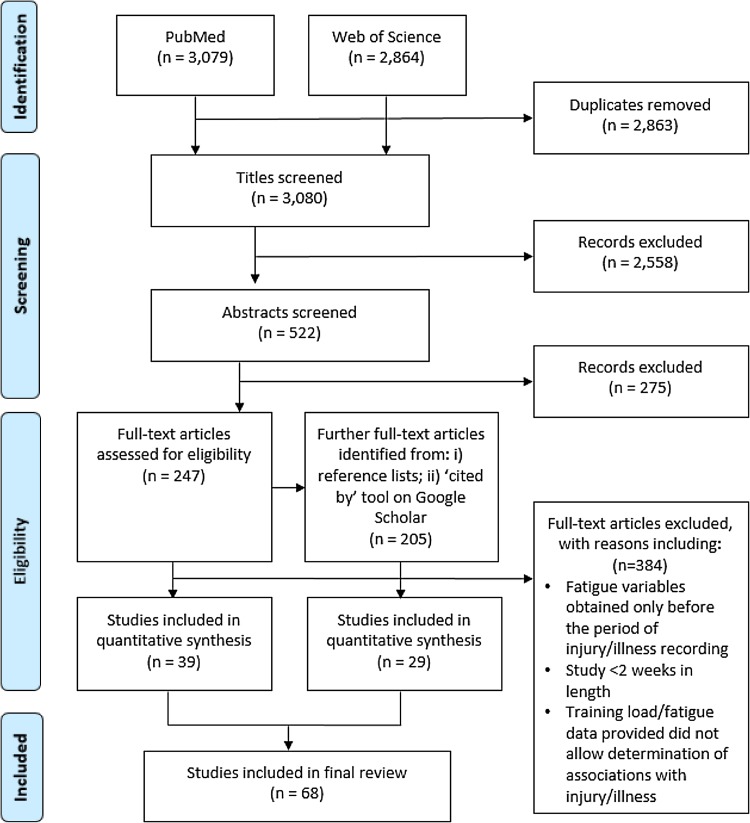
From the initial 5943 articles identified, 2863 duplicates were removed, followed by a further 2833 articles from title and abstract selection. Manual searching of the reference lists of the remaining 247 articles, together with use of the Google Scholar 'cited by' tool, yielded 205 extra articles deemed worthy of assessment. Sixty-eight studies were subsequently selected for inclusion in this study, of which 45 investigated injury only, 17 investigated illness only, and 6 investigated both injury and illness. This systematic review highlighted a number of key findings, including disparity within the literature regarding the use of various terminologies such as training load, fatigue, injury and illness. Athletes are at an increased risk of injury/illness at key stages in their training and competition, including periods of training load intensification and periods of accumulated training loads.
Further investigation of individual athlete characteristics is required due to their impact on internal training load and, therefore, susceptibility to injury/illness.
教练、运动科学家、临床医生和医务人员在为运动员设定足够的训练负荷以产生训练适应的同时,还需要最小化疲劳、表现抑制以及受伤/患病的风险,这一直是他们面临的挑战。
本综述旨在研究运动人群中损伤/疾病与纵向训练负荷和疲劳标志物之间的关系。
对 Web of Science 和 PubMed 在线数据库进行系统检索,以 2015 年 8 月为时间截点,检索有关运动员人群中训练负荷/疲劳指标与损伤/疾病之间关系的文章。
从最初确定的 5943 篇文章中,去除 2863 篇重复的文章,然后根据标题和摘要再去除 2833 篇文章。对剩余 247 篇文章的参考文献列表进行手工搜索,并使用 Google Scholar 的“被引”工具,额外获得 205 篇值得评估的文章。随后,有 68 项研究被纳入本研究,其中 45 项仅研究损伤,17 项仅研究疾病,6 项同时研究损伤和疾病。本系统综述强调了一些关键发现,包括文献中在使用各种术语(如训练负荷、疲劳、损伤和疾病)方面存在差异。运动员在训练和比赛的关键阶段受伤/患病的风险增加,包括训练负荷强化阶段和累积训练负荷阶段。
需要进一步研究个体运动员的特征,因为这些特征会影响内部训练负荷,从而影响他们受伤/患病的易感性。