Guyot Patricia, Ades Anthony E, Beasley Matthew, Lueza Béranger, Pignon Jean-Pierre, Welton Nicky J
School of Social and Community Medicine, University of Bristol, Bristol, UK (PG, AED, NJW).
Mapi, Houten, the Netherlands (PG).
Med Decis Making. 2017 May;37(4):353-366. doi: 10.1177/0272989X16670604. Epub 2016 Sep 29.
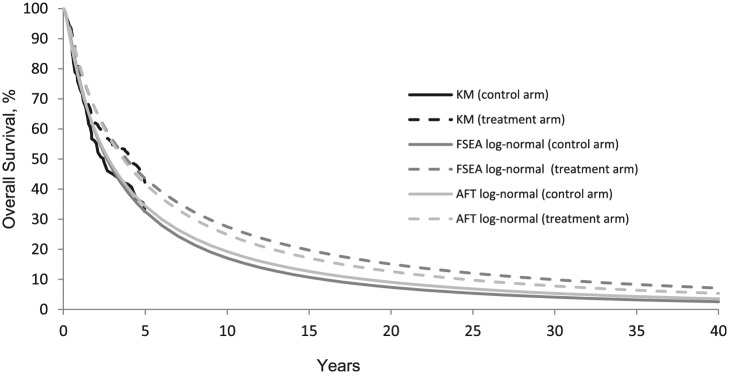
Estimates of life expectancy are a key input to cost-effectiveness analysis (CEA) models for cancer treatments. Due to the limited follow-up in Randomized Controlled Trials (RCTs), parametric models are frequently used to extrapolate survival outcomes beyond the RCT period. However, different parametric models that fit the RCT data equally well may generate highly divergent predictions of treatment-related gain in life expectancy. Here, we investigate the use of information external to the RCT data to inform model choice and estimation of life expectancy.
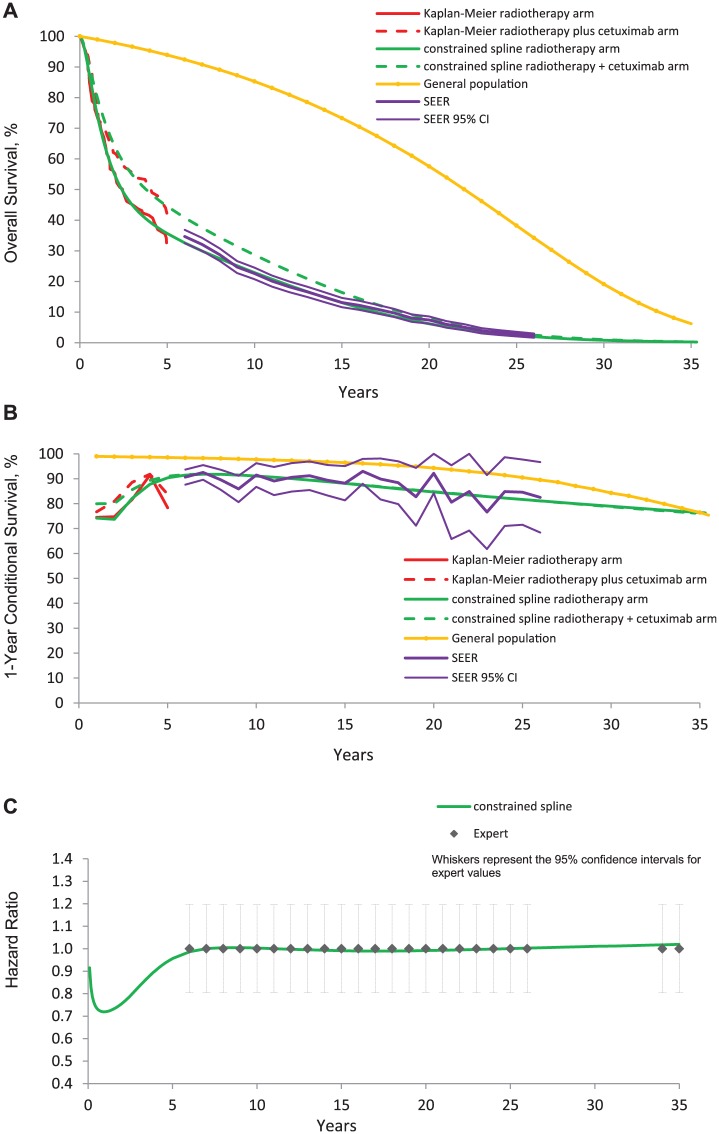
We used Bayesian multi-parameter evidence synthesis to combine the RCT data with external information on general population survival, conditional survival from cancer registry databases, and expert opinion. We illustrate with a 5-year follow-up RCT of cetuximab plus radiotherapy v. radiotherapy alone for head and neck cancer.
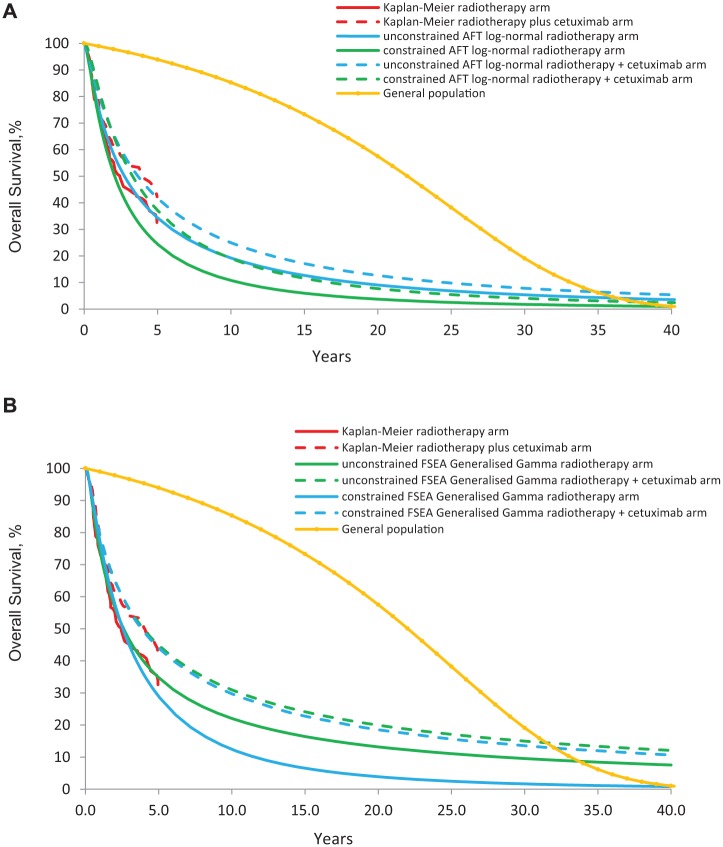
Standard survival time distributions were insufficiently flexible to simultaneously fit both the RCT data and external data on general population survival. Using spline models, we were able to estimate a model that was consistent with the trial data and all external data. A model integrating all sources achieved an adequate fit and predicted a 4.7-month (95% CrL: 0.4; 9.1) gain in life expectancy due to cetuximab.
Long-term extrapolation using parametric models based on RCT data alone is highly unreliable and these models are unlikely to be consistent with external data. External data can be integrated with RCT data using spline models to enable long-term extrapolation. Conditional survival data could be used for many cancers and general population survival may have a role in other conditions. The use of external data should be guided by knowledge of natural history and treatment mechanisms.
预期寿命估计是癌症治疗成本效益分析(CEA)模型的关键输入。由于随机对照试验(RCT)的随访有限,参数模型经常被用于推断RCT期之外的生存结果。然而,同样很好地拟合RCT数据的不同参数模型可能会对治疗相关的预期寿命增益产生高度不同的预测。在此,我们研究使用RCT数据之外的信息来指导模型选择和预期寿命估计。
我们使用贝叶斯多参数证据综合法,将RCT数据与关于一般人群生存、癌症登记数据库的条件生存以及专家意见的外部信息相结合。我们以一项针对头颈部癌的西妥昔单抗联合放疗与单纯放疗的5年随访RCT为例进行说明。
标准生存时间分布的灵活性不足以同时拟合RCT数据和一般人群生存的外部数据。使用样条模型,我们能够估计出一个与试验数据和所有外部数据一致的模型。整合所有来源的模型实现了充分拟合,并预测西妥昔单抗可使预期寿命增加4.7个月(95%可信区间:0.4;9.1)。
仅基于RCT数据使用参数模型进行长期推断是高度不可靠且这些模型不太可能与外部数据一致。外部数据可以使用样条模型与RCT数据整合以实现长期推断。条件生存数据可用于许多癌症,一般人群生存数据可能在其他情况中发挥作用。外部数据的使用应以对自然史和治疗机制的了解为指导。