Russo María Julieta, Cohen Gabriela, Chrem Mendez Patricio, Campos Jorge, Nahas Federico E, Surace Ezequiel I, Vazquez Silvia, Gustafson Deborah, Guinjoan Salvador, Allegri Ricardo F, Sevlever Gustavo
Center of Aging and Memory of Neurological Research Institute (FLENI), Buenos Aires, Argentina.
Department of Neurology, State University of New York-Downstate Medical Center, Brooklyn, NY, USA; Neuropsychiatric Epidemiology Unit, Institute of Neuroscience and Physiology, Sahlgrenska Academy, University of Gothenburg, Gothenburg, Sweden.
Neuropsychiatr Dis Treat. 2016 Sep 13;12:2199-2206. doi: 10.2147/NDT.S107051. eCollection 2016.
Argentina-Alzheimer's Disease Neuroimaging Initiative (Arg-ADNI) is the first ADNI study to be performed in Latin America at a medical center with the appropriate infrastructure. Our objective was to describe baseline characteristics and to examine whether biomarkers related to Alzheimer's disease (AD) physiopathology were associated with worse memory performance.
Fifteen controls and 28 mild cognitive impairment and 13 AD dementia subjects were included. For Arg-ADNI, all biomarker parameters and neuropsychological tests of ADNI-II were adopted. Results of positron emission tomography (PET) with fluorodeoxyglucose and C-Pittsburgh compound-B (PIB-PET) were available from all participants. Cerebrospinal fluid biomarker results were available from 39 subjects.
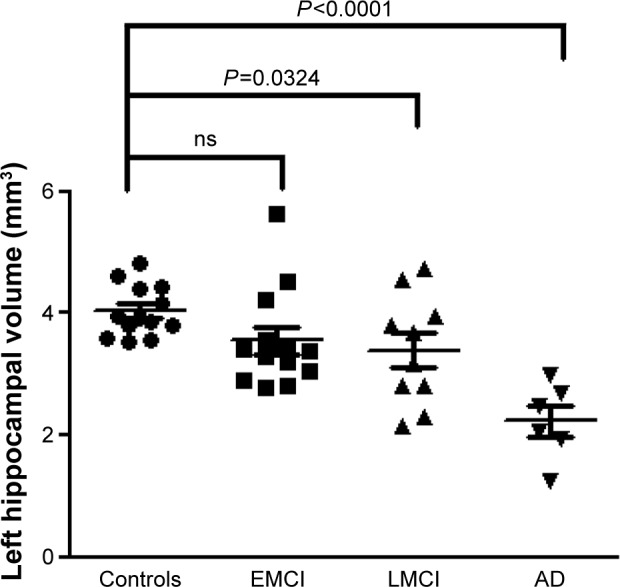
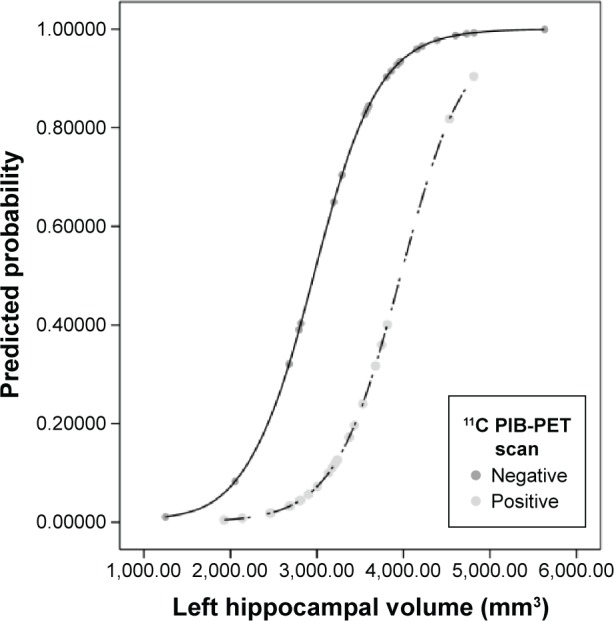
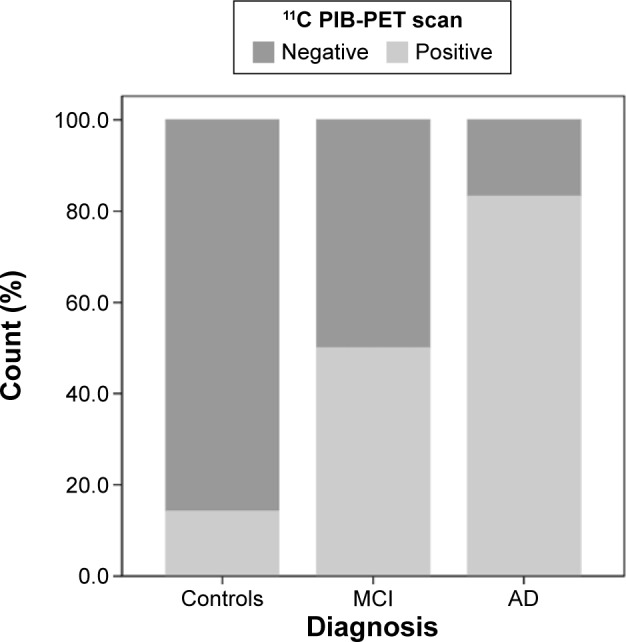
A total of 56 participants were included and underwent baseline evaluation. The three groups were similar with respect to years of education and sex, and they differed in age (=5.10, =0.01). Mean scores for the baseline measurements of the neuropsychological evaluation differed significantly among the three groups at <0.001, showing a continuum in their neuropsychological performance. No significant correlations were found between the principal measures (long-delay recall, C-Pittsburgh compound-B scan, left hippocampal volume, and APOEε4) and either age, sex, or education (>0.1). Baseline amyloid deposition and left hippocampal volume separated the three diagnostic groups and correlated with the memory performance (<0.001).
Cross-sectional analysis of baseline data revealed links between cognition, structural changes, and biomarkers. Follow-up of a larger and more representative cohort, particularly analyzing cerebrospinal fluid and brain biomarkers, will allow better characterization of AD in our country.
阿根廷阿尔茨海默病神经影像学倡议(Arg-ADNI)是在拉丁美洲一家具备适当基础设施的医疗中心开展的首个ADNI研究。我们的目的是描述基线特征,并研究与阿尔茨海默病(AD)病理生理学相关的生物标志物是否与较差的记忆表现相关。
纳入了15名对照者、28名轻度认知障碍者和13名AD痴呆患者。对于Arg-ADNI,采用了ADNI-II的所有生物标志物参数和神经心理学测试。所有参与者均有氟脱氧葡萄糖正电子发射断层扫描(PET)和C-匹兹堡化合物B(PIB-PET)的结果。39名受试者有脑脊液生物标志物结果。
共纳入56名参与者并进行了基线评估。三组在受教育年限和性别方面相似,在年龄上存在差异(F=5.10,P=0.01)。神经心理学评估基线测量的平均得分在三组间差异显著(P<0.001),显示出其神经心理学表现的连续性。在主要指标(长时延迟回忆、C-匹兹堡化合物B扫描、左侧海马体积和APOEε4)与年龄、性别或受教育程度之间未发现显著相关性(P>0.1)。基线淀粉样蛋白沉积和左侧海马体积区分了三个诊断组,并与记忆表现相关(P<0.001)。
基线数据的横断面分析揭示了认知、结构变化和生物标志物之间的联系。对更大且更具代表性的队列进行随访,特别是分析脑脊液和脑生物标志物,将有助于更好地描述我国的AD情况。