Allegri Ricardo F, Chrem Méndez Patricio, Calandri Ismael, Cohen Gabriela, Martín Maria Eugenia, Russo María Julieta, Crivelli Lucia, Pertierra Lucia, Tapajóz Fernanda, Clarens María Florencia, Campos Jorge, Nahas Federico E, Vázquez Silvia, Surace Ezequiel, Sevlever Gustavo
Department of Cognitive Neurology Neuropsychiatry and Neuropsychology, Instituto de Investigaciones Neurológicas FLENI Buenos Aires Argentina.
Department of Neurosciences Universidad de la Costa (CUC) Barranquilla Colombia.
Alzheimers Dement (Amst). 2020 May 22;12(1):e12026. doi: 10.1002/dad2.12026. eCollection 2020.
To describe results of the Amyloid, Tau, Neurodegeneration (ATN) research framework classification in the Argentine-Alzheimer's Disease Neuroimaging Initiative (arg-ADNI) cohort.
Twenty-three patients with mild cognitive impairment (MCI), 12 dementia of Alzheimer's type (DAT), and 14 normal controls were studied following the ADNI2 protocol. Patients were categorized according to presence or absence of the biomarkers for amyloid beta (Aβ; A: amyloid positron emission tomography [PET] scan or cerebrospinal fluid [CSF] Aβ42), tau (T: CSF phosphorylated-tau), and neurodegeneration (N: CSF total-tau, fluorodeoxyglucose [FDG]-PET scan, or structural magnetic resonance imaging [MRI] scan).
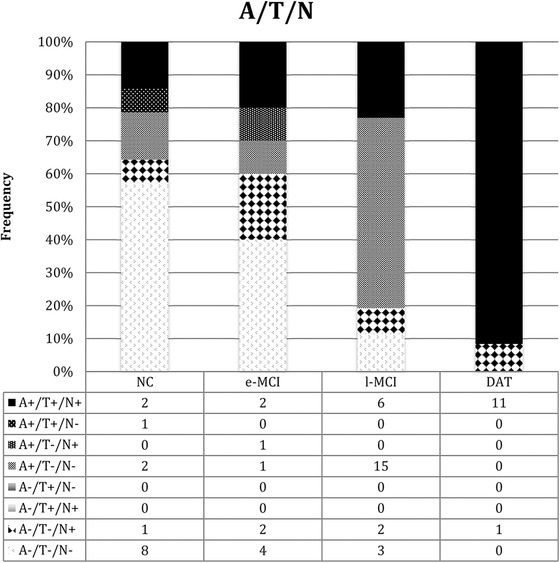
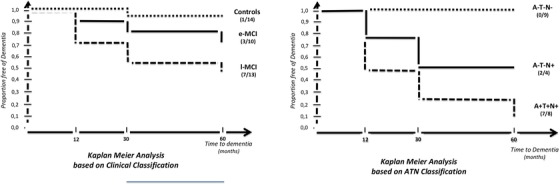
A+T+N+ biomarker profile was identified at baseline in 91% of mild dementia patients, 20% of early MCI patients, 46% of late MCI patients, and 14% of control subjects. Suspected non-AD pathophysiology (SNAP, A-T-N+) was found in 8% of mild dementia, 20% of early MCI, 15% of late MCI, and 7% of control subjects. Conversion rates to dementia after 5-year follow-up were 85% in A+T+N+ MCI patients and 50% in A-T-N+ patients.
We present initial 5-year follow-up results of a regional ADNI based on AD biomarkers and the ATN classification.
描述淀粉样蛋白、tau蛋白、神经退行性变(ATN)研究框架分类在阿根廷-阿尔茨海默病神经影像学倡议(arg-ADNI)队列中的结果。
按照ADNI2方案对23例轻度认知障碍(MCI)患者、12例阿尔茨海默病型痴呆(DAT)患者和14例正常对照进行研究。根据是否存在淀粉样β蛋白(Aβ;A:淀粉样正电子发射断层扫描[PET]或脑脊液[CSF] Aβ42)、tau蛋白(T:CSF磷酸化tau蛋白)和神经退行性变(N:CSF总tau蛋白、氟脱氧葡萄糖[FDG]-PET扫描或结构磁共振成像[MRI]扫描)的生物标志物对患者进行分类。
在基线时,91%的轻度痴呆患者、20%的早期MCI患者、46%的晚期MCI患者和14%的对照受试者被鉴定为A+T+N+生物标志物谱。在8%的轻度痴呆患者、20%的早期MCI患者、15%的晚期MCI患者和7%的对照受试者中发现了疑似非AD病理生理学(SNAP,A-T-N+)。5年随访后向痴呆的转化率在A+T+N+ MCI患者中为85%,在A-T-N+患者中为50%。
我们展示了基于AD生物标志物和ATN分类的区域ADNI的初步5年随访结果。