Jamnik Joseph, Rehman Sara, Blanco Mejia Sonia, de Souza Russell J, Khan Tauseef A, Leiter Lawrence A, Wolever Thomas M S, Kendall Cyril W C, Jenkins David J A, Sievenpiper John L
Department of Nutritional Sciences, Faculty of Medicine, University of Toronto, Toronto, Ontario, Canada.
Department of Nutritional Sciences, Faculty of Medicine, University of Toronto, Toronto, Ontario, Canada Toronto 3D Knowledge Synthesis and Clinical Trials Unit, Clinical Nutrition and Risk Factor Modification Centre, St. Michael's Hospital, Toronto, Ontario, Canada.
BMJ Open. 2016 Oct 3;6(10):e013191. doi: 10.1136/bmjopen-2016-013191.
The prevalence of hyperuricemia and gout has increased in recent decades. The role of dietary fructose in the development of these conditions remains unclear.
To conduct a systematic review and meta-analysis of prospective cohort studies investigating the association fructose consumption with incident gout and hyperuricemia.
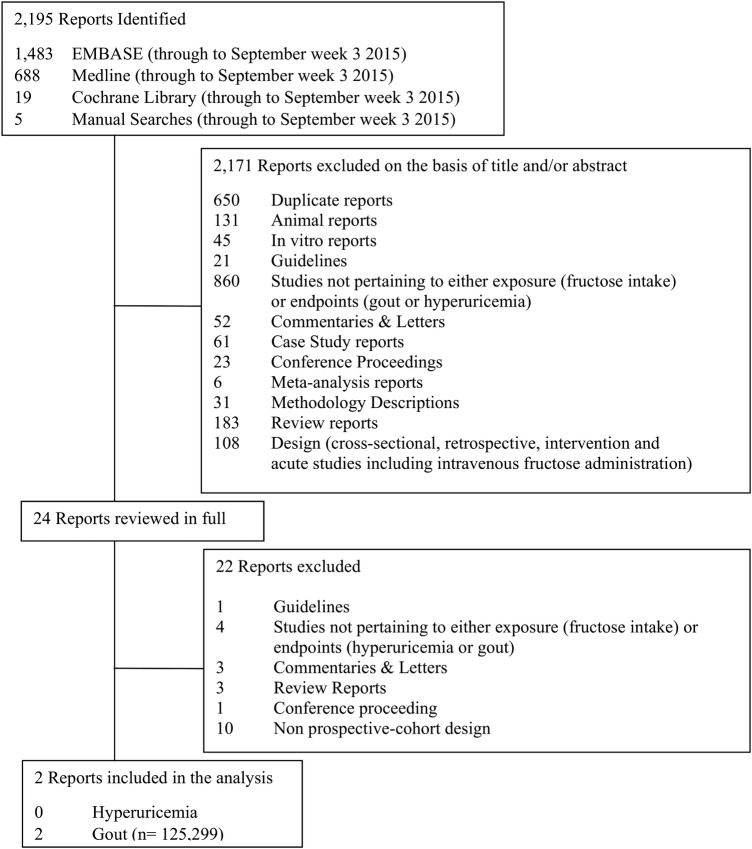
MEDLINE, EMBASE and the Cochrane Library were searched (through September 2015). We included prospective cohort studies that assessed fructose consumption and incident gout or hyperuricemia. 2 independent reviewers extracted relevant data and assessed study quality using the Newcastle-Ottawa Scale. We pooled natural-log transformed risk ratios (RRs) using the generic inverse variance method. Interstudy heterogeneity was assessed (Cochran Q statistic) and quantified (I statistic). The overall quality of the evidence was assessed using the Grading of Recommendations Assessment, Development and Evaluation (GRADE) approach.
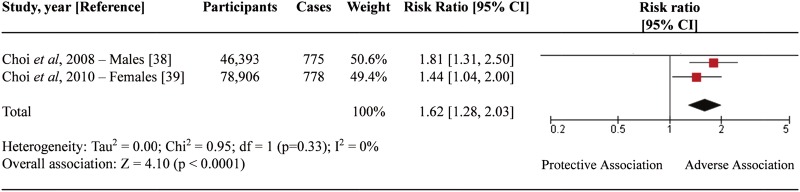
2 studies involving 125 299 participants and 1533 cases of incident gout assessed the association between fructose consumption and incident gout over an average of 17 years of follow-up. No eligible studies assessed incident hyperuricemia as an outcome. Fructose consumption was associated with an increase in the risk of gout (RR=1.62, 95% CI 1.28 to 2.03, p<0.0001) with no evidence of interstudy heterogeneity (I=0%, p=0.33) when comparing the highest (>11.8% to >11.9% total energy) and lowest (<6.9% to <7.5% total energy) quantiles of consumption.
Despite a dose-response gradient, the overall quality of evidence as assessed by GRADE was low, due to indirectness. There were only two prospective cohort studies involving predominantly white health professionals that assessed incident gout, and none assessed hyperuricemia.
Fructose consumption was associated with an increased risk of developing gout in predominantly white health professionals. More prospective studies are necessary to understand better the role of fructose and its food sources in the development of gout and hyperuricemia.
NCT01608620.
近几十年来,高尿酸血症和痛风的患病率有所上升。膳食果糖在这些疾病发展过程中的作用仍不明确。
对调查果糖摄入与痛风及高尿酸血症发病之间关联的前瞻性队列研究进行系统评价和荟萃分析。
检索了MEDLINE、EMBASE和Cochrane图书馆(截至2015年9月)。纳入评估果糖摄入与痛风或高尿酸血症发病的前瞻性队列研究。两名独立评审员提取相关数据,并使用纽卡斯尔-渥太华量表评估研究质量。我们采用通用逆方差法汇总自然对数转换后的风险比(RRs)。评估研究间异质性( Cochr an Q统计量)并进行量化(I统计量)。使用推荐分级评估、制定和评价(GRADE)方法评估证据的总体质量。
两项研究共纳入125299名参与者和1533例痛风发病病例,平均随访17年,评估了果糖摄入与痛风发病之间的关联。没有符合条件的研究将高尿酸血症发病作为结局进行评估。当比较最高(>总能量的11.8%至>11.9%)和最低(<总能量的6.9%至<7.5%)摄入量分位数时,果糖摄入与痛风风险增加相关(RR=1.62,95%CI 1.28至2.03,p<0.0001),且没有研究间异质性的证据(I=0%,p=0.33)。
尽管存在剂量反应梯度,但由于证据的间接性,GRADE评估的证据总体质量较低。仅有两项主要涉及白人健康专业人员的前瞻性队列研究评估了痛风发病情况,没有研究评估高尿酸血症。
在主要为白人的健康专业人员中,果糖摄入与痛风发病风险增加相关。需要更多的前瞻性研究来更好地了解果糖及其食物来源在痛风和高尿酸血症发展中的作用。
NCT01608620。