Lee Dong-Won, Choi Eun-Young
Division of Pulmonology, Department of Internal Medicine, Andong Sungso Hospital, Andong, Korea.
Division of Pulmonology and Allergy, Department of Internal Medicine, Yeungnam University Hospital, Daegu, Korea.
PLoS One. 2016 Oct 17;11(10):e0164303. doi: 10.1371/journal.pone.0164303. eCollection 2016.
A decrease in bone mineral density (BMD) is a systemic consequence of chronic obstructive pulmonary disease (COPD). Past reports have rarely examined any correlation between sarcopenia and BMD. We investigated the relationship cross-sectionally between the presence of sarcopenia and BMD reduction in COPD patients.
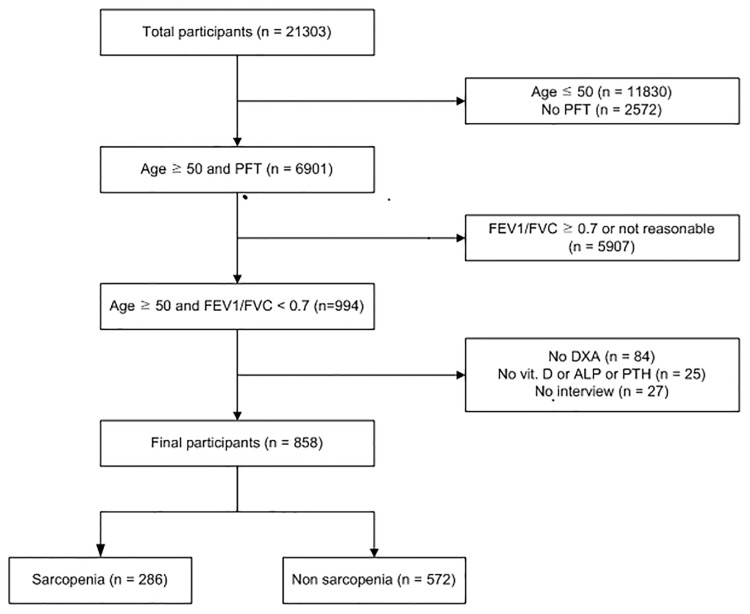
COPD patients aged 50 or older with qualifying spirometry and dual-energy X-ray absorptiometry data were from participants in the Korean National Health and Nutrition Examination Surveys IV and V (2008-2011).
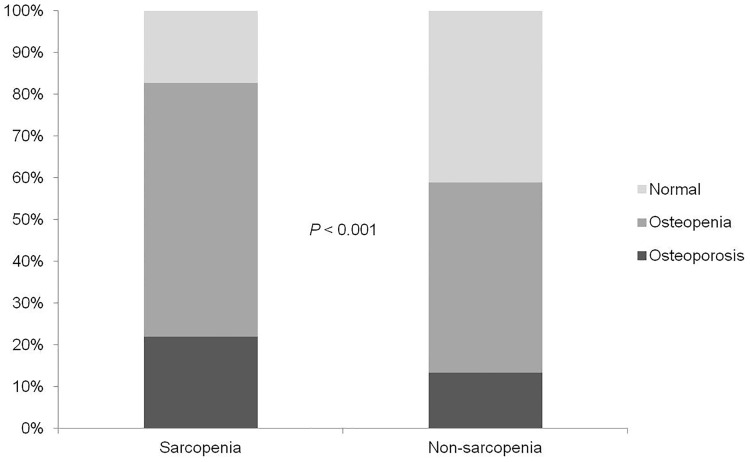
There were 286 (33.3%) subjects in the sarcopenia group and 572 (66.7%) in the non-sarcopenia group. The sarcopenia group had lower T-scores than the non-sarcopenia group (femur: -0.73±0.88 vs. -0.18±0.97, p < 0.001; femur neck: -1.44±0.98 vs. -0.99±1.06, p < 0.001; lumbar: -1.38±1.36 vs. -0.84±1.38, p < 0.001). The prevalences of osteopenia and osteoporosis were 60.8% and 22.0%, respectively, in the sarcopenia group and 45.6% and 13.3% in the non-sarcopenia group (both p < 0.001). After adjusting for multiple variables, the presence of sarcopenia associated with increased the risk of osteopenia, osteoporosis, and a low BMD (OR = 3.227, 95% CI = 2.125-4.899, p < 0.001, OR = 6.952, 95% CI = 3.418-14.139, p < 0.001, and OR = 3.495, 95% CI = 2.315-5.278, p < 0.001, respectively). In a subgroup analysis, similar OR changes were confirmed in the high-body-weight group (n = 493) (OR = 2.248, 95% CI = 1.084-4.665, p = 0.030, OR = 4.621, 95% CI = 1.167-18.291, p = 0.029, and OR = 2.376, 95% CI = 1.158-4.877, p = 0.018, respectively).
The presence of sarcopenia was associated with increased the risk for decreased BMD in COPD.
骨密度(BMD)降低是慢性阻塞性肺疾病(COPD)的一种全身性后果。过去的报告很少研究肌肉减少症与骨密度之间的任何相关性。我们对COPD患者中肌肉减少症的存在与骨密度降低之间的关系进行了横断面调查。
年龄在50岁及以上、有合格肺功能测定和双能X线吸收测定数据的COPD患者来自韩国国家健康与营养检查调查IV和V(2008 - 2011年)的参与者。
肌肉减少症组有286名(33.3%)受试者,非肌肉减少症组有572名(66.7%)。肌肉减少症组的T值低于非肌肉减少症组(股骨:-0.73±0.88对-0.18±0.97,p<0.001;股骨颈:-1.44±0.98对-0.99±1.06,p<0.001;腰椎:-1.38±1.36对-0.84±1.38,p<0.001)。肌肉减少症组的骨质减少和骨质疏松患病率分别为60.8%和22.0%,非肌肉减少症组分别为45. 6%和13.3%(两者p<0.001)。在调整多个变量后,肌肉减少症的存在与骨质减少、骨质疏松和低骨密度风险增加相关(OR = 3.227,95%CI = 2.125 - 4.899,p<0.001;OR = 6.952,95%CI = 3.418 - 14.139,p<0.001;OR = 3.495,95%CI = 2.315 - 5.278,p<0.001)。在亚组分析中,高体重组(n = 493)也证实了类似的OR变化(OR = 2.248,95%CI = 1.084 - 4.665,p = 0.0 30;OR = 4.621,95%CI = 1.167 - 18.291,p = 0.029;OR = 2.376,95%CI = 1.158 - 4.877,p = 0.018)。
肌肉减少症的存在与COPD患者骨密度降低风险增加相关。