Hydration and Health Department, Danone Research, Palaiseau 91767, France.
CREDOC (Centre de Recherche pour l'Etude et l'Observation des Conditions de Vie), Paris 75013, France.
Nutrients. 2016 Oct 14;8(10):630. doi: 10.3390/nu8100630.
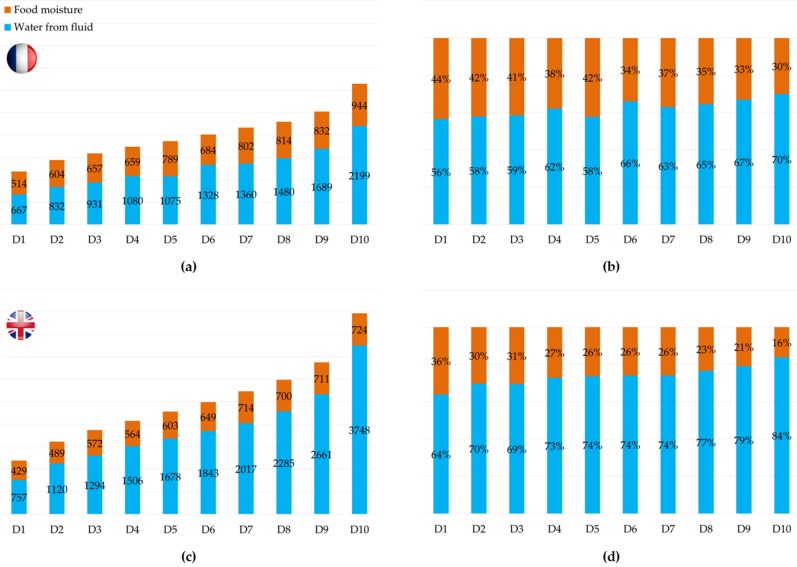
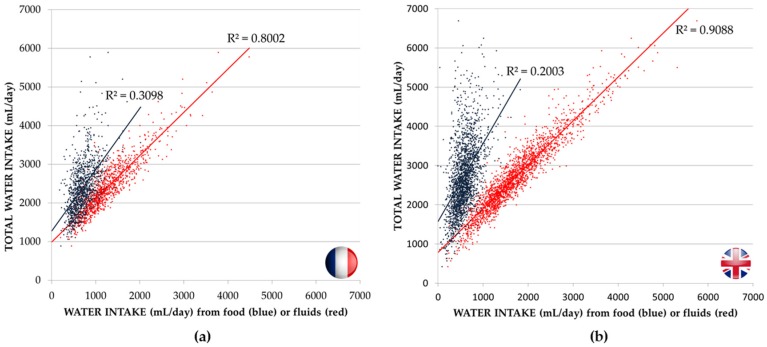
Little has been published on the contribution of food moisture (FM) to total water intake (TWI); therefore, the European Food Safety Authority assumed FM to contribute 20%-30% to TWI. The aim of the present analysis was to estimate and compare TWI, the percentage of water from FM and from fluids in population samples of France and UK. Data from 2 national nutrition surveys (Enquête Comportements et Consommations Alimentaires en France (CCAF) 2013 and the National Diet and Nutrition Survey (NDNS) 2008/2009-2011/2012) were analyzed for TWI and the contribution of water from FM and fluids. Children and adults TWI were significantly lower in France than in the UK. The contribution of water from foods was lower in the UK than in France (27% vs. 36%). As TWI increased, the proportion of water from fluids increased, suggesting that low drinkers did not compensate by increasing intake of water-rich foods. In addition, 80%-90% of the variance in TWI was explained by differences in water intake from fluids. More data on the contribution of FM to TWI is needed to develop more robust dietary recommendations on TWI and guidance on fluid intake for the general public.
关于食物水分(FM)对总水分摄入(TWI)的贡献,相关研究甚少;因此,欧洲食品安全局假设 FM 对 TWI 的贡献率为 20%-30%。本分析旨在估算和比较法国和英国人群样本中 TWI、FM 和液体来源的水分百分比。对 2 项国家营养调查(法国饮食行为和消费调查(CCAF)2013 年和英国国家饮食和营养调查(NDNS)2008/2009-2011/2012 年)的数据进行了 TWI 以及 FM 和液体来源水分的分析。结果表明,法国儿童和成年人的 TWI 明显低于英国。英国 FM 来源水分的贡献低于法国(27%比 36%)。随着 TWI 的增加,来自液体的水分比例增加,表明低饮水量人群并未通过增加摄入水分丰富的食物来补偿。此外,TWI 变异的 80%-90%可由液体摄入的差异来解释。需要更多关于 FM 对 TWI 贡献的数据,以制定关于 TWI 的更稳健的饮食建议和针对普通大众的液体摄入指南。