Department of Nutrition and Food Hygiene, School of Public Health, Peking University, Beijing 100191, China.
Laboratory of Toxicological Research and Risk Assessment for Food Safety, Beijing 100191, China.
Nutrients. 2024 May 21;16(11):1542. doi: 10.3390/nu16111542.
Evidence on the association between environmental factors and fluid intake behavior remains limited. The current study aims to explore seasonal variations in fluid intake behaviors among young adults in China.
A prospective cohort of 79 healthy young adults (43 males and 36 females) aged 19-21 in Hebei, China, was assessed for fluid intake behaviors for four seasons. For each assessment, the participants' anthropometric measurements were collected. Temperature and humidity on survey days were measured. Participants' total drinking fluid (TDF) was recorded using a self-administrative 7 d, 24 h fluid intake questionnaire. To calculate water from food (WFF), we weighed all foods consumed by participants. Duplicates of consumed food samples were collected to measure the water content via the drying method.
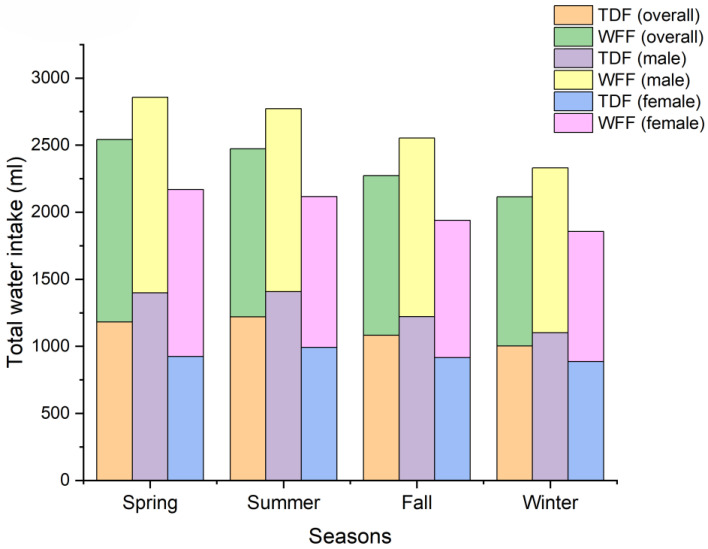
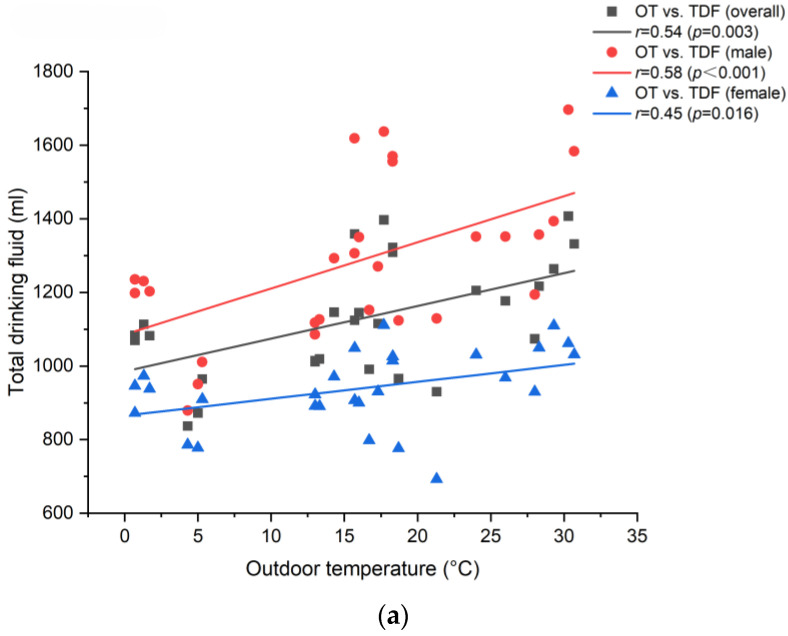
The mean total water intake (TWI) was 2761 ± 881, 2551 ± 845, 2210 ± 551, and 1989 ± 579 for spring, summer, fall, and winter, respectively ((2.37) = 42.29, < 0.001). The volume and proportion of TWI from TDF and WFF varied across the four seasons. The volume of WFF in spring (1361 ± 281, (2.61) = 17.21, < 0.001) and TDF in summer (1218 ± 502, (2.62) = 9.36, < 0.001) was among the highest, while participants' fluid intake behaviors in spring and summer were less distinct than the other pairwise comparisons. A moderate association was found between outdoor temperature and TDF ( = 0.53, < 0.01). Different general estimating equations suggested that gender, seasonality, outdoor temperature, differences in indoor and outdoor temperature, and mean temperature were independent factors of TDF. An interactive effect was found for gender and temperature, showing that the expected TDF of males may increase more as the temperature climbs.
Gender, seasonality, and air temperature could significantly affect fluid intake behaviors, including the amount and type of fluid intake. However, the independent effect of BMI and humidity remains unclear.
关于环境因素与液体摄入行为之间关联的证据仍然有限。本研究旨在探索中国年轻成年人液体摄入行为的季节性变化。
在中国河北,对 79 名年龄在 19-21 岁的健康年轻成年人(43 名男性和 36 名女性)进行了为期四个季节的液体摄入行为前瞻性队列研究。在每次评估时,收集参与者的人体测量学测量值。测量调查日的温度和湿度。参与者的总饮水量(TDF)通过自我管理的 7 天、24 小时液体摄入问卷进行记录。为了计算食物中的水分(WFF),我们对参与者所消耗的所有食物进行称重。收集消耗食物的重复样本,通过干燥法测量水分含量。
春季、夏季、秋季和冬季的平均总饮水量(TWI)分别为 2761 ± 881、2551 ± 845、2210 ± 551 和 1989 ± 579((2.37) = 42.29,<0.001)。TDF 和 WFF 的 TWI 量和比例在四个季节中均有所不同。春季 WFF 的量(1361 ± 281,(2.61) = 17.21,<0.001)和夏季 TDF 的量(1218 ± 502,(2.62) = 9.36,<0.001)最高,而参与者在春季和夏季的液体摄入行为不如其他两两比较明显。户外温度与 TDF 之间存在中度关联(= 0.53,<0.01)。不同的一般估计方程表明,性别、季节性、户外温度、室内外温度差异和平均温度是 TDF 的独立因素。发现性别和温度之间存在交互作用,表明男性的 TDF 预期值可能随着温度升高而增加更多。
性别、季节性和空气温度可能显著影响液体摄入行为,包括液体摄入的量和类型。然而,BMI 和湿度的独立影响仍不清楚。