Aljefree Najlaa M, Lee Patricia, Alsaqqaf Jamal M, Ahmed Faruk
Public Health, School of Medicine and Menzies Health Institute Queensland, Gold Coast Campus, Griffith University, Southport, QLD 4222, Australia.
Department of Cardiology, King Abdulla Medical City (KAMC), Makkah 21955, Saudi Arabia.
Healthcare (Basel). 2016 Oct 17;4(4):77. doi: 10.3390/healthcare4040077.
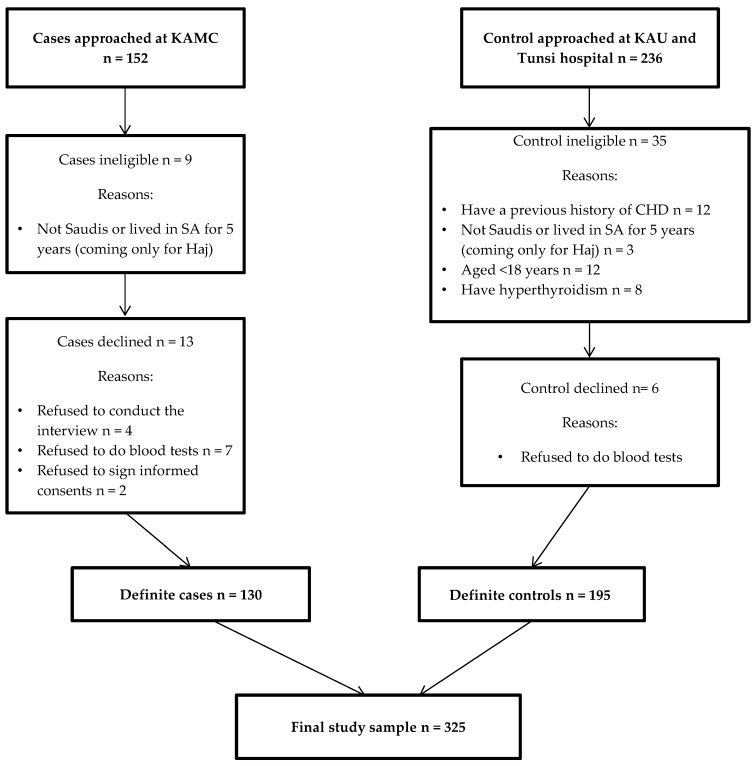
Recent evidence has pointed out an association between vitamin D deficiency and coronary heart disease (CHD). Due to the growing epidemic of CHD and vitamin D deficiency in Saudi Arabia, exploring the role of vitamin D in the prevention of CHD is crucial. The aim of this study was to examine the association between vitamin D status and CHD in Saudi Arabian adults. This case-control study included 130 CHD cases and 195 age-sex matched controls. Study subjects were recruited from three hospitals in the western region of Saudi Arabia. Study participants were interviewed face-to-face to collect data on their socio-demographic characteristics and family history of CHD. Fasting blood samples were collected, and serum levels of vitamin D, glucose, and total cholesterol were measured. Body weight, height, and blood pressure measurements were also recorded. Severe vitamin D deficiency (25(OH)D < 10 ng/mL) was much more prevalent in CHD cases than in controls (46% and 3%, respectively). The results of multivariate logistic regression showed that vitamin D deficiency (25(OH)D < 20 ng/mL) was associated with CHD, with an odds ratio of 6.5 (95% CI: 2.7-15, < 0.001). The current study revealed that vitamin D deficiency is independently associated with CHD, suggesting an important predictor of CHD among Saudi adults.
近期证据指出维生素D缺乏与冠心病(CHD)之间存在关联。鉴于沙特阿拉伯冠心病和维生素D缺乏的流行情况日益严重,探究维生素D在预防冠心病中的作用至关重要。本研究的目的是检验沙特阿拉伯成年人中维生素D状态与冠心病之间的关联。这项病例对照研究纳入了130例冠心病患者和195例年龄及性别匹配的对照。研究对象来自沙特阿拉伯西部地区的三家医院。研究参与者接受了面对面访谈,以收集其社会人口学特征和冠心病家族史的数据。采集空腹血样,测定血清维生素D、葡萄糖和总胆固醇水平。还记录了体重、身高和血压测量值。严重维生素D缺乏(25(OH)D < 10 ng/mL)在冠心病患者中的发生率远高于对照组(分别为46%和3%)。多因素逻辑回归结果显示,维生素D缺乏(25(OH)D < 20 ng/mL)与冠心病相关,比值比为6.5(95%置信区间:2.7 - 15,< 0.001)。当前研究表明,维生素D缺乏与冠心病独立相关,提示其为沙特成年人冠心病的重要预测指标。