Barbier Matthieu, Watson James R
Centre for Biodiversity Theory and Modelling, National Centre for Scientific Research(CNRS), France.
Stockholm Resilience Centre, Stockholm University, Sweden.
PLoS Comput Biol. 2016 Oct 20;12(10):e1005147. doi: 10.1371/journal.pcbi.1005147. eCollection 2016 Oct.
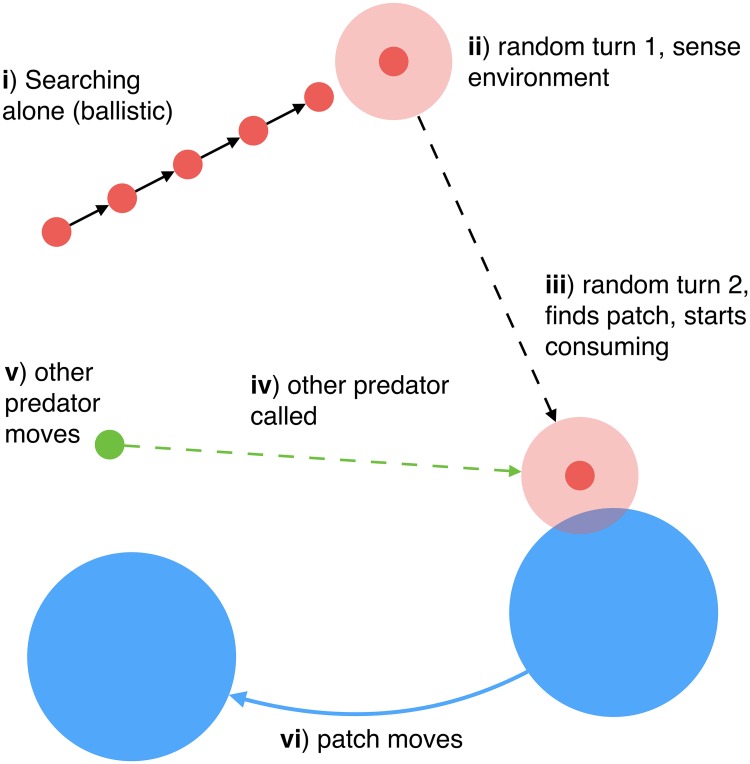
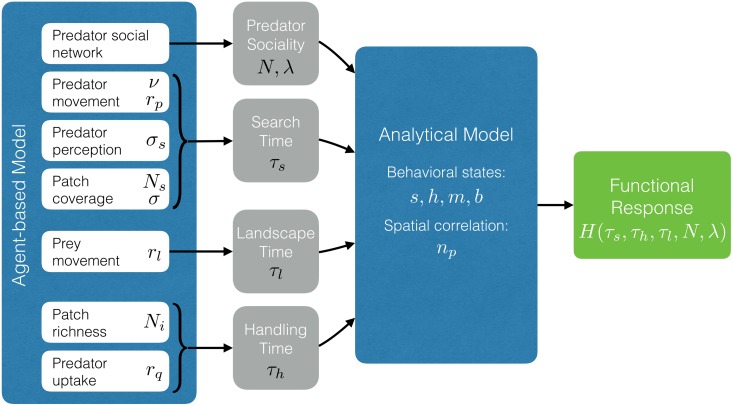
Predators of all kinds, be they lions hunting in the Serengeti or fishermen searching for their catch, display various collective strategies. A common strategy is to share information about the location of prey. However, depending on the spatial characteristics and mobility of predators and prey, information sharing can either improve or hinder individual success. Here, our goal is to investigate the interacting effects of space and information sharing on predation efficiency, represented by the expected rate at which prey are found and consumed. We derive a feeding functional response that accounts for both spatio-temporal heterogeneity and communication, and validate this mathematical analysis with a computational agent-based model. This agent-based model has an explicit yet minimal representation of space, as well as information sharing about the location of prey. The analytical model simplifies predator behavior into a few discrete states and one essential trade-off, between the individual benefit of acquiring information and the cost of creating spatial and temporal correlation between predators. Despite the absence of an explicit spatial dimension in these equations, they quantitatively predict the predator consumption rates measured in the agent-based simulations across the explored parameter space. Together, the mathematical analysis and agent-based simulations identify the conditions for when there is a benefit to sharing information, and also when there is a cost.
各种捕食者,无论是在塞伦盖蒂狩猎的狮子还是捕鱼的渔民,都会展现出各种集体策略。一种常见的策略是分享有关猎物位置的信息。然而,根据捕食者和猎物的空间特征及移动性,信息共享既可能提高也可能阻碍个体的成功。在此,我们的目标是研究空间和信息共享对捕食效率的相互作用影响,捕食效率以发现和消耗猎物的预期速率来表示。我们推导了一个考虑时空异质性和通信的摄食功能反应,并使用基于计算智能体的模型验证了这一数学分析。这个基于智能体的模型对空间有明确但极简的表示,同时也有关于猎物位置的信息共享。分析模型将捕食者行为简化为几个离散状态以及一个基本权衡,即在获取信息的个体利益与在捕食者之间建立时空相关性的成本之间的权衡。尽管这些方程中没有明确的空间维度,但它们定量地预测了在基于智能体的模拟中,在所探索的参数空间内测得的捕食者消耗率。数学分析和基于智能体的模拟共同确定了何时共享信息有益,以及何时存在成本的条件。