Lope Virginia, Fernández de Larrea Nerea, Pérez-Gómez Beatriz, Martín Vicente, Moreno Victor, Costas Laura, Longo Federico, Jiménez-Moleón José Juan, Llorca Javier, Ascunce Nieves, Peiró-Pérez Rosana, Altzibar Jone M, Tardón Adonina, Alguacil Juan, Navarro Carmen, Sierra Ángeles, Vega Ana Belén, Villafañe Amaya, Castaño-Vinyals Gemma, Kogevinas Manolis, Pollán Marina, Aragonés Nuria
Cancer and Environmental Epidemiology Unit, National Center for Epidemiology, Carlos III Institute of Health, Madrid 28029, Spain.
Consortium for Biomedical Research in Epidemiology and Public Health (CIBER Epidemiología y Salud Pública, CIBERESP), Madrid 28029, Spain.
PLoS One. 2016 Oct 24;11(10):e0164620. doi: 10.1371/journal.pone.0164620. eCollection 2016.
Sex hormones play a role in gastric cancer and colorectal cancer etiology, however, epidemiological evidence is inconsistent. This study examines the influence of menstrual and reproductive factors over the risk of both tumors.
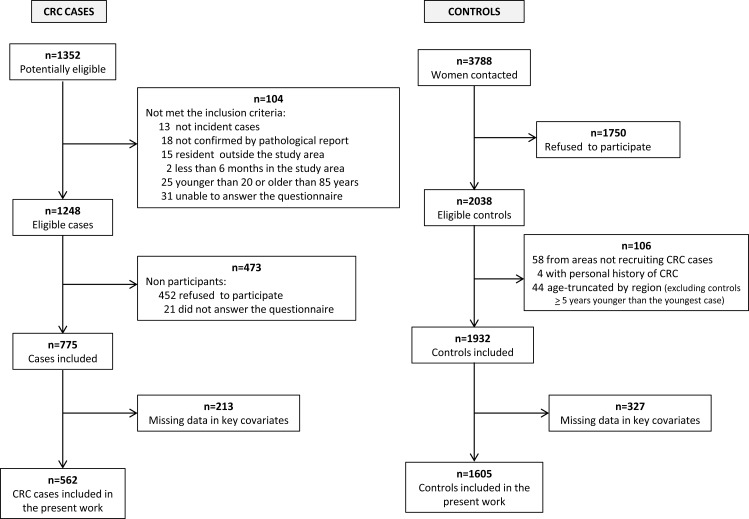
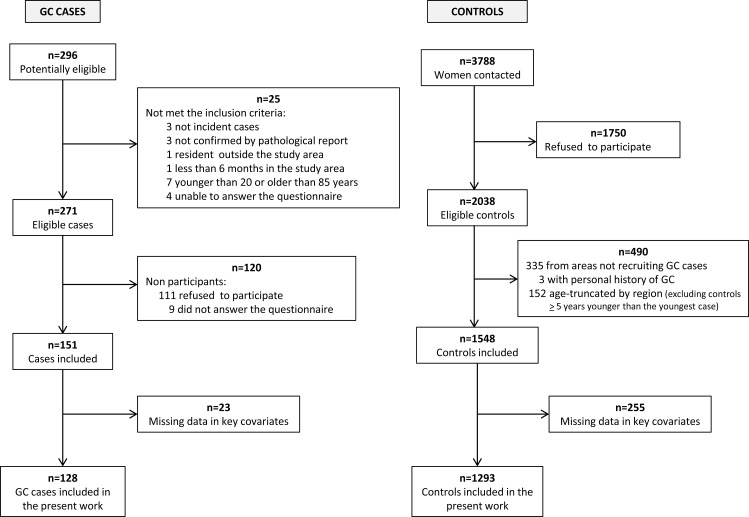
In this case-control study 128 women with gastric cancer and 1293 controls, as well as 562 female and colorectal cancer cases and 1605 controls were recruited in 9 and 11 Spanish provinces, respectively. Population controls were frequency matched to cases by age and province. Demographic and reproductive data were directly surveyed by trained staff. The association with gastric, colon and rectal cancer was assessed using logistic and multinomial mixed regression models.
Our results show an inverse association of age at first birth with gastric cancer risk (five-year trend: OR = 0.69; p-value = 0.006). Ever users of hormonal contraception presented a decreased risk of gastric (OR = 0.42; 95%CI = 0.26-0.69), colon (OR = 0.64; 95%CI = 0.48-0.86) and rectal cancer (OR = 0.61; 95%CI = 0.43-0.88). Postmenopausal women who used hormone replacement therapy showed a decreased risk of colon and rectal tumors. A significant interaction of educational level with parity and months of first child lactation was also observed.
These findings suggest a protective role of exogenous hormones in gastric and colorectal cancer risk. The role of endogenous hormones remains unclear.
性激素在胃癌和结直肠癌的病因学中发挥作用,然而,流行病学证据并不一致。本研究考察月经和生殖因素对这两种肿瘤发病风险的影响。
在这项病例对照研究中,分别在西班牙的9个和11个省份招募了128例胃癌女性患者及1293名对照,以及562例结直肠癌女性患者及1605名对照。人群对照按年龄和省份与病例进行频率匹配。人口统计学和生殖数据由经过培训的工作人员直接调查。使用逻辑回归和多项混合回归模型评估与胃癌、结肠癌和直肠癌的关联。
我们的结果显示,初产年龄与胃癌风险呈负相关(五年趋势:OR = 0.69;p值 = 0.006)。曾使用激素避孕的女性患胃癌(OR = 0.42;95%CI = 0.26 - 0.69)、结肠癌(OR = 0.64;95%CI = 0.48 - 0.86)和直肠癌(OR = 0.61;95%CI = 0.43 - 0.88)的风险降低。使用激素替代疗法的绝经后女性患结肠癌和直肠癌的风险降低。还观察到教育水平与产次及头胎哺乳月数之间存在显著交互作用。
这些发现表明外源性激素对胃癌和结直肠癌风险具有保护作用。内源性激素的作用仍不明确。