Lu Ming-Shian, Chen Miao-Fen, Huang Yao-Kuang, Liu Hui-Ping, Tsai Ying-Huang
Division of Thoracic and Cardiovascular Surgery Department of Radiation Oncology Division of Pulmonary and Critical Care Medicine, Chang Gung Memorial Hospital, at ChiaYi Department of Respiratory Therapy, Chang Gung University, Taiwan.
Medicine (Baltimore). 2016 Oct;95(43):e5203. doi: 10.1097/MD.0000000000005203.
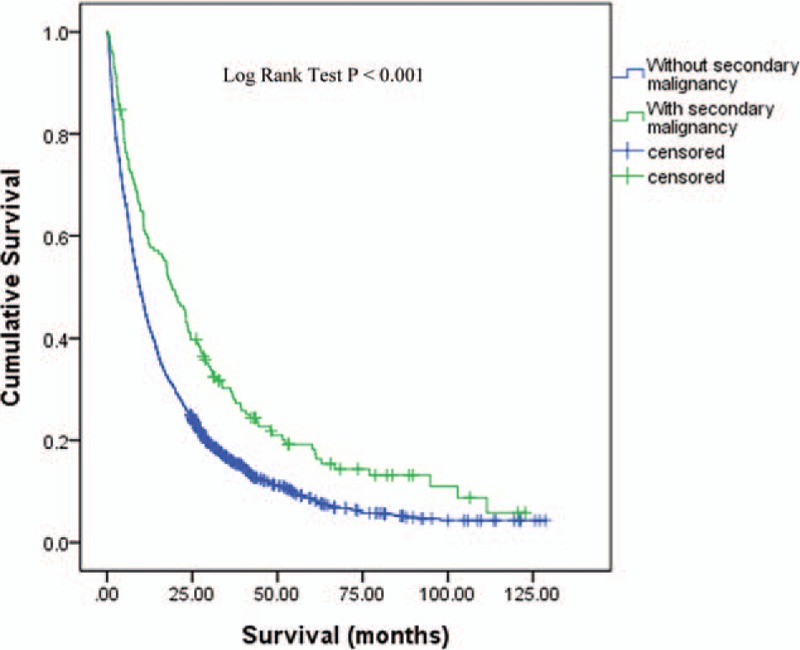
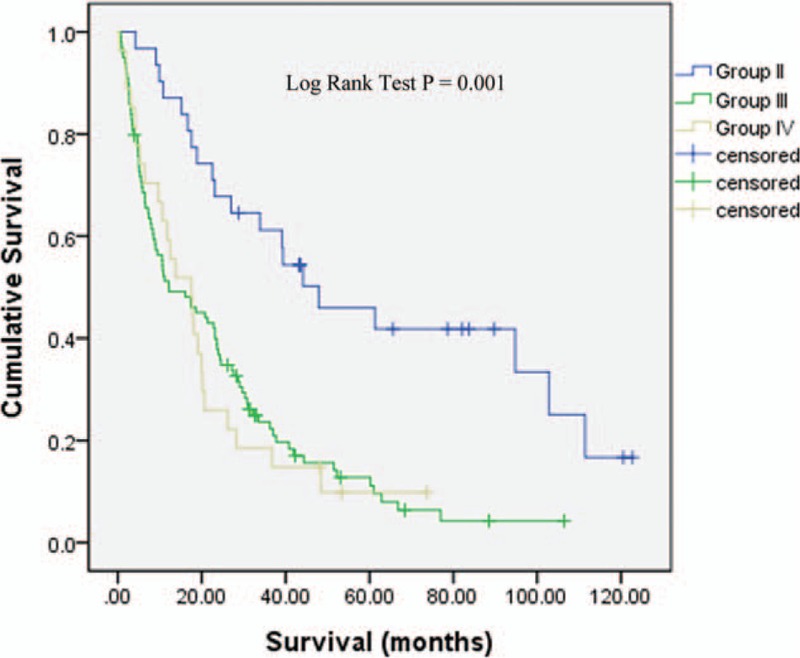
The aim of the study was to determine the clinical outcome of lung cancer patients with a secondary malignancy according to the time sequence between the lung cancer and the secondary malignancy.Retrospective review of all lung cancer patients with any secondary cancer treated from June 2004 to July 2012. The survival of patients with a secondary malignancy was compared to those patients without a secondary malignancy. According to the time sequence between the lung cancer and the secondary malignancy, patients were divided into 4 groups. Group I: lung cancer without any other malignancy, Group II: lung cancer with a secondary malignancy at follow-up, Group III: lung cancer with a pre-existing malignancy, Group IV: synchronous malignancies (diagnosis interval between lung cancer and a secondary malignancy of less than 3 months).Patients with any secondary cancer in their history or at follow up included 157 patients (9.5%). Collectively; the median survival was significantly better for patients with a secondary malignancy, 19.09 months, compared to those without a secondary malignancy, 9.53 months, P < 0.001, HR 0.66 (95% CI 0.55 - 0.79). However, the survival differed significantly according to the time sequence between the lung cancer and the secondary malignancy. The median survival was 47.9 months for group II patients, 12.19 months for group III, 17.51 months for group IV, and 9.53 months for group I; P = 0.001. In Cox proportional hazard analysis, the risk of dying decreased by 68% in group II patients compared to group I patients, HR 0.32 (95% CI 0.21-0.5), P < 0.001. Although the risk of dying for group III and IV decreased by 19% and 16% respectively compared to group I patients, it did not reach statistical significance.Nowadays, secondary malignancy in lung cancer patients is a frequent finding. Better survival was observed for patient with secondary malignancy following lung cancer.
本研究的目的是根据肺癌与继发恶性肿瘤之间的时间顺序,确定患有继发恶性肿瘤的肺癌患者的临床结局。对2004年6月至2012年7月期间接受治疗的所有患有任何继发癌症的肺癌患者进行回顾性研究。将患有继发恶性肿瘤的患者的生存率与未患有继发恶性肿瘤的患者进行比较。根据肺癌与继发恶性肿瘤之间的时间顺序,将患者分为4组。第一组:无任何其他恶性肿瘤的肺癌;第二组:随访时患有继发恶性肿瘤的肺癌;第三组:患有既往恶性肿瘤的肺癌;第四组:同步恶性肿瘤(肺癌与继发恶性肿瘤的诊断间隔小于3个月)。有任何继发癌症病史或随访时患有继发癌症的患者有157例(9.5%)。总体而言,患有继发恶性肿瘤的患者的中位生存期明显更长,为19.09个月,而未患有继发恶性肿瘤的患者为9.53个月,P<0.001,风险比(HR)为0.66(95%置信区间0.55 - 0.79)。然而,根据肺癌与继发恶性肿瘤之间的时间顺序,生存率有显著差异。第二组患者的中位生存期为47.9个月,第三组为12.19个月,第四组为17.51个月,第一组为9.53个月;P = 0.001。在Cox比例风险分析中,与第一组患者相比,第二组患者死亡风险降低了68%,HR为0.32(95%置信区间0.21 - 0.5),P<0.001。尽管与第一组患者相比,第三组和第四组患者的死亡风险分别降低了19%和16%,但未达到统计学意义。如今,肺癌患者继发恶性肿瘤是一个常见的发现。肺癌患者继发恶性肿瘤后的生存期较好。