Jankovic Nicole, Geelen Anouk, Winkels Renate M, Mwungura Blaise, Fedirko Veronika, Jenab Mazda, Illner Anne K, Brenner Hermann, Ordóñez-Mena José M, Kiefte de Jong Jessica C, Franco Oscar H, Orfanos Philippos, Trichopoulou Antonia, Boffetta Paolo, Agudo Antonio, Peeters Petra H, Tjønneland Anne, Hallmans Göran, Bueno-de-Mesquita H Bas, Park Yikyung, Feskens Edith J, de Groot Lisette C, Kampman Ellen
Department Agrotechnology and Food Sciences, Division of Human Nutrition, Wageningen University, Wageningen, The Netherlands.
Institute for Medical Informatics, Biometry and Epidemiology, Centre of Clinical Epidemiology, Faculty of Medicine, University Duisburg-Essen, Essen, Germany.
Cancer Epidemiol Biomarkers Prev. 2017 Jan;26(1):136-144. doi: 10.1158/1055-9965.EPI-16-0428. Epub 2016 Oct 28.
It is unknown whether dietary recommendations for cancer prevention are applicable to the elderly. We analyzed WCRF/AICR recommendations in cohorts of European and U.S. adults ages 60 years and above.
Individual participant data meta-analysis included 362,114 participants (43% women), from seven prospective cohort studies, free from cancer at enrollment. The WCRF/AICR diet score was based on: (i) energy-dense foods and sugary drinks, (ii) plant foods, (iii) red and processed meat, and (iv) alcoholic drinks. Cox proportional hazards regression was used to examine the association between the diet score and cancer risks. Adjusted, cohort-specific HRs were pooled using random-effects meta-analysis. Risk advancement periods (RAP) were calculated to quantify the time period by which the risk of cancer was postponed among those adhering to the recommendations.
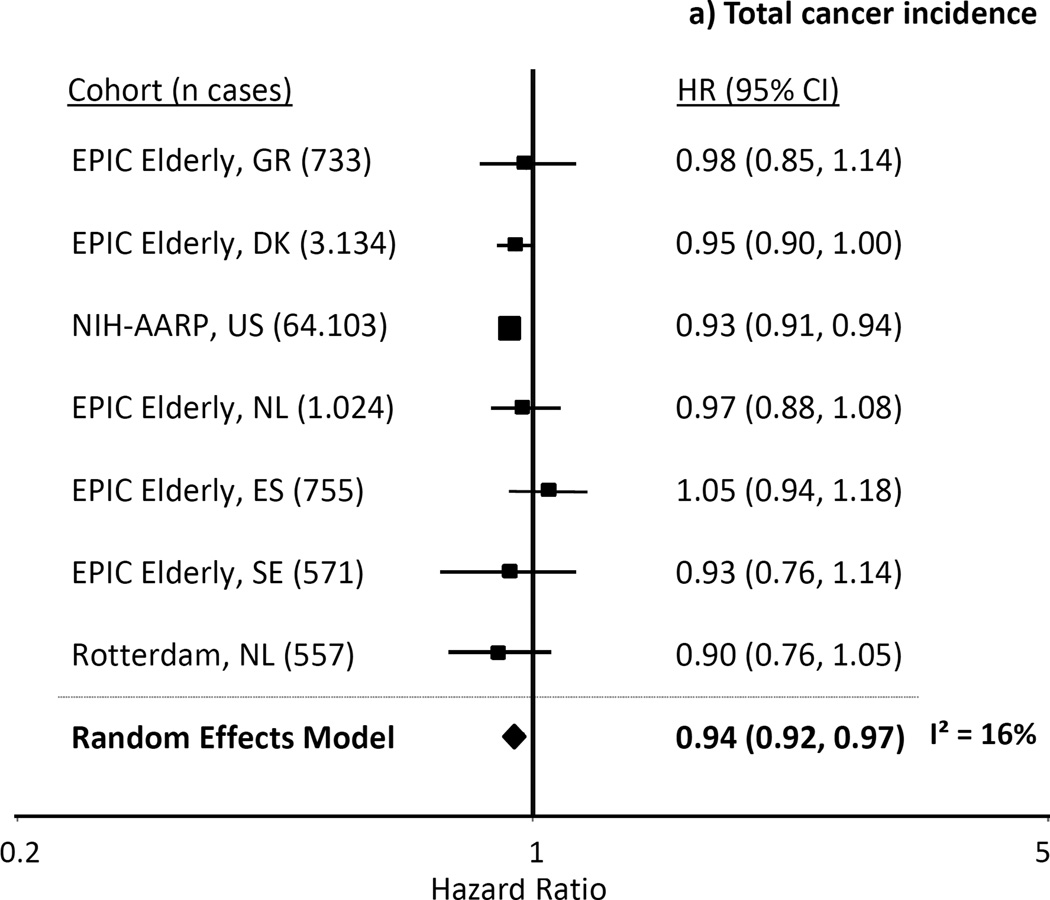
After a median follow-up of 11 to 15 years across cohorts, 70,877 cancer cases were identified. Each one-point increase in the WCRF/AICR diet score [range, 0 (no) to 4 (complete adherence)] was significantly associated with a lower risk of total cancer [HR, 0.94; 95% confidence interval (CI), 0.92-0.97], cancers of the colorectum (HR, 0.84; 95% CI, 0.80-0.89) and prostate (HR, 0.94; 95% CI, 0.92-0.97), but not breast or lung. Adherence to an additional component of the WCRF/AICR diet score significantly postponed the incidence of cancer at any site by 1.6 years (RAP, -1.6; 95% CI, -4.09 to -2.16).
Adherence to WCRF/AICR dietary recommendations is associated with lower risk of cancer among older adults.
Dietary recommendations for cancer prevention are applicable to the elderly. Cancer Epidemiol Biomarkers Prev; 26(1); 136-44. ©2016 AACR.
癌症预防的饮食建议是否适用于老年人尚不清楚。我们在60岁及以上的欧洲和美国成年人队列中分析了世界癌症研究基金会/美国癌症研究所(WCRF/AICR)的建议。
个体参与者数据荟萃分析纳入了来自7项前瞻性队列研究的362,114名参与者(43%为女性),这些参与者在入组时无癌症。WCRF/AICR饮食评分基于:(i)能量密集型食物和含糖饮料,(ii)植物性食物,(iii)红肉和加工肉类,以及(iv)酒精饮料。采用Cox比例风险回归分析饮食评分与癌症风险之间的关联。使用随机效应荟萃分析汇总调整后的特定队列风险比(HR)。计算风险提前期(RAP)以量化在遵循建议的人群中癌症风险被推迟的时间段。
各队列中位随访11至15年后,共确定了70,877例癌症病例。WCRF/AICR饮食评分每增加1分(范围:0(无)至4(完全遵循))与总癌症风险显著降低相关[HR,0.94;95%置信区间(CI),0.92 - 0.97],结直肠癌(HR,0.84;95%CI,0.80 - 0.89)和前列腺癌(HR,0.94;95%CI,0.92 - 0.97)风险降低,但乳腺癌或肺癌风险未降低。遵循WCRF/AICR饮食评分的一项额外建议可使任何部位癌症的发病时间显著推迟1.6年(RAP, - 1.6;95%CI, - 4.09至 - 2.16)。
遵循WCRF/AICR饮食建议与老年人患癌风险较低相关。
癌症预防的饮食建议适用于老年人。《癌症流行病学、生物标志物与预防》;26(1);136 - 44。©2016美国癌症研究协会。