Murchie Peter, Norwood Patricia F, Pietrucin-Materek Marta, Porteous Terry, Hannaford Philip C, Ryan Mandy
Centre for Academic Primary Care, Division of Applied Health Sciences, University of Aberdeen, Foresterhill, Aberdeen AB25 2ZD, UK.
Health Economics Research Unit (HERU), Division of Applied Health Sciences, University of Aberdeen, Foresterhill, Aberdeen AB25 2ZD, UK.
Br J Cancer. 2016 Dec 6;115(12):1495-1503. doi: 10.1038/bjc.2016.352. Epub 2016 Nov 1.
Specialist-led cancer follow-up is becoming increasingly expensive and is failing to meet many survivors' needs. Alternative models informed by survivors' preferences are urgently needed. It is unknown if follow-up preferences differ by cancer type. We conducted the first study to assess British cancer survivors' follow-up preferences, and the first anywhere to compare the preferences of survivors from different cancers.
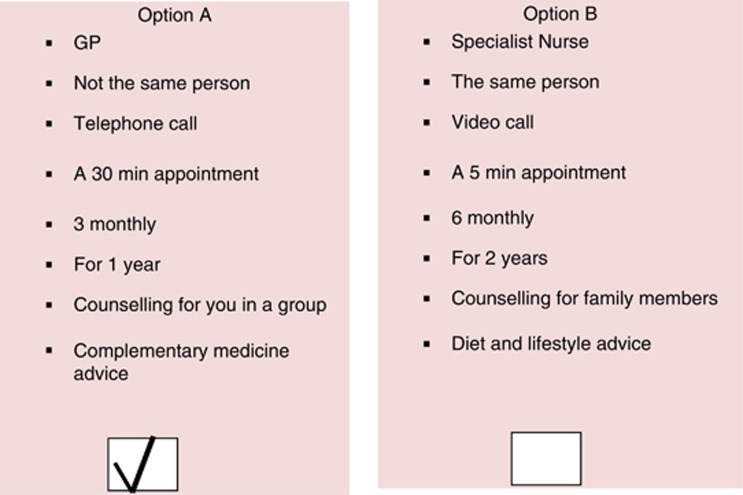
A discrete choice experiment questionnaire was mailed to 1201 adults in Northeast Scotland surviving melanoma, breast, prostate or colorectal cancer. Preferences and trade-offs for attributes of cancer follow-up were explored, overall and by cancer site.
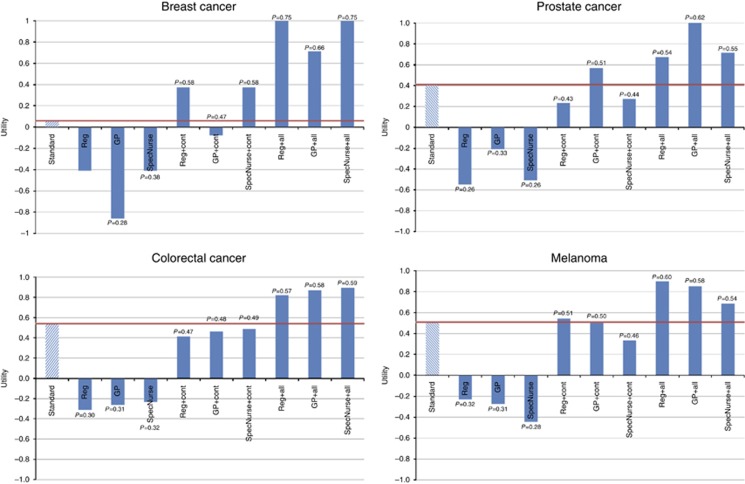
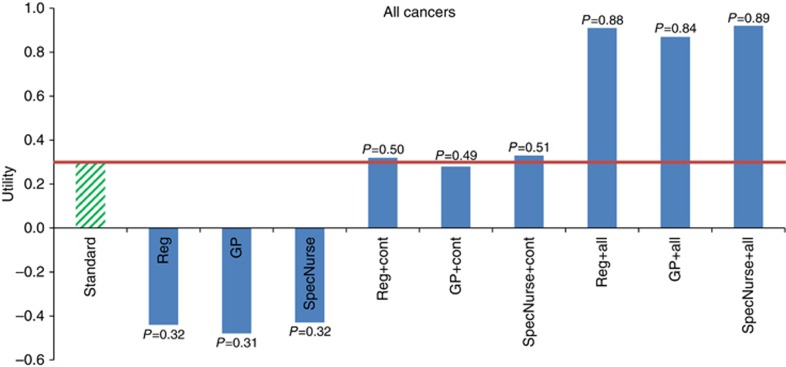
668 (56.6%) recipients (132 melanoma, 213 breast, 158 prostate, 165 colorectal) responded. Cancer survivors had a strong preference to see a consultant during a face-to-face appointment when receiving cancer follow-up. However, cancer survivors appeared willing to accept follow-up from specialist nurses, registrars or GPs provided that they are compensated by increased continuity of care, dietary advice and one-to-one counselling. Longer appointments were also valued. Telephone and web-based follow-up and group counselling, were not considered desirable. Survivors of colorectal cancer and melanoma would see any alternative provider for greater continuity, whereas breast cancer survivors wished to see a registrar or specialist nurse, and prostate cancer survivors, a general practitioner.
Cancer survivors may accept non-consultant follow-up if compensated with changes elsewhere. Care continuity was sufficient compensation for most cancers. Given practicalities, costs and the potential to develop continuous care, specialist nurse-led cancer follow-up may be attractive.
由专科医生主导的癌症随访成本越来越高,且无法满足许多幸存者的需求。迫切需要根据幸存者偏好制定的替代模式。目前尚不清楚随访偏好是否因癌症类型而异。我们开展了第一项评估英国癌症幸存者随访偏好的研究,也是第一项在任何地方比较不同癌症幸存者偏好的研究。
向苏格兰东北部1201名患有黑色素瘤、乳腺癌、前列腺癌或结直肠癌的成年幸存者邮寄了一份离散选择实验问卷。探讨了癌症随访属性的偏好和权衡,包括总体情况以及按癌症部位的情况。
668名(56.6%)收件人(132名黑色素瘤患者、213名乳腺癌患者、158名前列腺癌患者、165名结直肠癌患者)做出了回应。癌症幸存者在接受癌症随访时强烈倾向于在面对面预约时见到顾问医生。然而,癌症幸存者似乎愿意接受专科护士、住院医生或全科医生的随访,前提是他们能通过增加护理连续性、饮食建议和一对一咨询得到补偿。较长的预约时间也受到重视。电话和基于网络的随访以及团体咨询则不被认为是理想的方式。结直肠癌和黑色素瘤幸存者会为了更高的连续性而接受任何替代提供者的随访,而乳腺癌幸存者希望见到住院医生或专科护士,前列腺癌幸存者则希望见到全科医生。
如果在其他方面得到补偿,癌症幸存者可能会接受非顾问医生的随访。护理连续性对大多数癌症来说是足够的补偿。考虑到实际情况、成本以及发展持续护理的潜力,由专科护士主导的癌症随访可能具有吸引力。