Genevois Coralie, Loiseau Hugues, Couillaud Franck
Molecular Imaging and Innovative Therapy in Oncology (IMOTION), EA 7435, University of Bordeaux, Bordeaux 33076, France.
Int J Mol Sci. 2016 Oct 31;17(11):1815. doi: 10.3390/ijms17111815.
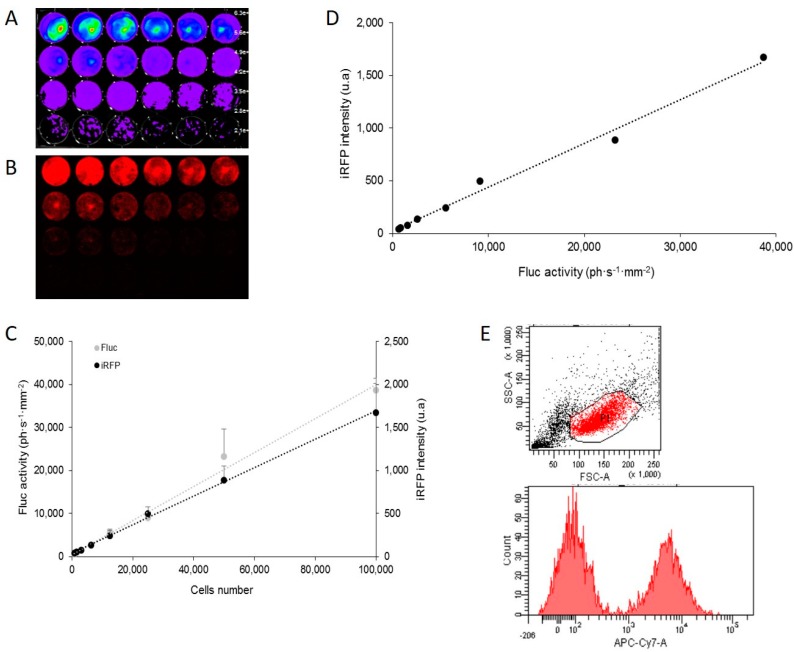
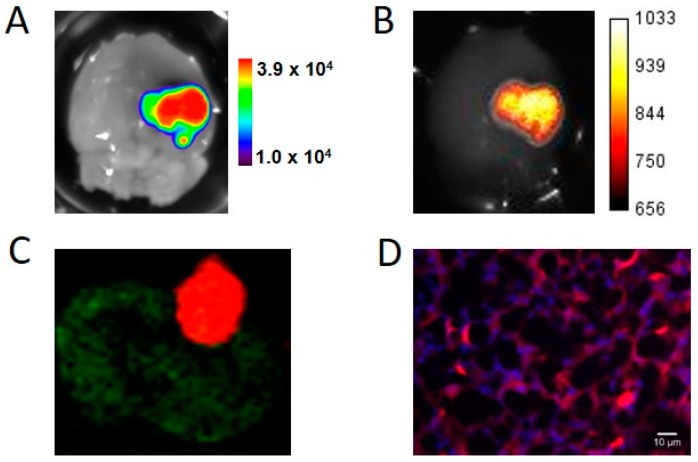
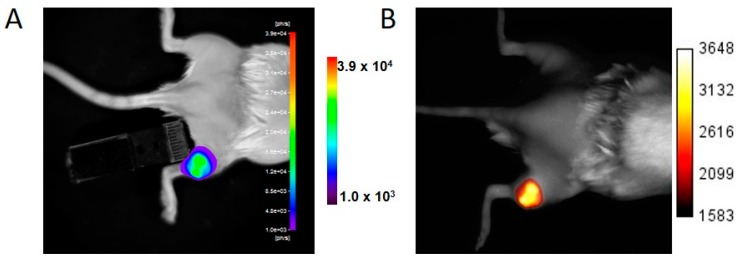
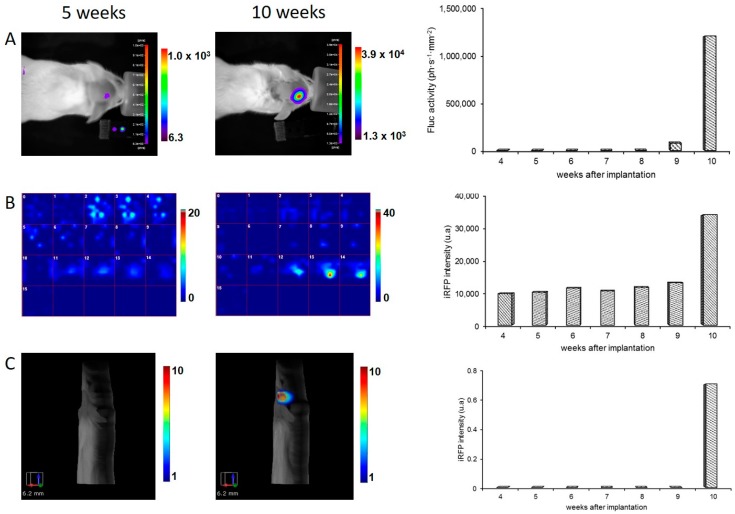
Reporter gene-based strategies are widely used in experimental oncology. Bioluminescence imaging (BLI) using the firefly luciferase (Fluc) as a reporter gene and d-luciferin as a substrate is currently the most widely employed technique. The present paper compares the performances of BLI imaging with fluorescence imaging using the near infrared fluorescent protein (iRFP) to monitor brain tumor growth in mice. Fluorescence imaging includes fluorescence reflectance imaging (FRI), fluorescence diffuse tomography (fDOT), and fluorescence molecular Imaging (FMT). A U87 cell line was genetically modified for constitutive expression of both the encoding Fluc and iRFP reporter genes and assayed for cell, subcutaneous tumor and brain tumor imaging. On cultured cells, BLI was more sensitive than FRI; in vivo, tumors were first detected by BLI. Fluorescence of iRFP provided convenient tools such as flux cytometry, direct detection of the fluorescent protein on histological slices, and fluorescent tomography that allowed for 3D localization and absolute quantification of the fluorescent signal in brain tumors.
基于报告基因的策略在实验肿瘤学中被广泛应用。使用萤火虫荧光素酶(Fluc)作为报告基因、D - 荧光素作为底物的生物发光成像(BLI)是目前应用最广泛的技术。本文比较了BLI成像与使用近红外荧光蛋白(iRFP)的荧光成像在监测小鼠脑肿瘤生长方面的性能。荧光成像包括荧光反射成像(FRI)、荧光扩散断层扫描(fDOT)和荧光分子成像(FMT)。对U87细胞系进行基因改造,使其组成性表达编码Fluc和iRFP的报告基因,并用于细胞、皮下肿瘤和脑肿瘤成像检测。在培养细胞上,BLI比FRI更敏感;在体内,肿瘤首先通过BLI被检测到。iRFP的荧光提供了便捷工具,如流式细胞术、在组织切片上直接检测荧光蛋白以及荧光断层扫描,后者可实现脑肿瘤中荧光信号的三维定位和绝对定量。