Knoll Lisa J, Fuhrmann Delia, Sakhardande Ashok L, Stamp Fabian, Speekenbrink Maarten, Blakemore Sarah-Jayne
1 Institute of Cognitive Neuroscience.
2 Department of Experimental Psychology, University College London.
Psychol Sci. 2016 Dec;27(12):1620-1631. doi: 10.1177/0956797616671327. Epub 2016 Nov 5.
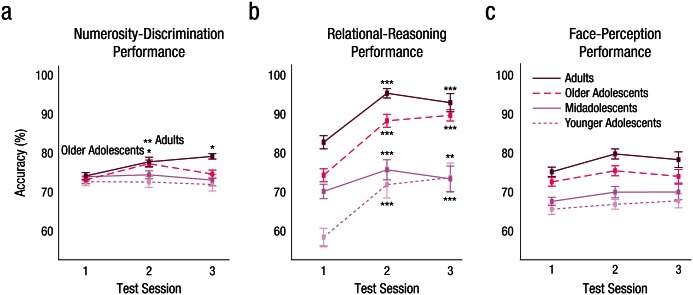
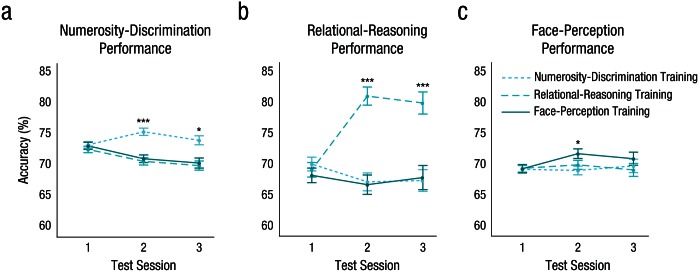
In the current study, we investigated windows for enhanced learning of cognitive skills during adolescence. Six hundred thirty-three participants (11-33 years old) were divided into four age groups, and each participant was randomly allocated to one of three training groups. Each training group completed up to 20 days of online training in numerosity discrimination (i.e., discriminating small from large numbers of objects), relational reasoning (i.e., detecting abstract relationships between groups of items), or face perception (i.e., identifying differences in faces). Training yielded some improvement in performance on the numerosity-discrimination task, but only in older adolescents or adults. In contrast, training in relational reasoning improved performance on that task in all age groups, but training benefits were greater for people in late adolescence and adulthood than for people earlier in adolescence. Training did not increase performance on the face-perception task for any age group. Our findings suggest that for certain cognitive skills, training during late adolescence and adulthood yields greater improvement than training earlier in adolescence, which highlights the relevance of this late developmental stage for education.
在当前的研究中,我们调查了青少年时期增强认知技能学习的窗口期。633名参与者(年龄在11至33岁之间)被分为四个年龄组,且每位参与者被随机分配到三个训练组中的一组。每个训练组完成了长达20天的在线训练,训练内容分别为数字辨别(即区分少量和大量物体)、关系推理(即检测项目组之间的抽象关系)或面部感知(即识别面部差异)。训练在数字辨别任务的表现上产生了一些改善,但仅在年龄较大的青少年或成年人中。相比之下,关系推理训练在所有年龄组中都提高了该任务的表现,但对于青少年晚期和成年期的人来说,训练带来的益处比青春期早期的人更大。训练对任何年龄组的面部感知任务表现均未提高。我们的研究结果表明,对于某些认知技能,青少年晚期和成年期的训练比青春期早期的训练产生更大的改善,这凸显了这个发育后期阶段对教育的相关性。