de Beer Marieke, Vrijkotte Tanja G M, Fall Caroline H D, van Eijsden Manon, Osmond Clive, Gemke Reinoud J B J
Department of Pediatrics, VU University Medical Center, Amsterdam, The Netherlands.
Department of Social Medicine, Academic Medical Center, University of Amsterdam, Amsterdam, The Netherlands.
PLoS One. 2016 Nov 10;11(11):e0166281. doi: 10.1371/journal.pone.0166281. eCollection 2016.
Small birth size and rapid postnatal growth have been associated with higher future blood pressure. The timing of these effects, the relative importance of weight gain and linear growth and the role of infant feeding need to be clarified.
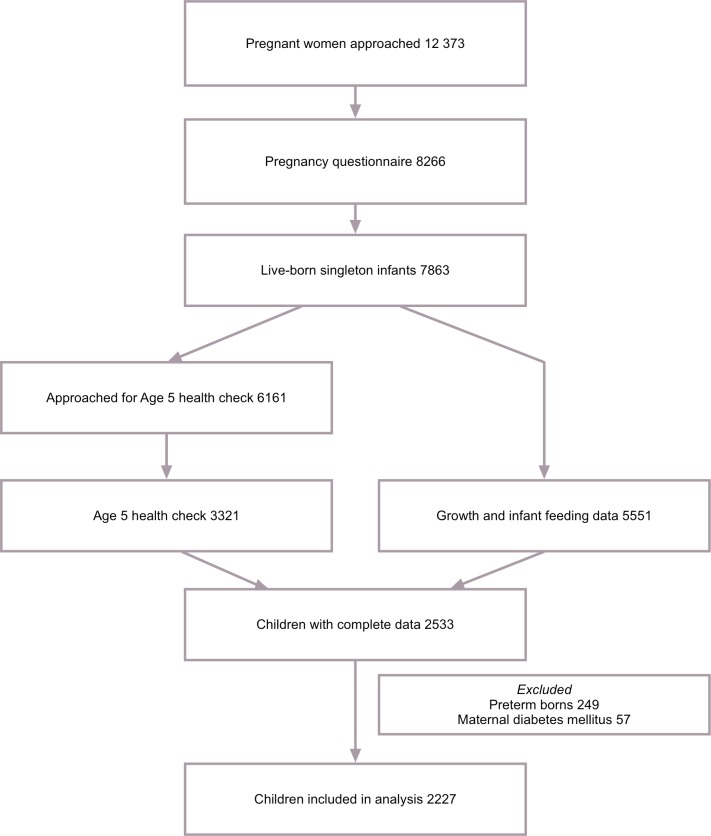
We assessed how blood pressure relates to birth weight, infant and childhood growth and infant feeding (duration of exclusive breastfeeding and timing of introduction of complementary feeding) in 2227 children aged 5 years from a prospective cohort study (Amsterdam Born Children and their Development). Postnatal growth was represented by statistically independent measures of relative weight gain (weight gain independent of height) and linear growth in four age periods during infancy (0-1 month; 1-3 months; 3-6 months; 6-12 months) and from 12 months to 5 years.
Lower birth weight was associated with higher childhood diastolic blood pressure (-0.38 mm Hg.SD-1; P = 0.007). Faster relative weight gain and linear growth after 1 month were positively associated with systolic and diastolic blood pressure. Associations of linear growth with systolic blood pressure ranged from 0.47 to 1.49 mm Hg.SD-1; P<0.01 for all. Coefficients were similar for different periods of infancy and also for relative weight gain and linear growth. Compared to breastfeeding <1 month, breastfeeding >1 month was associated with lower blood pressure (e.g. >6 months -1.56 mm Hg systolic blood pressure; P<0.001). Compared to >6 months, introduction of complementary feeding <6 months was associated with higher blood pressure (e.g. 4-6 months 0.91 mm Hg systolic blood pressure; P = 0.004).
After the age of one month faster growth in either weight or height is associated with higher childhood blood pressure. It is unknown whether faster weight gain and linear growth carry the same risk for adult hypertension and cardiovascular morbidity. Longer breastfeeding and delayed introduction of complementary feeding may be associated with lower adult blood pressure.
出生时体型小和出生后快速生长与未来更高的血压相关。这些影响的时间、体重增加和线性生长的相对重要性以及婴儿喂养的作用需要阐明。
我们在一项前瞻性队列研究(阿姆斯特丹出生儿童及其发育研究)中,评估了2227名5岁儿童的血压与出生体重、婴儿期和儿童期生长以及婴儿喂养(纯母乳喂养持续时间和引入辅食的时间)之间的关系。出生后生长通过婴儿期四个年龄段(0 - 1个月;1 - 3个月;3 - 6个月;6 - 12个月)以及从12个月至5岁期间相对体重增加(独立于身高的体重增加)和线性生长的统计学独立测量指标来表示。
较低的出生体重与较高的儿童期舒张压相关(-0.38 mmHg·SD⁻¹;P = 0.007)。1个月后更快的相对体重增加和线性生长与收缩压和舒张压呈正相关。线性生长与收缩压的关联范围为0.47至1.49 mmHg·SD⁻¹;所有P值均<0.01。不同婴儿期以及相对体重增加和线性生长的系数相似。与母乳喂养<1个月相比,母乳喂养>1个月与较低的血压相关(例如,>6个月时收缩压降低1.56 mmHg;P<0.001)。与>6个月相比,在<6个月时引入辅食与较高的血压相关(例如,4 - 6个月时收缩压升高0.91 mmHg;P = 0.004)。
1个月龄后体重或身高的更快增长与儿童期更高的血压相关。体重增加和线性生长更快是否对成人高血压和心血管疾病发病率具有相同风险尚不清楚。更长时间的母乳喂养和延迟引入辅食可能与较低的成人血压相关。