Catt Susan, Starkings Rachel, Shilling Valerie, Fallowfield Lesley
Sussex Health Outcomes Research and Education in Cancer (SHORE-C), Brighton and Sussex Medical School, University of Sussex, Falmer, Brighton, BN1 9RX, UK.
J Cancer Surviv. 2017 Apr;11(2):211-232. doi: 10.1007/s11764-016-0580-1. Epub 2016 Nov 10.
Patients with advanced disease are living longer and commonly used patient-reported outcome measures (PROMs) may miss relevant elements of the quality of extended survival. This systematic review examines the measures used to capture aspects of the quality of survival including impact on patients' everyday lives such as finances, work and family roles.
Searches were conducted in MEDLINE, EMBASE, CINAHL and PsycINFO restricted to English language articles. Information on study characteristics, instruments and outcomes was systematically extracted and synthesised. A predefined set of criteria was used to rate the quality of studies.
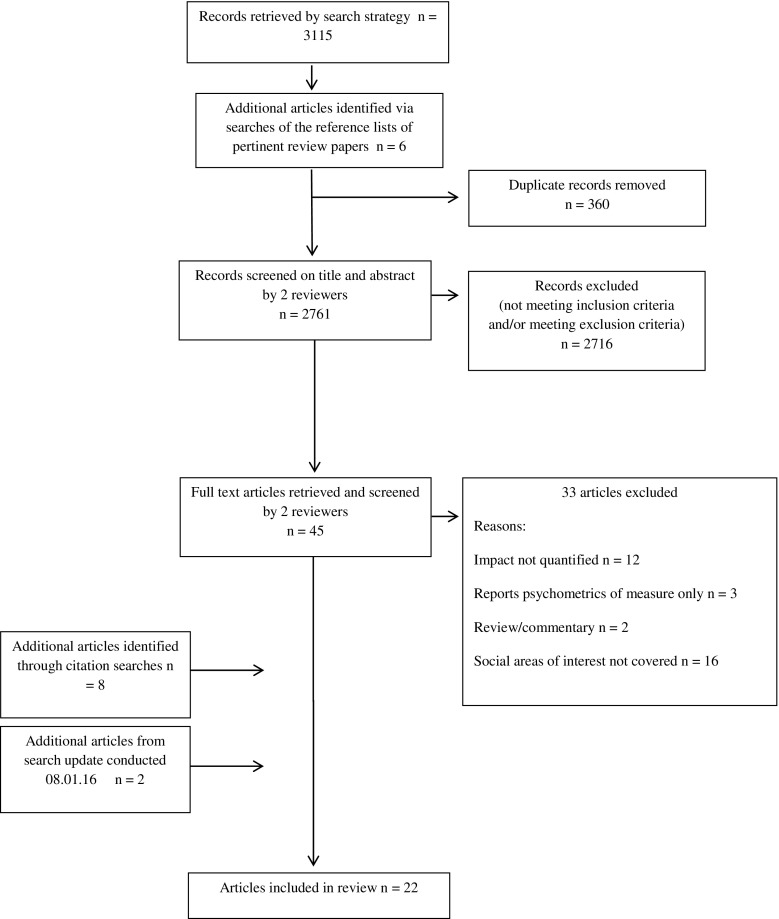
From 2761 potentially relevant articles, 22 met all inclusion criteria, including 10 concerning financial distress, 3 on roles and responsibilities and 9 on multiple aspects of social well-being. Generally, studies were not of high quality; many lacked bias free participant selection, had confounding factors and had not accounted for all participants. High levels of financial distress were reported and were associated with multiple demographic factors such as age and income. There were few reports concerned with impacts on patients' roles/responsibilities in everyday life although practical and emotional struggles with parenting were identified. Social difficulties were common and associated with multiple factors including being a caregiver. Many studies were single time-point surveys and used non-validated measures. Exceptions were employment of the COST and Social Difficulties Inventory (SDI), validated measures of financial and social distress respectively.
Impact on some important parts of patients' everyday lives is insufficiently and inconsistently captured. Further PROM development focussing on roles and responsibilities, including work and caring for dependents, is warranted.
Factors such as finances, employment and responsibility for caring for dependants (e.g. children and elderly relatives) can affect the well-being of cancer survivors. There is a need to ensure that any instruments used to assess patients' social well-being are broad enough to include these areas so that any difficulties arising can be better understood and appropriately supported.
患有晚期疾病的患者寿命延长,常用的患者报告结局指标(PROMs)可能会遗漏延长生存期质量的相关要素。本系统评价旨在研究用于描述生存质量各个方面的指标,包括对患者日常生活(如财务、工作和家庭角色)的影响。
在MEDLINE、EMBASE、CINAHL和PsycINFO中进行检索,仅限于英文文章。系统提取并综合了关于研究特征、工具和结局的信息。使用一组预先定义的标准对研究质量进行评分。
在2761篇潜在相关文章中,22篇符合所有纳入标准,其中10篇涉及财务困境,3篇涉及角色和责任,9篇涉及社会福祉的多个方面。总体而言,研究质量不高;许多研究缺乏无偏倚的参与者选择,存在混杂因素,且未对所有参与者进行统计。报告显示财务困境程度较高,且与年龄和收入等多种人口统计学因素相关。尽管发现了在养育子女方面的实际和情感挣扎,但很少有报告涉及对患者日常生活中角色/责任的影响。社会困难很常见,且与包括作为照顾者在内的多种因素相关。许多研究是单时间点调查,且使用的是未经验证的指标。例外情况是分别使用了经验证的财务和社会困境指标——COST和社会困难量表(SDI)。
对患者日常生活中一些重要方面的影响未得到充分且一致的描述。有必要进一步开发聚焦于角色和责任(包括工作及照顾家属)的患者报告结局指标。
财务、就业以及照顾家属(如子女和老年亲属)的责任等因素会影响癌症幸存者的福祉。需要确保用于评估患者社会福祉的任何工具都足够广泛,以涵盖这些领域,以便更好地理解并适当支持所出现的任何困难。