Jalali Mahdi, Zare Sakhvidi Mohammad Javad, Bahrami Abdulrahman, Berijani Nima, Mahjub Hussein
Department of Occupational Health, Social Determinants of Health Research Center, Birjand University of Medical Sciences, Birjand, Iran.
Department of Occupational Health, School of Public Health, Yazd University of Medical Science, Yazd, Iran.
J Res Health Sci. 2016 Summer;16(3):153-161.
Silicosis is considered an oxidative stress related disease that can lead to the development of lung cancer. In this study, our purpose was to analysis of volatile organic compounds (VOCs) in the exhaled breath of workers exposed to silica containing dust and compare peak area of these compounds with silicosis patients and healthy volunteers (smokers and nonsmokers) groups.
In this cross sectional case-control study, the exhaled breath of 69 subjects including workers exposed to silica (n=20), silicosis patient (n=4), healthy non-smoker (n=20) and healthy smoker (n=25) were analyzed. We collected breath samples using 3-liter Tedlar bags. The VOCs were extracted with solid phase micro-extraction (SPME) and analyzed by gas chromatography-mass spectrometry (GC-MS). Personal exposure intensity was measured according to NIOSH 7601 method. Respiratory parameters were measured using spirometry.
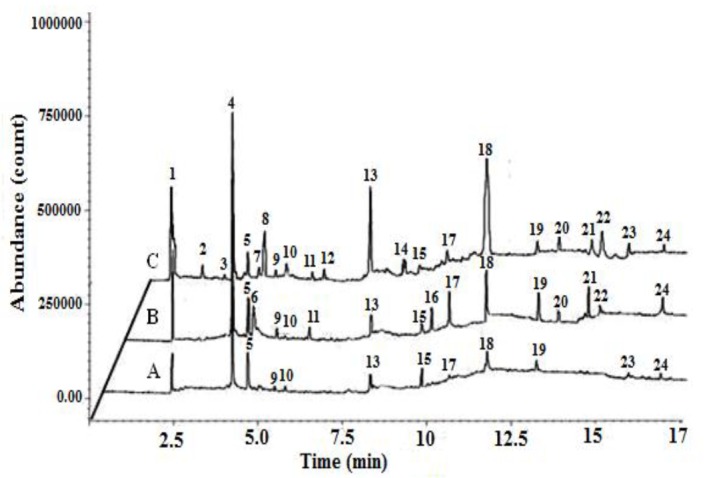
Seventy percent and 100% of the exposures to crystalline silica dust exceeded from 8 h TWA ACGIH TLVs in case and positive control groups, respectively. A significant negative correlation was found between dust exposure intensity and FEV1/FVC when exposure and positive control groups were studied in a group (r2=-0.601, P<0.001). Totally, forty VOCs were found in all exhaled breath samples. Among the VOCs, the mean of peak area acetaldehyde, hexanal, nonanal, decane, pentad cane, 2-propanol and 3-hydroxy-2-butanone were higher in exhaled breath of the workers exposed to silica and silicosis patient compared to the healthy smoker and nonsmoker controls. In some cases the difference was significant (P<0.05).
The analysis of some VOCs in exhaled breath of subjects is appropriate biomarker to determine of exposure to silica.
矽肺被认为是一种与氧化应激相关的疾病,可导致肺癌的发生。在本研究中,我们的目的是分析接触含硅粉尘工人呼出气体中的挥发性有机化合物(VOCs),并将这些化合物的峰面积与矽肺患者及健康志愿者(吸烟者和非吸烟者)组进行比较。
在这项横断面病例对照研究中,分析了69名受试者的呼出气体,包括接触硅的工人(n = 20)、矽肺患者(n = 4)、健康非吸烟者(n = 20)和健康吸烟者(n = 25)。我们使用3升 Tedlar 袋收集呼出气体样本。VOCs 采用固相微萃取(SPME)提取,并用气相色谱 - 质谱联用仪(GC - MS)进行分析。个人暴露强度根据美国国家职业安全与健康研究所(NIOSH)7601方法进行测量。呼吸参数使用肺量计进行测量。
病例组和阳性对照组中,分别有70%和100%的结晶硅粉尘8小时时间加权平均(TWA)暴露量超过美国政府工业卫生学家会议(ACGIH)阈限值(TLVs)。在将暴露组和阳性对照组作为一组研究时,发现粉尘暴露强度与第一秒用力呼气容积/用力肺活量(FEV1/FVC)之间存在显著负相关(r2 = -0.601,P < 0.001)。在所有呼出气体样本中总共发现了40种VOCs。在这些VOCs中,与健康吸烟者和非吸烟者对照组相比,接触硅的工人和矽肺患者呼出气体中乙醛、己醛、壬醛、癸烷、十五烷、2 - 丙醇和3 - 羟基 - 2 - 丁酮的峰面积平均值更高。在某些情况下,差异具有统计学意义(P < 0.05)。
分析受试者呼出气体中的某些VOCs是确定硅暴露的合适生物标志物。