Barnett Carolina, Merkies Ingemar S J, Katzberg Hans, Bril Vera
Division of Neurology - Department of Medicine. University Health Network, Toronto General Hospital, Toronto, Canada.
Department of Neurology, Maastricht University Medical Centre, Maastricht, The Netherlands.
J Neuromuscul Dis. 2015 Sep 2;2(3):301-311. doi: 10.3233/JND-150082.
The Quantitative Myasthenia Gravis Score and the Myasthenia Gravis Composite are two commonly used outcome measures in Myasthenia Gravis. So far, their measurement properties have not been compared, so we aimed to study their psychometric properties using the Rasch model.
251 patients with stable myasthenia gravis were assessed with both scales, and 211 patients returned for a second assessment. We studied fit to the Rasch model at the first visit, and compared item fit, thresholds, differential item functioning, local dependence, person separation index, and tests for unidimensionality. We also assessed test-retest reliability and estimated the Minimal Detectable Change.
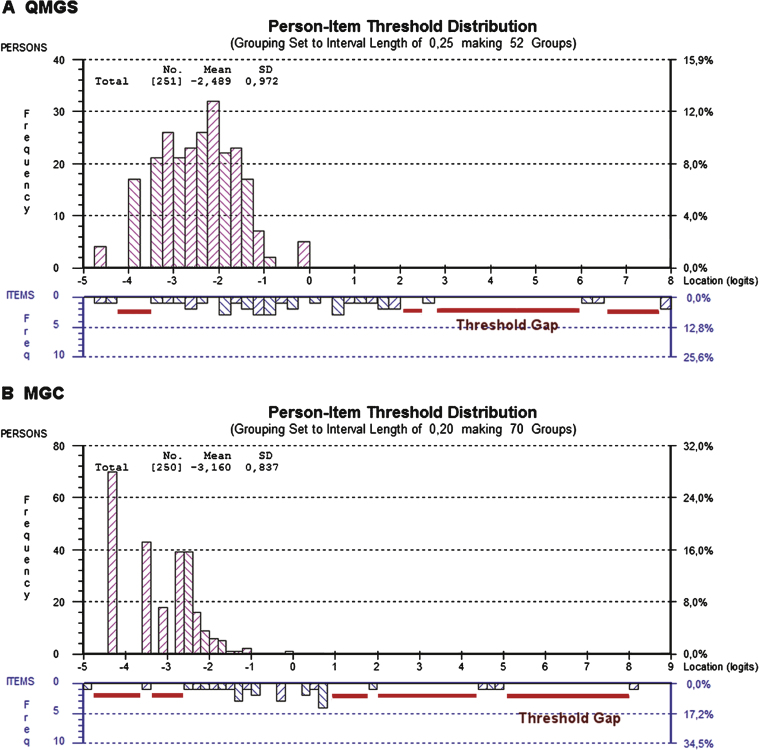
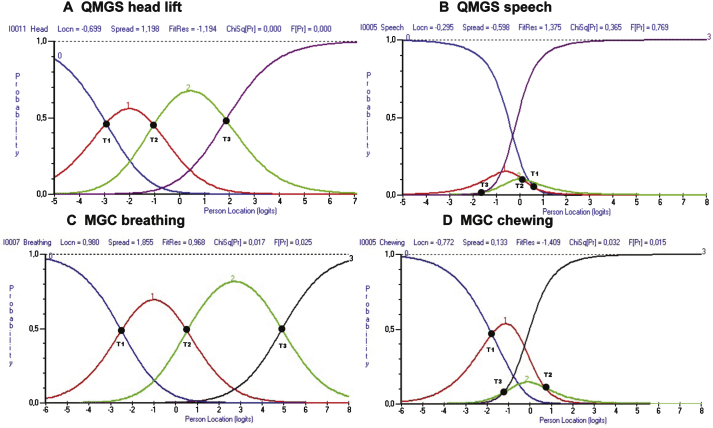
Neither scale fit the Rasch model (X2p < 0.05). The Myasthenia Gravis Composite had lower discrimination properties than the Quantitative Myasthenia Gravis Scale (Person Separation Index: 0.14 and 0.7). There was local dependence in both scales, as well as differential item functioning for ocular and generalized disease. Disordered thresholds were found in 6(60%) items of the Myasthenia Gravis Composite and in 4(31%) of the Quantitative Myasthenia Gravis Score. Both tools had adequate test-retest reliability (ICCs >0.8). The minimally detectable change was 4.9 points for the Myasthenia Gravis Composite and 4.3 points for the Quantitative Myasthenia Gravis Score.
Neither scale fulfilled Rasch model expectations. The Quantitative Myasthenia Gravis Score has higher discrimination than the Myasthenia Gravis Composite. Both tools have items with disordered thresholds, differential item functioning and local dependency. There was evidence of multidimensionality in the QMGS. The minimal detectable change values are higher than previous studies on the minimal significant change. These findings might inform future modifications of these tools.
重症肌无力定量评分和重症肌无力综合评分是重症肌无力中两种常用的疗效指标。到目前为止,尚未对它们的测量特性进行比较,因此我们旨在使用拉施模型研究它们的心理测量特性。
用这两种量表对251例病情稳定的重症肌无力患者进行评估,211例患者返回进行第二次评估。我们在首次就诊时研究了量表与拉施模型的拟合情况,并比较了项目拟合度、阈值、项目功能差异、局部依赖性、人员分离指数和单维度性检验。我们还评估了重测信度并估计了最小可检测变化。
两种量表均不拟合拉施模型(X2p<0.05)。重症肌无力综合评分的区分度低于重症肌无力定量量表(人员分离指数:0.14和0.7)。两种量表均存在局部依赖性,以及眼部和全身性疾病的项目功能差异。在重症肌无力综合评分的6项(60%)项目和重症肌无力定量评分的4项(31%)项目中发现阈值紊乱。两种工具均具有足够的重测信度(组内相关系数>0.8)。重症肌无力综合评分的最小可检测变化为4.9分,重症肌无力定量评分为4.3分。
两种量表均未达到拉施模型的预期。重症肌无力定量评分的区分度高于重症肌无力综合评分。两种工具都有阈值紊乱、项目功能差异和局部依赖性的项目。有证据表明重症肌无力定量量表存在多维性。最小可检测变化值高于先前关于最小显著变化的研究。这些发现可能为这些工具的未来改进提供参考。