Zhu Min, Zhu Yufang, Zhang Lingxia, Shi Jianlin
School of Materials Science and Engineering, University of Shanghai for Science and Technology, 516 Jungong Road, Shanghai 200093, People's Republic of China.
State Key Laboratory of High Performance Ceramics, Shanghai Institute of Ceramics, Chinese Academy of Sciences, 1295 Ding-Xi Road, Shanghai 200050, People's Republic of China.
Sci Technol Adv Mater. 2013 Jul 23;14(4):045005. doi: 10.1088/1468-6996/14/4/045005. eCollection 2013 Aug.
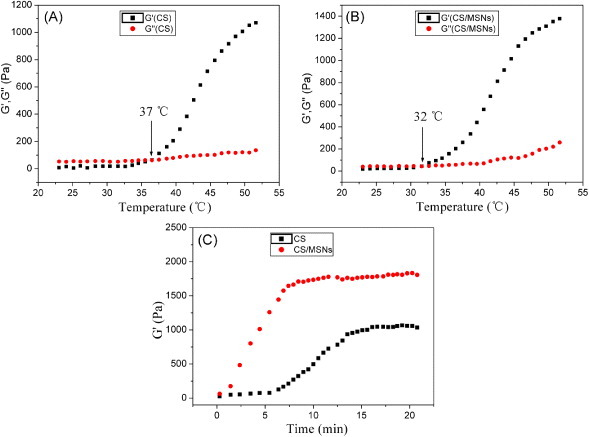
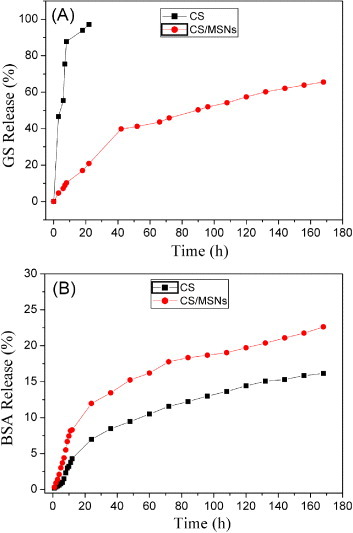
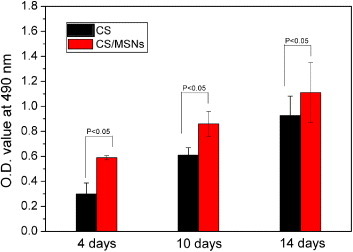
We have developed composite hydrogels of chitosan (CS) and mesoporous silica nanoparticles (MSNs) in this study. The gelation rate, gel strength, drug delivery behavior and chondrocyte proliferation properties were investigated. The introduction of MSNs into CS accelerated the gelation process at body temperature and also increased the elastic modulus ' from 1000 to 1800 Pa. When we used gentamicin (GS) and bovine serum albumin (BSA) as model small chemical drugs and biomacromolecules, respectively, the CS/MSN hydrogels released GS and BSA in a sustained manner simultaneously, but the CS hydrogels only showed sustained BSA release. Furthermore, chondrocyte culture showed that the CS/MSN composite hydrogels indeed performed much better in supporting chondrocyte growth and maintaining chondrocytic phenotype compared to the CS hydrogels. Therefore, the results suggest that the CS/MSN composite hydrogels can be potentially very useful for cartilage regeneration.
在本研究中,我们制备了壳聚糖(CS)与介孔二氧化硅纳米颗粒(MSN)的复合水凝胶。研究了其凝胶化速率、凝胶强度、药物递送行为及软骨细胞增殖特性。将MSN引入CS中可加速体温下的凝胶化过程,同时还将弹性模量从1000 Pa提高到1800 Pa。当我们分别使用庆大霉素(GS)和牛血清白蛋白(BSA)作为模型小分子化学药物和生物大分子时,CS/MSN水凝胶同时持续释放GS和BSA,但CS水凝胶仅显示出BSA的持续释放。此外,软骨细胞培养表明,与CS水凝胶相比,CS/MSN复合水凝胶在支持软骨细胞生长和维持软骨细胞表型方面确实表现得更好。因此,结果表明CS/MSN复合水凝胶在软骨再生方面可能非常有用。