Angelis Apostolis, Hubert Jane, Aligiannis Nektarios, Michalea Rozalia, Abedini Amin, Nuzillard Jean-Marc, Gangloff Sophie C, Skaltsounis Alexios-Leandros, Renault Jean-Hugues
Institut de Chimie Moléculaire de Reims, UMR CNRS 7312, SFR CAP'SANTE, UFR de Pharmacie, Université de Reims Champagne-Ardenne, Reims 51687, France.
Division of Pharmacognosy and Natural Products Chemistry, School of Pharmacy, University of Athens, Panepistimioupolis, Zografou, Athens 15771, Greece.
Molecules. 2016 Nov 21;21(11):1586. doi: 10.3390/molecules21111586.
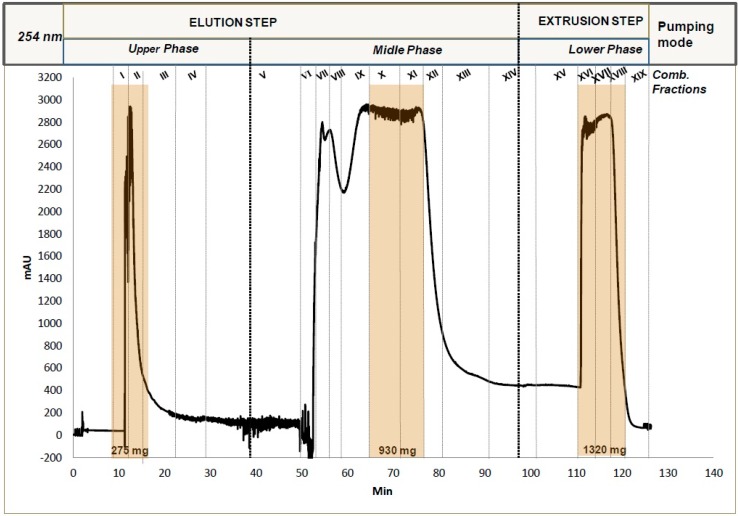
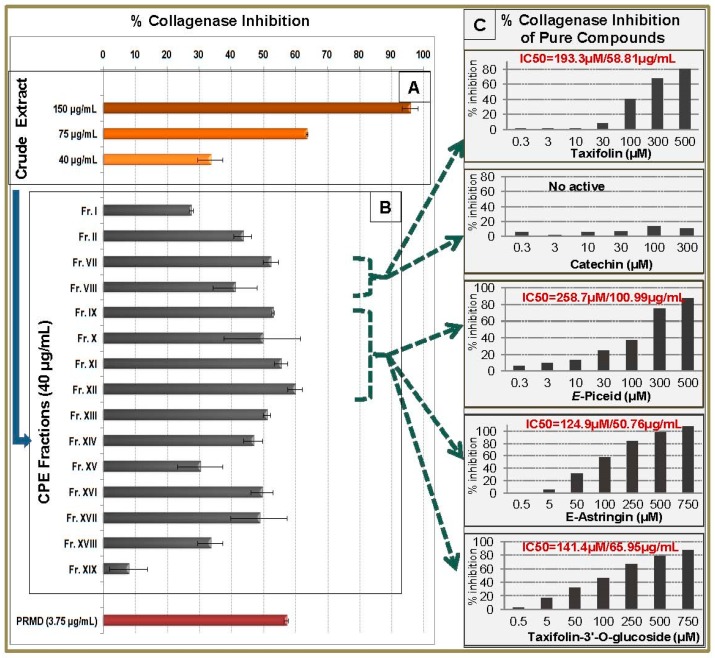
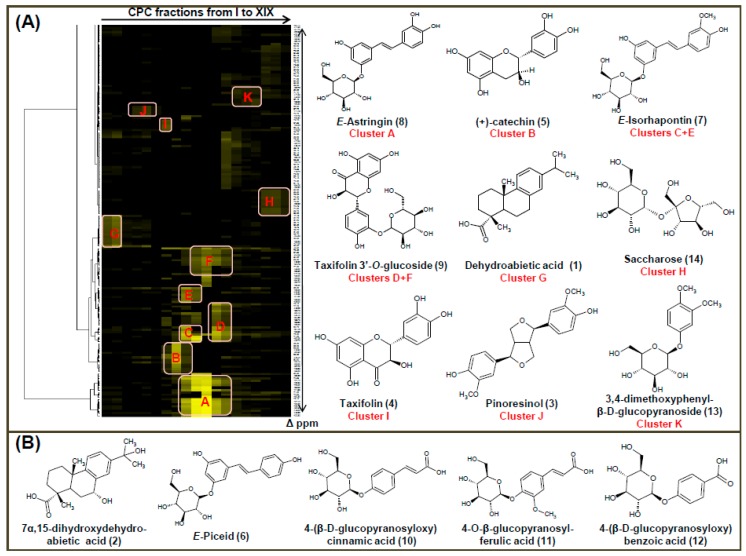
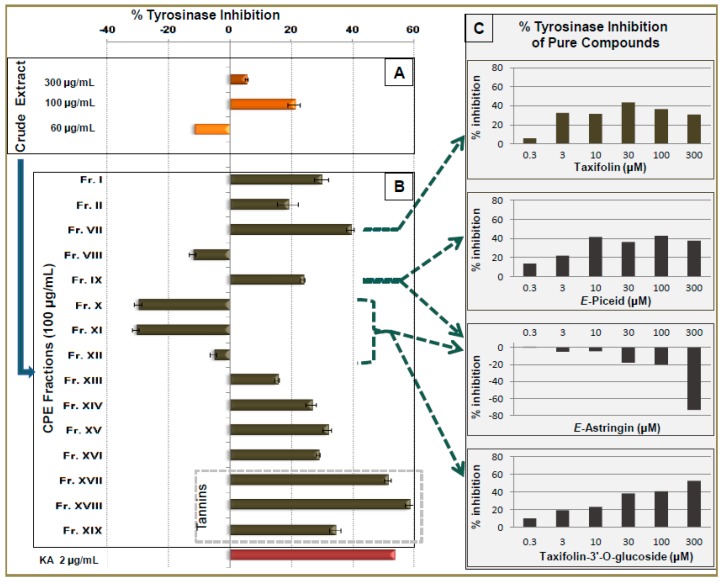
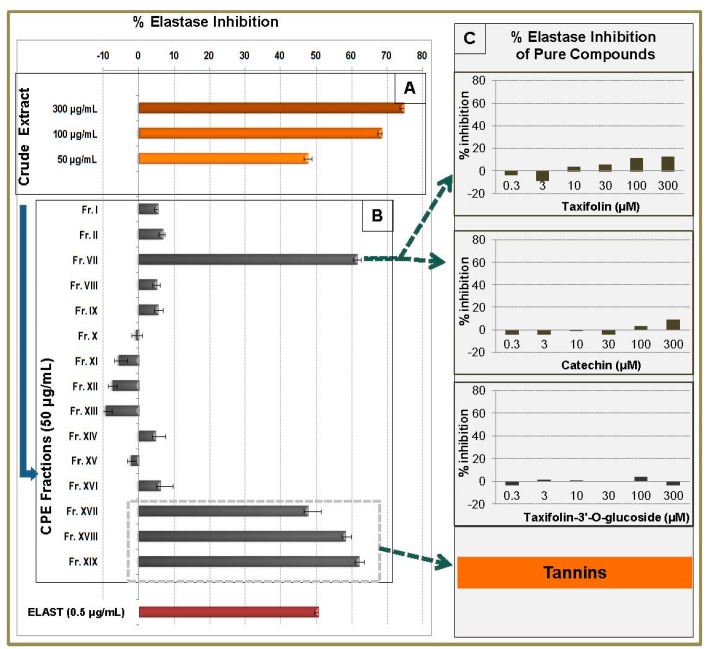
Common spruce ( L.) is a fast-growing coniferous tree, widely used in several countries for the production of sawn wood, timber and pulp. During this industrial exploitation, large quantities of barks are generated as waste materials. The aim of this study was the bio-guided investigation and the effective recovery of methanol-soluble metabolites of common spruce bark for the development of new dermo-cosmetic agents. The active methanol extract was initially fractionated by Centrifugal Partition Chromatography (CPC) using a triphasic solvent system in a step-gradient elution mode. All resulting fractions were evaluated for their antibacterial activity, antioxidant activity and their capability to inhibit tyrosinase, elastase and collagenase activity. In parallel, the chemical composition of each fraction was established by combining a C-NMR dereplication approach and 2D-NMR analyses. As a result, fourteen secondary metabolites corresponding to stilbene, flavonoid and phenolic acid derivatives were directly identified in the CPC fractions. A high amount (0.93 g) of -astringin was recovered from 3 g of crude extract in a single 125 min run. -Astringin significantly induced the tyrosinase activity while -piceid, taxifolin, and taxifolin-3'--glucopyranoside exhibited significant anti-tyrosinase activity. The above compounds showed important anti-collagenase and antimicrobial activities, thus providing new perspectives for potential applications as cosmetic ingredients.
欧洲云杉(L.)是一种生长迅速的针叶树,在多个国家广泛用于锯材、木材和纸浆生产。在这种工业开发过程中,会产生大量树皮作为废料。本研究的目的是对欧洲云杉树皮的甲醇可溶性代谢产物进行生物导向研究并有效回收,以开发新型皮肤美容剂。活性甲醇提取物最初通过离心分配色谱法(CPC),使用三相溶剂系统以梯度洗脱模式进行分离。对所有得到的馏分进行抗菌活性、抗氧化活性以及抑制酪氨酸酶、弹性蛋白酶和胶原酶活性能力的评估。同时,通过结合碳核磁共振(C-NMR)去重复方法和二维核磁共振(2D-NMR)分析确定每个馏分的化学成分。结果,在CPC馏分中直接鉴定出了十四种与芪、黄酮和酚酸衍生物相对应的次生代谢产物。在单次125分钟的运行中,从3克粗提物中回收了大量(0.93克)的α-阿斯汀。α-阿斯汀显著诱导酪氨酸酶活性,而β-松脂醇、紫杉叶素和紫杉叶素-3'-O-葡萄糖苷表现出显著的抗酪氨酸酶活性。上述化合物显示出重要的抗胶原酶和抗菌活性,从而为作为化妆品成分的潜在应用提供了新的前景。