Yamashita Masamichi, Imagawa Tomohiro, Sako Yasuhito, Okamoto Munehiro, Yanagida Tetsuya, Okamoto Yoshiharu, Tsuka Takeshi, Osaki Tomohiro, Ito Akira
Department of Veterinary Diagnostic Imaging, School of Veterinary Medicine, Faculty of Agriculture, Tottori University, Tottori 680-8553, Japan.
J Vet Med Sci. 2017 Feb 14;79(2):308-313. doi: 10.1292/jvms.16-0513. Epub 2016 Nov 27.
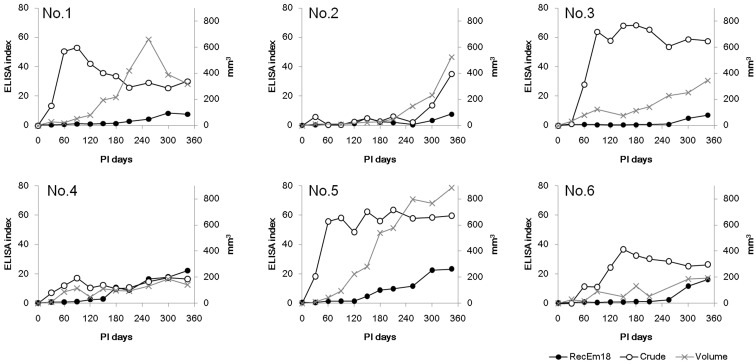
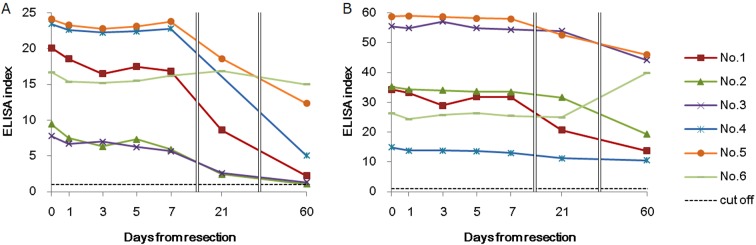
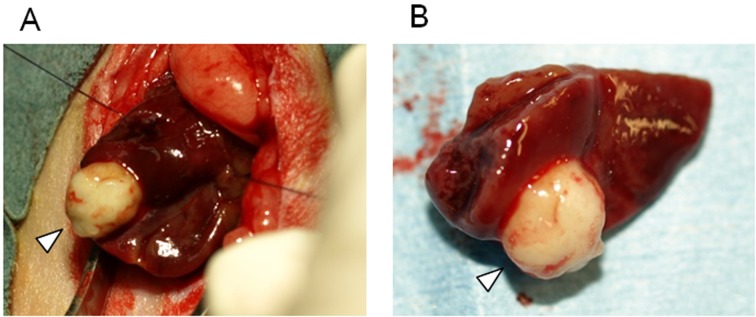
Serology is important for the diagnosis and follow-up of human alveolar echinococcosis (AE). However, patient conditions are highly variable among those with AE, and antibody responses in serological follow-up have not been well-defined. We recently described a new AE rat model established by implantation of small AE tissue into a single arbitrary location in the liver; no metastasis and dissemination were observed. In the present study, we examined the serological characteristics in our rat model before and after surgical treatment. The results showed that antibody responses against crude antigens were increased at one month after transplantation and similar to those of other model animals. For the antigen Em18, antibody responses were slower in our rat model than in other animal models. After surgical resection, changes in antibody responses against Em18 were similar to those observed in human patients with AE. Because of the slow growth of lesions, establishment of a single hepatic lesion and patterns of antibody responses, our rat model may be useful for clarifying follow-up serodiagnoses in human AE and determining the mechanisms of multi-organ involvement by primary infection with oncospheres rather than metastasis.
血清学对于人类肺泡型棘球蚴病(AE)的诊断和随访很重要。然而,AE患者的病情差异很大,血清学随访中的抗体反应尚未明确界定。我们最近描述了一种新的AE大鼠模型,通过将小的AE组织植入肝脏中的单个任意位置建立;未观察到转移和扩散。在本研究中,我们检查了大鼠模型手术治疗前后的血清学特征。结果表明,移植后1个月针对粗抗原的抗体反应增加,与其他模型动物相似。对于抗原Em18,我们的大鼠模型中的抗体反应比其他动物模型慢。手术切除后,针对Em18的抗体反应变化与AE人类患者中观察到的相似。由于病变生长缓慢、单个肝病变的形成以及抗体反应模式,我们的大鼠模型可能有助于阐明人类AE的随访血清诊断,并确定由原头蚴原发性感染而非转移引起的多器官受累机制。