Morris Megan M, Haggerty John M, Papudeshi Bhavya N, Vega Alejandro A, Edwards Matthew S, Dinsdale Elizabeth A
Department of Biology, San Diego State University San Diego, CA, USA.
Bioinformatics and Medical Informatics, San Diego State University San Diego, CA, USA.
Front Microbiol. 2016 Nov 14;7:1800. doi: 10.3389/fmicb.2016.01800. eCollection 2016.
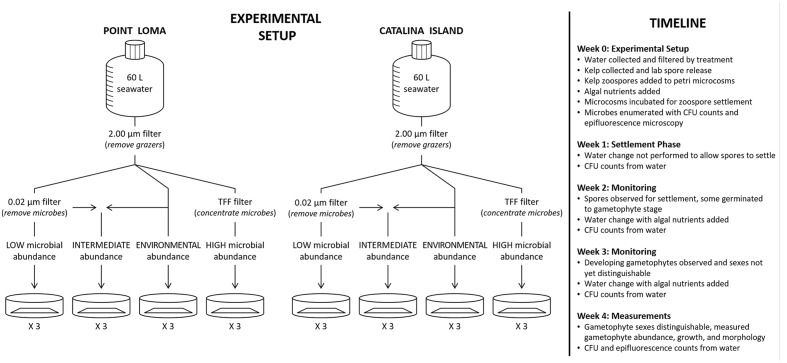
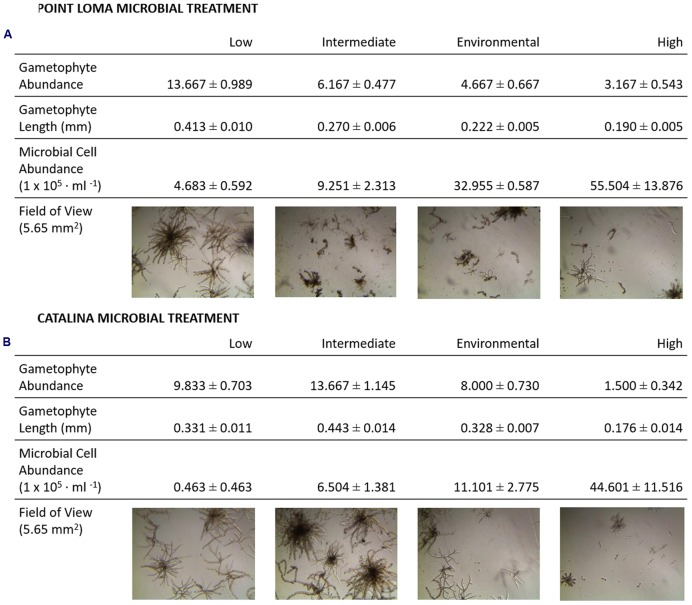
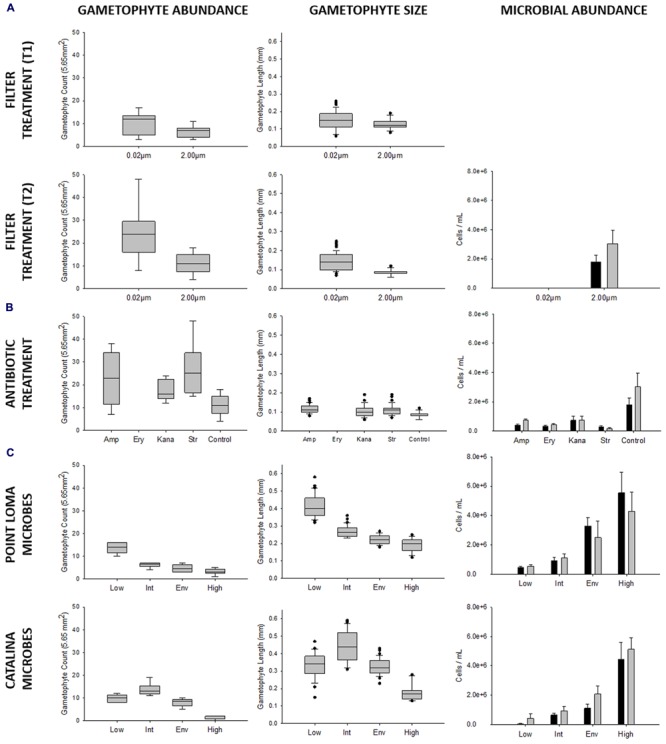
Marine microbes mediate key ecological processes in kelp forest ecosystems and interact with macroalgae. Pelagic and biofilm-associated microbes interact with macroalgal propagules at multiple stages of recruitment, yet these interactions have not been described for . Here we investigate the influence of microbes from coastal environments on recruitment of giant kelp, . Through repeated laboratory experiments, we tested the effects of altered pelagic microbial abundance on the settlement and development of the microscopic propagules of during recruitment. zoospores were reared in laboratory microcosms exposed to environmental microbial communities from seawater during the complete haploid stages of the kelp recruitment cycle, including zoospore release, followed by zoospore settlement, to gametophyte germination and development. We altered the microbial abundance states differentially in three independent experiments with repeated trials, where microbes were (a) present or absent in seawater, (b) altered in community composition, and (c) altered in abundance. Within the third experiment, we also tested the effect of nearshore versus offshore microbial communities on the macroalgal propagules. Distinct pelagic microbial communities were collected from two southern California temperate environments reflecting contrasting intensity of human influence, the nearshore Point Loma kelp forest and the offshore Santa Catalina Island kelp forest. The Point Loma kelp forest is a high impacted coastal region adjacent to the populous San Diego Bay; whereas the kelp forest at Catalina Island is a low impacted region of the Channel Islands, 40 km offshore the southern California coast, and is adjacent to a marine protected area. Kelp gametophytes reared with nearshore Point Loma microbes showed lower survival, growth, and deteriorated morphology compared to gametophytes with the offshore Catalina Island microbial community, and these effects were magnified under high microbial abundances. Reducing abundance of Point Loma microbes restored propagule success. Yet an intermediate microbial abundance was optimal for kelp propagules reared with Catalina Island microbes, suggesting that microbes also have a beneficial influence on kelp. Our study shows that pelagic microbes from nearshore and offshore environments are differentially influencing kelp propagule success, which has significant implications for kelp recruitment and kelp forest ecosystem health.
海洋微生物介导海带森林生态系统中的关键生态过程,并与大型藻类相互作用。浮游微生物和生物膜相关微生物在大型藻类繁殖的多个阶段与大型藻类繁殖体相互作用,但尚未对这些相互作用进行描述。在这里,我们研究来自沿海环境的微生物对巨型海带繁殖的影响。通过反复的实验室实验,我们测试了浮游微生物丰度变化对海带繁殖过程中微观繁殖体的附着和发育的影响。在海带繁殖周期的完整单倍体阶段,包括游动孢子释放,随后游动孢子附着,到配子体萌发和发育过程中,将海带游动孢子置于暴露于海水环境微生物群落的实验室微宇宙中进行培养。我们在三个独立实验中进行了重复试验,以不同方式改变微生物丰度状态,其中微生物(a)在海水中存在或不存在,(b)群落组成改变,以及(c)丰度改变。在第三个实验中,我们还测试了近岸与离岸微生物群落对大型藻类繁殖体的影响。从南加州两个温带环境中收集了不同的浮游微生物群落,这两个环境反映了人类影响强度的差异,即近岸的洛马角海带森林和离岸的圣卡塔利娜岛海带森林。洛马角海带森林是一个受影响较大的沿海地区,毗邻人口众多的圣地亚哥湾;而卡塔利娜岛的海带森林是海峡群岛中受影响较小的地区,位于南加州海岸离岸40公里处,且毗邻一个海洋保护区。与接触离岸圣卡塔利娜岛微生物群落的配子体相比,接触近岸洛马角微生物的海带配子体存活率更低、生长更慢且形态恶化,并且在高微生物丰度下这些影响会放大。降低洛马角微生物的丰度可恢复海带繁殖体的成功率。然而,对于用卡塔利娜岛微生物培养的海带繁殖体来说,中等微生物丰度是最优的,这表明微生物对海带也有有益影响。我们的研究表明,来自近岸和离岸环境的浮游微生物对海带繁殖体成功率的影响不同,这对海带繁殖和海带森林生态系统健康具有重要意义。