Harrell M B, Weaver S R, Loukas A, Creamer M, Marti C N, Jackson C D, Heath J W, Nayak P, Perry C L, Pechacek T F, Eriksen M P
UTHealth School of Public Health in Austin, Michael & Susan Dell Center for Healthy Living, , 1616 Guadalupe, Suite 6.300, Austin, TX 78701, USA.
Georgia State University Tobacco Center of Regulatory Science & Division of Epidemiology & Biostatistics, School of Public Health, Georgia State University, 33 Gilmer Street SE, Atlanta, GA 30303, USA.
Prev Med Rep. 2016 Nov 11;5:33-40. doi: 10.1016/j.pmedr.2016.11.001. eCollection 2017 Mar.
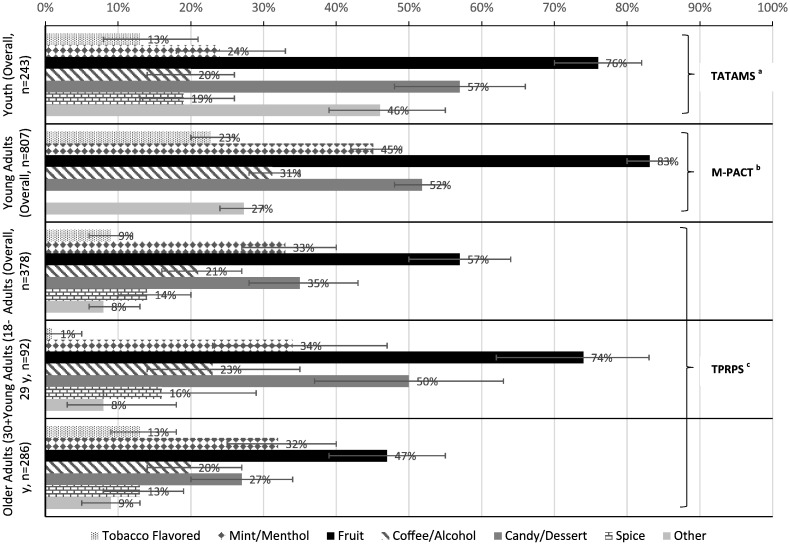
The purpose of this study is to investigate how the use of flavored e-cigarettes varies between youth (12-17 years old), young adults (18-29 years old), and older adults (30 + years old). Cross-sectional surveys of school-going youth ( = 3907) and young adult college students ( = 5482) in Texas, and young adults and older adults ( = 6051) nationwide were administered in 2014-2015. Proportions and 95% confidence intervals were used to describe the percentage of e-cigarette use at initiation and in the past 30 days that was flavored, among current e-cigarette users. Chi-square tests were applied to examine differences by combustible tobacco product use and demographic factors. Most e-cigarette users said their first and "usual" e-cigarettes were flavored. At initiation, the majority of Texas school-going youth (98%), Texas young adult college students (95%), and young adults (71.2%) nationwide said their first e-cigarettes were flavored to taste like something other than tobacco, compared to 44.1% of older adults nationwide. Fruit and candy flavors predominated for all groups; and, for youth, flavors were an especially salient reason to use e-cigarettes. Among adults, the use of tobacco flavor at initiation was common among dual users (e-cigarettes + combustible tobacco), while other flavors were more common among former cigarette smokers (P = 0.03). Restricting the range of e-cigarette flavors (e.g., eliminating sweet flavors, like fruit and candy) may benefit youth and young adult prevention efforts. However, it is unclear what impact this change would have on adult smoking cessation.
本研究的目的是调查调味电子烟在青少年(12 - 17岁)、年轻成年人(18 - 29岁)和老年人(30岁及以上)中的使用情况有何不同。2014 - 2015年对得克萨斯州的在校青少年(n = 3907)、年轻成年大学生(n = 5482)以及全国范围内的年轻成年人和老年人(n = 6051)进行了横断面调查。比例和95%置信区间用于描述当前电子烟使用者中开始使用和过去30天内使用的调味电子烟的百分比。应用卡方检验来检查可燃烟草制品使用情况和人口统计学因素的差异。大多数电子烟使用者表示他们的第一支和“常用”电子烟是有味道的。开始使用时,得克萨斯州的大多数在校青少年(98%)、得克萨斯州的年轻成年大学生(95%)以及全国范围内的年轻成年人(71.2%)表示他们的第一支电子烟的味道不是烟草味,而全国范围内只有44.1%的老年人是这样。所有群体中水果和糖果味占主导;对于青少年来说,味道是使用电子烟的一个特别突出的原因。在成年人中,开始使用时烟草味在双重使用者(电子烟 + 可燃烟草)中很常见,而其他味道在曾经吸过烟的人中更常见(P = 0.03)。限制电子烟味道的范围(例如,去除甜味,如水果和糖果味)可能有助于青少年和年轻成年人的预防工作。然而,尚不清楚这种变化对成年人戒烟会有什么影响。