Jang Jin-Uk, Kim Soo-Young, Yoon Eul-Sik, Kim Woo-Kyung, Park Seung-Ha, Lee Byung-Il, Kim Deok-Woo
Department of Plastic Surgery, Korea University College of Medicine, Seoul, Korea.
Arch Plast Surg. 2016 Nov;43(6):575-581. doi: 10.5999/aps.2016.43.6.575. Epub 2016 Nov 18.
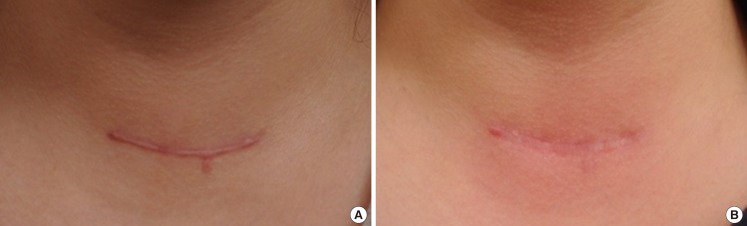
Open thyroidectomy is conventionally performed at the anterior side of neck, which is a body part with a comparatively great degree of open exposure; due to this, postoperative scarring may cause distress in patients. We aimed to compare the effects of ablative and nonablative fractional laser treatments on thyroidectomy scars. We examined medical records in a retrospective manner and analyzed scars based on their digital images by using the modified Manchester Scar Scale (mMSS).
Between February 2012 and May 2013, 55 patients with thyroidectomy scars were treated with ablative (34 patients) or nonablative (21 patients) fractional laser. Each patient underwent 4 laser treatment sessions in 3-4 week intervals, 1-2 months postoperatively. Scar improvement was assessed using patient images and the mMSS scale.
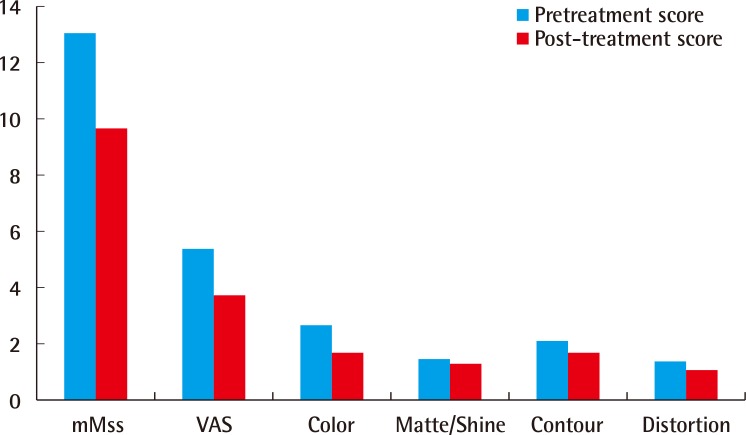
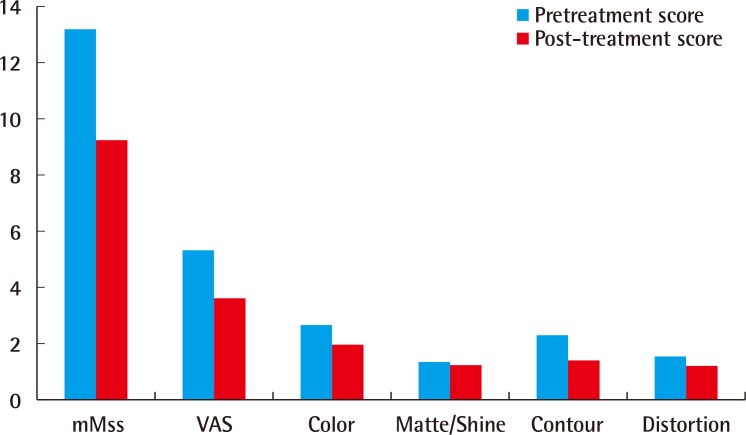
The mean decrease in scar score was 3.91 and 3.47 in the ablative and nonablative groups, respectively; the reduction between 2 groups did not exhibit any significant difference (P=0.16). We used the scale once again to individually evaluate scar attributes. The nonablative group accounted for a considerably higher color score value (P=0.03); the ablative group accounted for a considerably higher contour score value (P<0.01). Patient satisfaction was high and no complications occurred.
Both types of fractional laser treatments can be used successfully for thyroidectomy scar treatment with minimal complications; however, results indicate that higher effectiveness may be obtained from the use of ablative and nonablative lasers for hypertrophic scars and early erythematous scars, respectively. Therefore, the appropriate laser for scar treatment should be selected according to its specific characteristics.
传统的开放性甲状腺切除术是在颈部前方进行,该身体部位开放性暴露程度相对较高;因此,术后瘢痕可能会给患者带来困扰。我们旨在比较剥脱性和非剥脱性分次激光治疗对甲状腺切除术后瘢痕的效果。我们以回顾性方式检查病历,并使用改良曼彻斯特瘢痕量表(mMSS)基于数字图像分析瘢痕。
在2012年2月至2013年5月期间,55例有甲状腺切除术后瘢痕的患者接受了剥脱性(34例患者)或非剥脱性(21例患者)分次激光治疗。每位患者在术后1 - 2个月,每隔3 - 4周接受4次激光治疗。使用患者图像和mMSS量表评估瘢痕改善情况。
剥脱性组和非剥脱性组瘢痕评分的平均降低分别为3.91和3.47;两组之间的降低没有显示出任何显著差异(P = 0.16)。我们再次使用该量表单独评估瘢痕属性。非剥脱性组的颜色评分值明显更高(P = 0.03);剥脱性组的轮廓评分值明显更高(P < 0.01)。患者满意度较高,且未发生并发症。
两种类型的分次激光治疗均可成功用于甲状腺切除术后瘢痕治疗,并发症极少;然而,结果表明,分别使用剥脱性和非剥脱性激光治疗肥厚性瘢痕和早期红斑性瘢痕可能会获得更高的疗效。因此,应根据瘢痕的具体特征选择合适的激光进行治疗。