McGilton Katherine S, Rochon Elizabeth, Sidani Souraya, Shaw Alexander, Ben-David Boaz M, Saragosa Marianne, Boscart Veronique M, Wilson Rozanne, Galimidi-Epstein Karmit K, Pichora-Fuller M Kathleen
1 Toronto Rehabilitation Institute - University Health Network, Toronto, Ontario, Canada.
2 Lawrence S. Bloomberg Faculty of Nursing, University of Toronto, Toronto, Ontario, Canada.
Am J Alzheimers Dis Other Demen. 2017 Feb;32(1):41-50. doi: 10.1177/1533317516680899. Epub 2016 Nov 30.
Effective communication between residents with dementia and care providers in long-term care homes (LTCHs) is essential to resident-centered care.
To determine the effects of a communication intervention on residents' quality of life (QOL) and care, as well as care providers' perceived knowledge, mood, and burden.
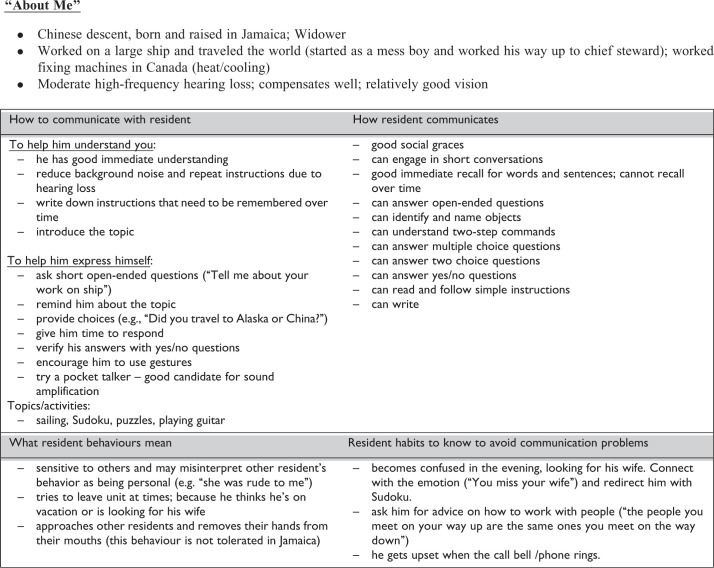
The intervention included (1) individualized communication plans, (2) a dementia care workshop, and (3) a care provider support system. Pre- and postintervention scores were compared to evaluate the effects of the intervention. A total of 12 residents and 20 care providers in an LTCH participated in the feasibility study.
The rate of care providers' adherence to the communication plans was 91%. Postintervention, residents experienced a significant increase in overall QOL. Care providers had significant improvement in mood and perceived reduced burden.
The results suggest that the communication intervention demonstrates preliminary evidence of positive effects on residents' QOL and care providers' mood and burden.
在长期护理机构(LTCHs)中,痴呆症患者与护理人员之间的有效沟通对于以患者为中心的护理至关重要。
确定沟通干预对患者生活质量(QOL)和护理的影响,以及护理人员的感知知识、情绪和负担。
干预措施包括(1)个性化沟通计划,(2)痴呆症护理工作坊,以及(3)护理人员支持系统。比较干预前后的得分以评估干预效果。一家LTCH的12名患者和20名护理人员参与了可行性研究。
护理人员对沟通计划的依从率为91%。干预后,患者的总体生活质量显著提高。护理人员的情绪有显著改善,且感知负担减轻。
结果表明,沟通干预对患者生活质量以及护理人员的情绪和负担产生积极影响的初步证据。