Epidemiology of highly pathogenic microorganisms, Robert Koch-Institute, Berlin, Germany.
Albert-Ludwigs-University, Faculty of Biology, Freiburg, Germany.
Sci Rep. 2016 Nov 30;6:37952. doi: 10.1038/srep37952.
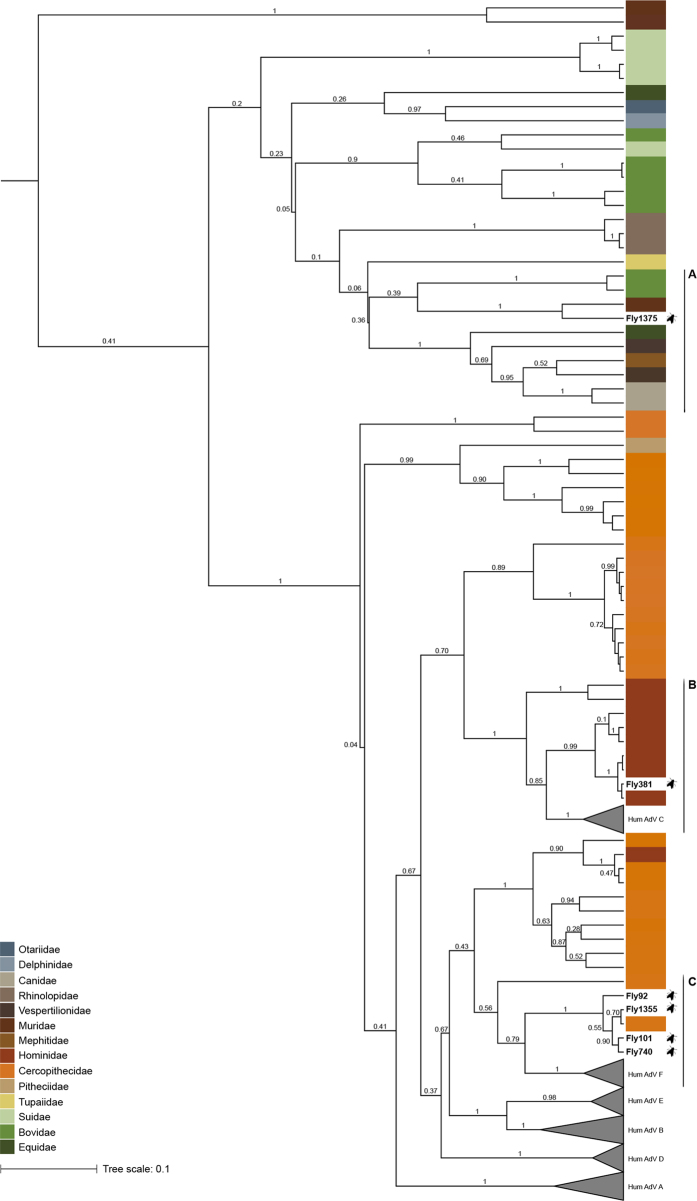
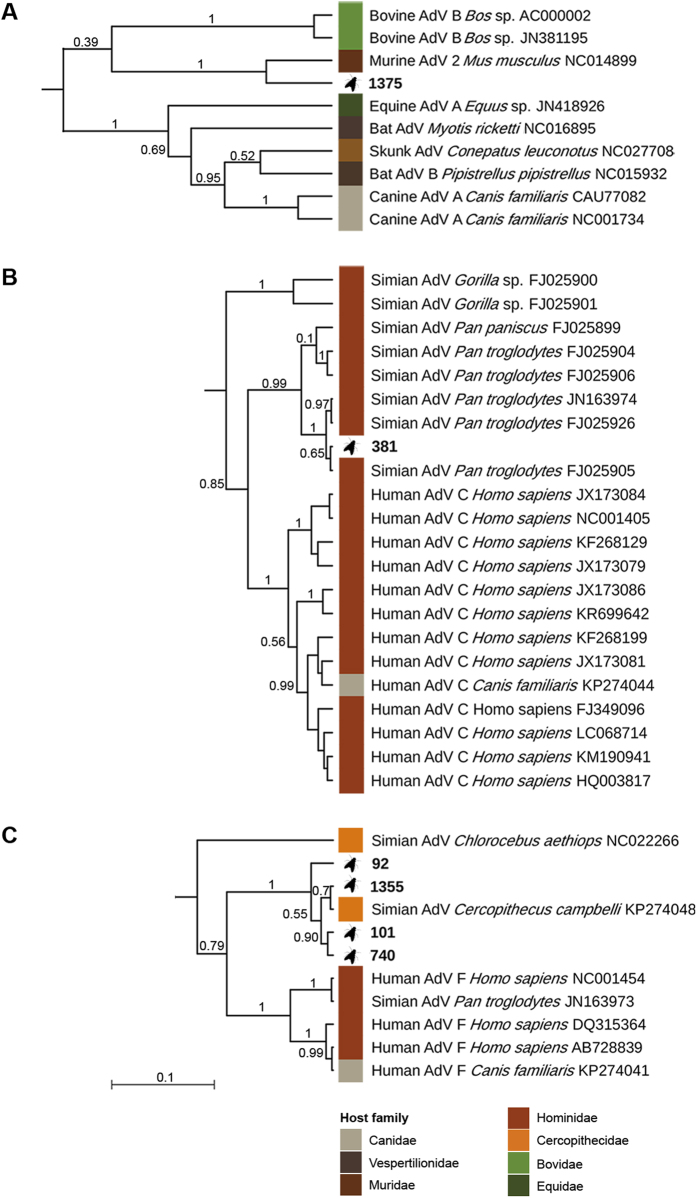
Monitoring wildlife infectious agents requires acquiring samples suitable for analyses, which is often logistically demanding. A possible alternative to invasive or non-invasive sampling of wild-living vertebrates is the use of vertebrate material contained in invertebrates feeding on them, their feces, or their remains. Carrion flies have been shown to contain vertebrate DNA; here we investigate whether they might also be suitable for wildlife pathogen detection. We collected 498 flies in Taï National Park, Côte d'Ivoire, a tropical rainforest and examined them for adenoviruses (family Adenoviridae), whose DNA is frequently shed in feces of local mammals. Adenoviral DNA was detected in 6/142 mammal-positive flies. Phylogenetic analyses revealed that five of these sequences were closely related to sequences obtained from local non-human primates, while the sixth sequence was closely related to a murine adenovirus. Next-generation sequencing-based DNA-profiling of the meals of the respective flies identified putative hosts that were a good fit to those suggested by adenoviral sequence affinities. We conclude that, while characterizing the genetic diversity of wildlife infectious agents through fly-based monitoring may not be cost-efficient, this method could probably be used to detect the genetic material of wildlife infectious agents causing wildlife mass mortality in pristine areas.
监测野生动物传染病原体需要获取适合分析的样本,这在后勤上往往具有挑战性。对于生活在野外的脊椎动物进行非侵入性或侵入性采样的一种可能替代方法是使用以它们为食、其粪便或遗骸为食的无脊椎动物中的脊椎动物材料。已证明腐肉蝇含有脊椎动物 DNA;在这里,我们研究它们是否也适合用于野生动物病原体检测。我们在科特迪瓦的泰伊国家公园收集了 498 只苍蝇,并对它们进行了腺病毒(腺病毒科)的检测,腺病毒 DNA 经常在当地哺乳动物的粪便中脱落。在 142 只哺乳动物阳性苍蝇中检测到 6 只腺病毒 DNA。系统发育分析表明,其中 5 个序列与从当地非人类灵长类动物获得的序列密切相关,而第 6 个序列与鼠腺病毒密切相关。基于下一代测序的 DNA 分析确定了各自苍蝇的食物中的潜在宿主,这些宿主与腺病毒序列亲缘关系所提示的宿主非常吻合。我们的结论是,虽然通过蝇类监测来描述野生动物传染病原体的遗传多样性可能不具有成本效益,但这种方法可能可用于检测导致原始地区野生动物大量死亡的野生动物传染病原体的遗传物质。