Young Ian, Waddell Lisa
School of Occupational and Public Health, Ryerson University, Toronto, Ontario, Canada.
National Microbiology Laboratory @ Guelph, Public Health Agency of Canada, Guelph, Ontario, Canada.
PLoS One. 2016 Dec 1;11(12):e0167695. doi: 10.1371/journal.pone.0167695. eCollection 2016.
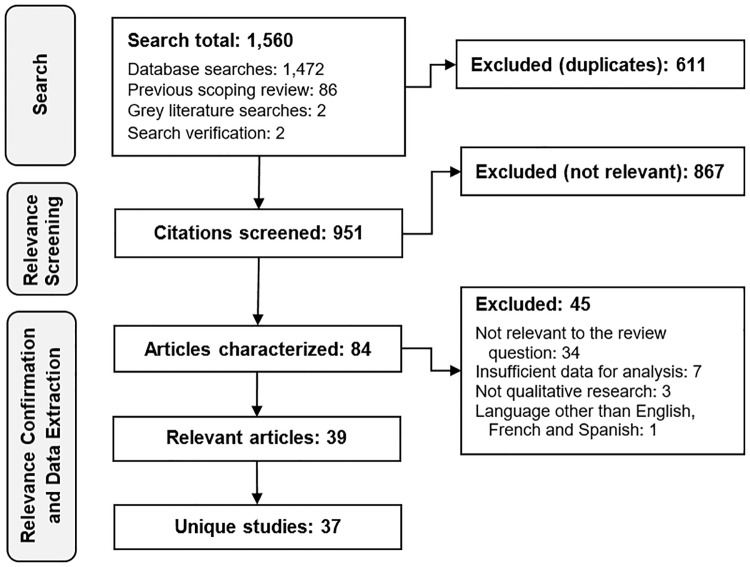
Foodborne illness has a substantial health and economic burden on society, and most cases are believed to be due to unsafe food handling practices at home. Several qualitative research studies have been conducted to investigate consumers' perspectives, opinions, and experiences with safe food handling at home, and these studies provide insights into the underlying barriers and facilitators affecting their safe food handling behaviours. We conducted a systematic review of previously published qualitative studies in this area to synthesize the main across-study themes and to develop recommendations for future consumer interventions and research. The review was conducted using the following steps: comprehensive search strategy; relevance screening of abstracts; relevance confirmation of articles; study quality assessment; thematic synthesis of the results; and quality-of-evidence assessment. A total of 39 relevant articles reporting on 37 unique qualitative studies were identified. Twenty-one barriers and 10 facilitators to safe food handling were identified, grouped across six descriptive themes: confidence and perceived risk; knowledge-behaviour gap; habits and heuristics; practical and lifestyle constraints; food preferences; and societal and social influences. Our overall confidence that each barrier and facilitator represents the phenomenon of interest was rated as high (n = 11), moderate (11), and low (9). Overarching analytical themes included: 1) safe food handling behaviours occur as part of a complex interaction of everyday consumer practices and habituation; 2) most consumers are not concerned about food safety and are generally not motivated to change their behaviours based on new knowledge about food safety risks; and 3) consumers are amenable to changing their safe food handling habits through relevant social pressures. Key implications and recommendations for research, policy and practice are discussed.
食源性疾病给社会带来了巨大的健康和经济负担,并且大多数病例被认为是由于家庭中不安全的食品处理行为所致。已经开展了多项定性研究来调查消费者对于家庭安全食品处理的观点、意见和经历,这些研究为影响其安全食品处理行为的潜在障碍和促进因素提供了见解。我们对该领域先前发表的定性研究进行了系统综述,以综合主要的跨研究主题,并为未来的消费者干预措施和研究提出建议。该综述按照以下步骤进行:全面的搜索策略;摘要的相关性筛选;文章的相关性确认;研究质量评估;结果的主题综合;以及证据质量评估。总共确定了39篇报道37项独特定性研究的相关文章。确定了21个安全食品处理的障碍和10个促进因素,分为六个描述性主题:信心和感知风险;知识与行为差距;习惯和启发法;实际和生活方式限制;食物偏好;以及社会和社会影响。我们对每个障碍和促进因素代表所关注现象的总体信心被评为高(n = 11)、中(11)和低(9)。总体分析主题包括:1)安全食品处理行为是日常消费者行为和习惯化复杂相互作用的一部分;2)大多数消费者不关心食品安全,通常也没有动力根据关于食品安全风险的新知识改变他们的行为;3)消费者愿意通过相关的社会压力改变他们的安全食品处理习惯。讨论了对研究、政策和实践的关键影响和建议。