Shakoor Zahid, AlFaifi Abrar, AlAmro Bayan, AlTawil Lama Nabil, AlOhaly Rana Yazid
Ann Saudi Med. 2016 Nov-Dec;36(6):386-390. doi: 10.5144/0256-4947.2016.386.
Food intolerance mediated by food specific IgG antibodies has been implicated in a variety of disorders.
To assess the prevalence of food specific IgG antibodies among patients clinically presenting with allergic symptoms lacking laboratory evidence of allergy.
Descriptive retrospective cross-sectional study.
King Khalid University Hospital, Riyadh between 2010-2015.
Patients were screened for food specific IgG antibodies. All symptomatic patients lacking laboratory evidence of allergy who underwent food specific IgG testing during the study duration were included.
MAIN OUTCOME MEASURE(S): Levels of IgG antibodies in patients with unidentified allergic symptoms.
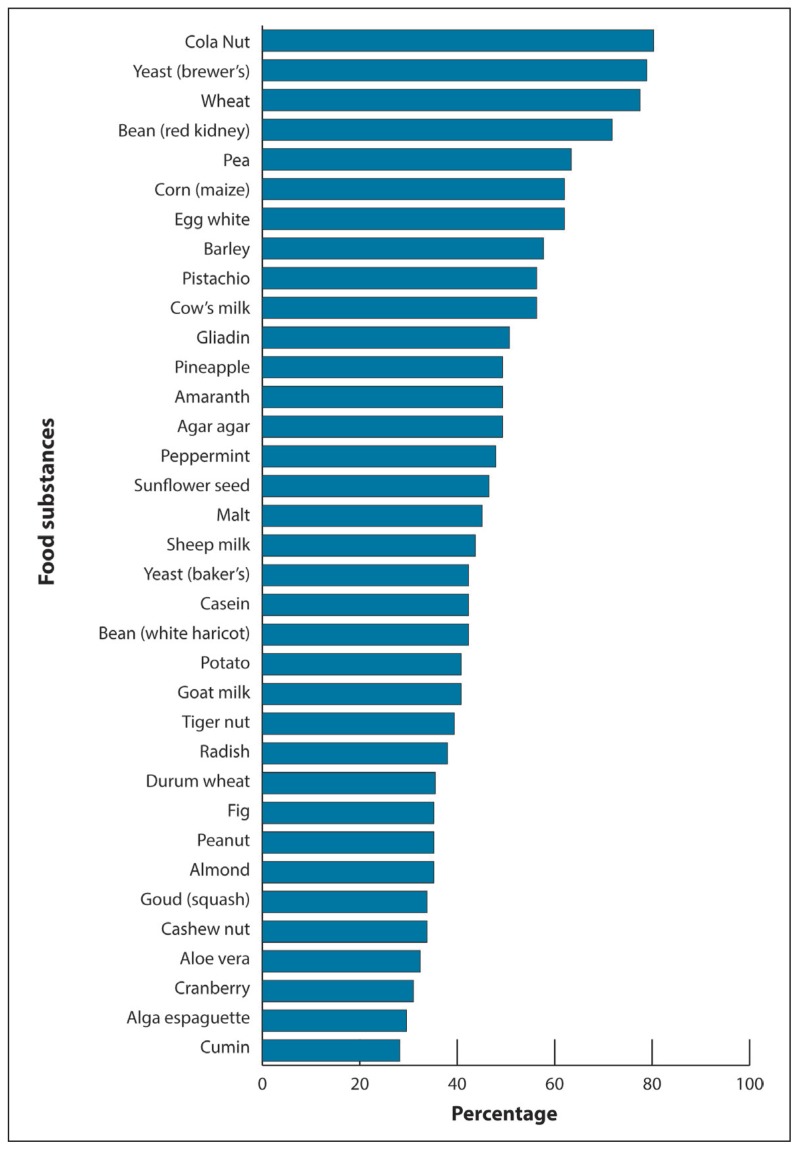
We selected 71 patients with allergic symptoms lacking laboratory evidence of allergy. There were 49 female and 22 male patients mean age 38.8 (16.0) years. The majority (85.7%) had urticaria. The most frequently occurring food specific IgG antibodies were against cola nut in 80.3% of patients followed by yeast in 78.9%, wheat in 77.5%, red kidney bean in 71.8%, pea in 63.4%, corn in 62% and egg white in 62% of the patients. Compared with male patients, females harbored significantly higher food specific IgG antibodies for frequently occurring food materials, particularly against wheat (74% vs 25.5%; P < .0001), corn (77.3% vs 22.7%; P < .0001) and cola nut (71.9% vs 28.1%; P < .001). Patients aged less than 40 years had higher levels of food specific IgG against gliadin (P < .003), egg white (P < .03) and barley (P < .05) compared with older patients.
The detection of a variety of food specific IgG antibodies among patients with allergic symptoms indicates a possible link to food intolerance allergy. Females are prone to develop food intolerance more than males.
Difficulty of comparison of results with previous studies because of lack of data. Follow-up studies could not be performed to assess the effects of elimination from the diet due to limited time allocated for this study.
由食物特异性IgG抗体介导的食物不耐受与多种疾病有关。
评估临床上出现过敏症状但缺乏实验室过敏证据的患者中食物特异性IgG抗体的患病率。
描述性回顾性横断面研究。
2010年至2015年期间位于利雅得的哈立德国王大学医院。
对患者进行食物特异性IgG抗体筛查。纳入在研究期间接受食物特异性IgG检测且缺乏实验室过敏证据的所有有症状患者。
不明过敏症状患者的IgG抗体水平。
我们选择了71例有过敏症状但缺乏实验室过敏证据的患者。其中有49名女性和22名男性患者,平均年龄38.8(16.0)岁。大多数(85.7%)患有荨麻疹。最常见的食物特异性IgG抗体是针对可乐果的,在80.3%的患者中出现,其次是酵母(78.9%)、小麦(77.5%)、红芸豆(71.8%)、豌豆(63.4%)、玉米(62%)和蛋清(62%)。与男性患者相比,女性患者针对常见食物材料的食物特异性IgG抗体水平显著更高,尤其是针对小麦(74%对25.5%;P <.0001)、玉米(77.3%对22.7%;P <.0001)和可乐果(71.9%对28.1%;P <.001)。与老年患者相比,年龄小于40岁的患者针对麦醇溶蛋白(P <.003)、蛋清(P <.03)和大麦(P <.05)的食物特异性IgG水平更高。
在有过敏症状的患者中检测到多种食物特异性IgG抗体表明可能与食物不耐受过敏有关。女性比男性更容易发生食物不耐受。
由于缺乏数据,难以与先前的研究结果进行比较。由于本研究分配的时间有限,无法进行随访研究以评估从饮食中排除某些食物的效果。