Wang Pei, Wang Huiling, Yu Jianhai, Xie Qian, Yao Zhiwei, Qin Zhiran, Lu Weizhi, Li Jia, Zhang Minyi, Cao Guangjin, Zhong Zhicheng, He Tianwen, Ma Danjuan, Zhang Bao, Zhao Wei
Guangdong Provincial Key Laboratory of Tropical Disease Research, School of Public Health, Southern Medical University, Guangzhou, 510515 China ; Department of Laboratory Medicine, The Second People's Hospital of Guangdong Province, No. 466 Xingangdong Road, Guangzhou, 510317 China.
Guangdong Provincial Key Laboratory of Tropical Disease Research, School of Public Health, Southern Medical University, Guangzhou, 510515 China.
Springerplus. 2016 Nov 9;5(1):1942. doi: 10.1186/s40064-016-3604-4. eCollection 2016.
Dengue is one of the most important emerging diseases of humans, with no preventive vaccines or antiviral cures available currently. In 2014, the Southeast Asian region experienced an unprecedented outbreak of dengue, especially in Guangdong, China.
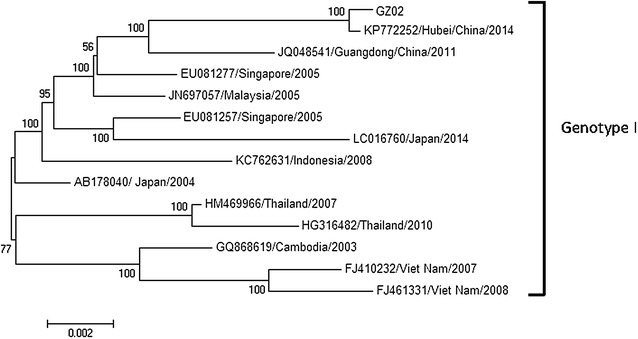
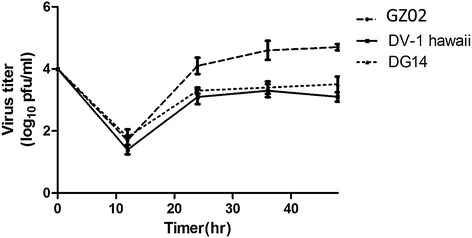
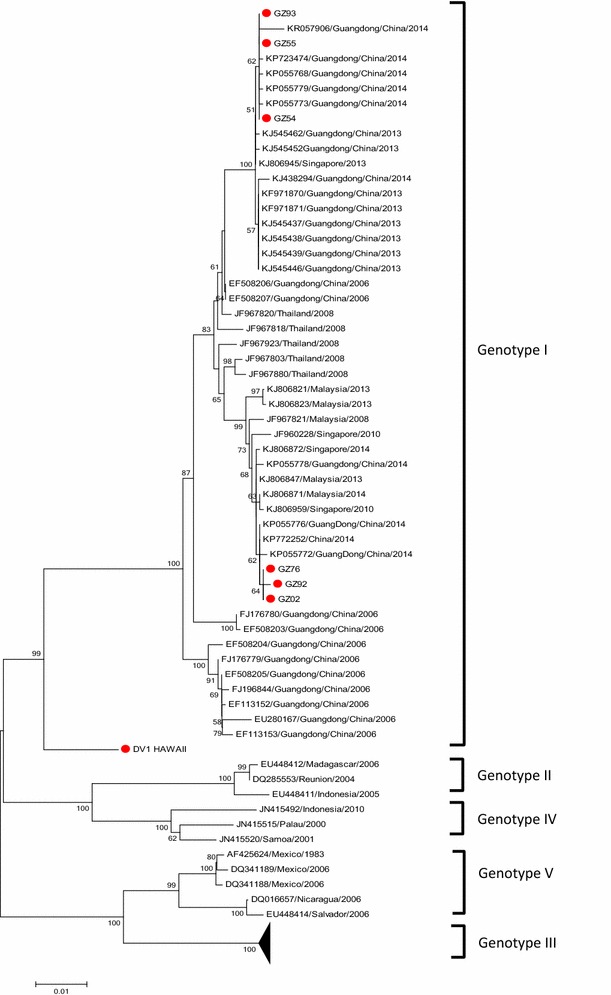
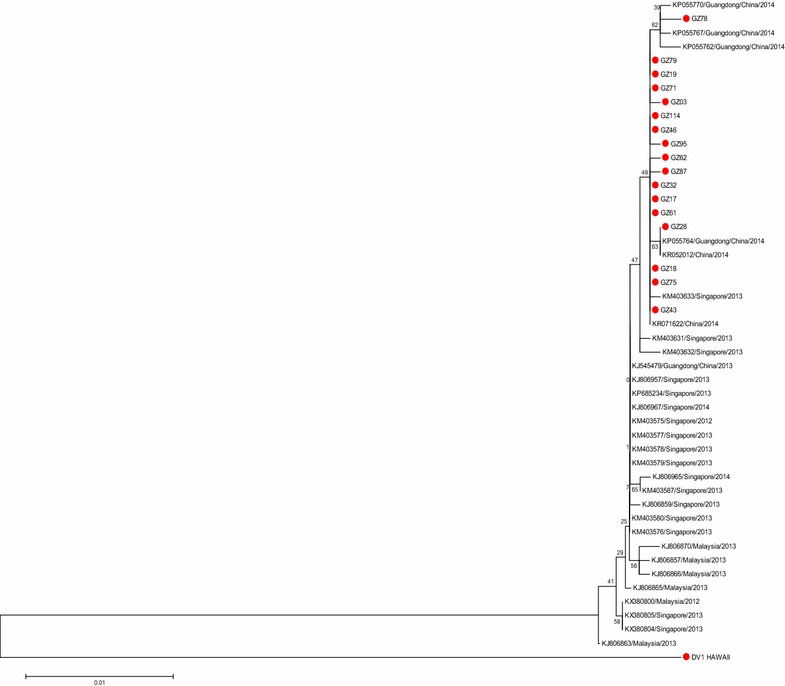
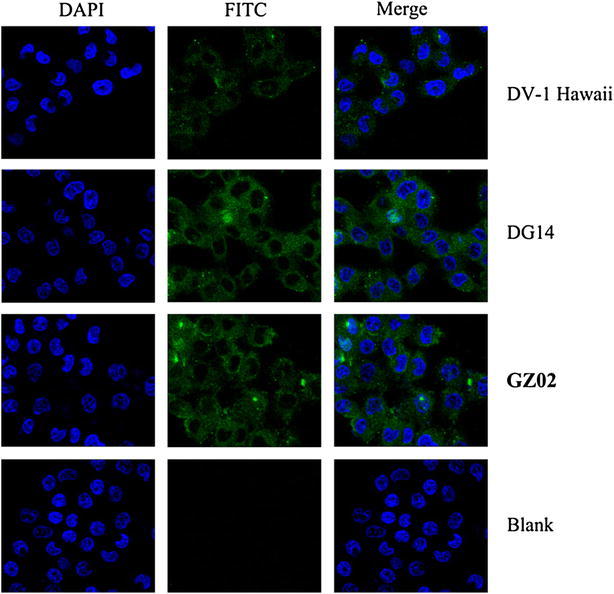
The nucleotide sequences of the E gene from 23 patients sera of dengue virus type 1 (DENV-1) from Guangzhou, China, were determined. One isolate that was recovered from a patient with serious liver damage was designated GZ02. The whole genome sequence of GZ02 was amplified, and confocal microscopy and plaque reduction neutralization test were performed to investigate the replication kinetics in liver L02 cells. In the study, assembly and genetic comparisons showed 11 of those E gene nucleotide sequences were absolutely accordant, and the nucleic acid sequence divergence among the other strains had no marked difference.
Phylogenetic analysis based on the E gene indicated that the 23 new strains were closely related to strains from Malaysia or Singapore. Two different genotypes (genotype I and III) of DENV-1 were co-circulating in Guangdong, Malaysia, and Singapore from 2013 to 2014. However, no recombination event was found after 2005 between DENV strains from Guangdong and Malaysia or Singapore. GZ02 had a significant replicative advantage over DG14 and the DV1 standard strain. Importation of DENV-1 from Southeast Asian countries may have been an important contributing factor to the 2014 outbreak in Guangdong.
登革热是人类最重要的新发疾病之一,目前尚无预防性疫苗或抗病毒治疗方法。2014年,东南亚地区经历了前所未有的登革热疫情,尤其是在中国广东。
测定了来自中国广州的23例1型登革病毒(DENV-1)患者血清中E基因的核苷酸序列。从一名严重肝损伤患者中分离出的一株病毒被命名为GZ02。扩增了GZ02的全基因组序列,并进行了共聚焦显微镜检查和蚀斑减少中和试验,以研究其在肝L02细胞中的复制动力学。在该研究中,组装和遗传比较显示,其中11个E基因核苷酸序列完全一致,其他菌株之间的核酸序列差异无明显差异。
基于E基因的系统发育分析表明,这23株新菌株与来自马来西亚或新加坡的菌株密切相关。2013年至2014年期间,DENV-1的两种不同基因型(基因型I和III)在广东、马来西亚和新加坡共同流行。然而,2005年后,未发现来自广东与马来西亚或新加坡的DENV菌株之间发生重组事件。GZ02比DG14和DV1标准菌株具有显著的复制优势。从东南亚国家输入DENV-1可能是2014年广东疫情爆发的一个重要促成因素。