Wilder-Smith Annelies
Institute of Public Health, University of Heidelberg, Im Neuenheimer Feld 365, Heidelberg, Germany.
Paediatr Int Child Health. 2012 May;32 Suppl 1(s1):28-32. doi: 10.1179/2046904712Z.00000000050.
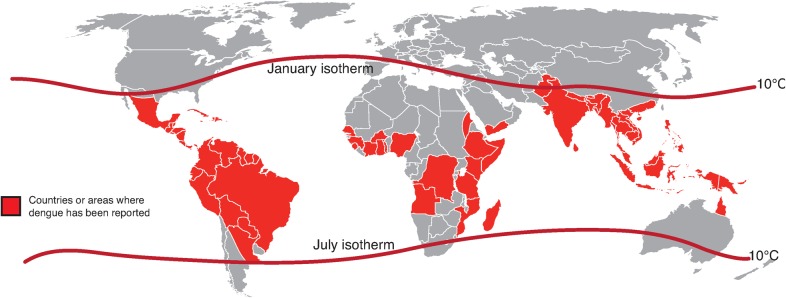
Dengue has been designated a major international public health problem by the World Health Organization (WHO). It is endemic in most tropical and sub-tropical countries, which are also popular tourist destinations. Travellers are not only at significant risk of acquiring dengue but they also contribute to its spread to non-endemic regions. Furthermore, they may serve as sentinels to alert the international community to epidemics in dengue-endemic regions. GeoSentinel, a global surveillance network, monitors all travel-related illnesses and estimates that dengue accounts for 2% of all illness in travellers returning from dengue-endemic regions. In fact, in travellers returning from South-east Asia, dengue is now a more frequent cause of febrile illness than malaria. Dengue-infected travellers returning home to countries where the vector exists can place the local population at risk of further spread of the disease with subsequent autochthonous cycles of infection. The true incidence of dengue amongst travellers may be underestimated because of variability in reporting requirements in different countries and under-diagnosis owing to the non-specific clinical presentation of the disease. Risk factors for acquiring dengue include duration of stay, season of travel and epidemic activity at the destination. Any pre-travel advice on the risks of developing dengue infections should consider these factors.
登革热已被世界卫生组织(WHO)列为一个重大的国际公共卫生问题。它在大多数热带和亚热带国家呈地方性流行,而这些国家也是热门旅游目的地。旅行者不仅极易感染登革热,还会促使其传播至非流行地区。此外,他们可能充当哨兵,向国际社会警示登革热流行地区的疫情。全球监测网络“地理哨兵”对所有与旅行相关的疾病进行监测,并估计登革热占从登革热流行地区返回的旅行者所有疾病的2%。事实上,在从东南亚返回的旅行者中,登革热现在已成为比疟疾更常见的发热疾病病因。感染登革热的旅行者返回存在传播媒介的国家后,可能会使当地居民面临疾病进一步传播以及随后出现本地感染循环的风险。由于不同国家报告要求存在差异,且该疾病临床表现不具特异性导致诊断不足,旅行者中登革热的实际发病率可能被低估。感染登革热的风险因素包括停留时间、旅行季节以及目的地的疫情活动情况。任何关于感染登革热风险的旅行前建议都应考虑这些因素。