Max Planck Institute of Molecular Cell Biology and Genetics, Pfotenhauerstraße 108, D-01307 Dresden, Germany.
Max Planck Institute for Evolutionary Anthropology, Deutscher Platz 6, D-04103 Leipzig, Germany.
Sci Adv. 2016 Dec 7;2(12):e1601941. doi: 10.1126/sciadv.1601941. eCollection 2016 Dec.
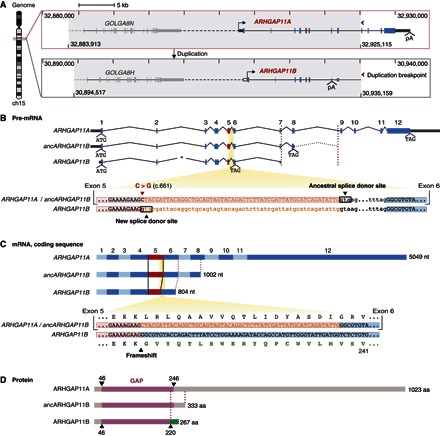
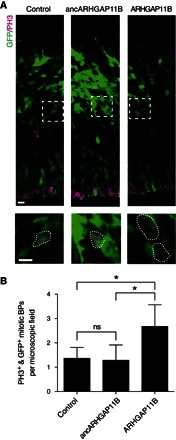
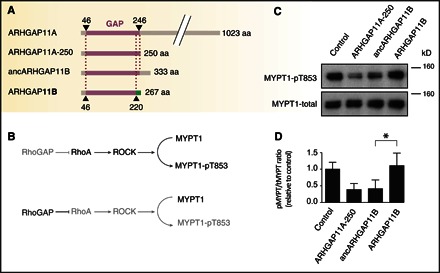
The gene promotes basal progenitor amplification and is implicated in neocortex expansion. It arose on the human evolutionary lineage by partial duplication of , which encodes a Rho guanosine triphosphatase-activating protein (RhoGAP). However, a lack of 55 nucleotides in mRNA leads to loss of RhoGAP activity by GAP domain truncation and addition of a human-specific carboxy-terminal amino acid sequence. We show that these 55 nucleotides are deleted by mRNA splicing due to a single C→G substitution that creates a novel splice donor site. We reconstructed an ancestral complementary DNA without this substitution. Ancestral ARHGAP11B exhibits RhoGAP activity but has no ability to increase basal progenitors during neocortex development. Hence, a single nucleotide substitution underlies the specific properties of ARHGAP11B that likely contributed to the evolutionary expansion of the human neocortex.
该基因促进基底祖细胞扩增,并与大脑新皮层扩张有关。它通过部分重复编码 Rho 鸟苷三磷酸酶激活蛋白(RhoGAP)的 基因而在人类进化谱系中产生。然而, mRNA 中缺少 55 个核苷酸会导致 RhoGAP 活性丧失,这是由于 GAP 结构域截断和添加人类特异性羧基末端氨基酸序列所致。我们发现,由于单个 C→G 取代导致 mRNA 剪接会缺失这 55 个核苷酸,从而产生新的剪接供体位点。我们构建了一个没有这种取代的祖先 cDNA。没有这种取代的祖先 ARHGAP11B 具有 RhoGAP 活性,但在大脑新皮层发育过程中没有增加基底祖细胞的能力。因此,一个核苷酸取代是 ARHGAP11B 特有性质的基础,这可能有助于人类大脑新皮层的进化扩张。