Mihalov-Kovács Eszter, Martella Vito, Lanave Gianvito, Bodnar Livia, Fehér Enikő, Marton Szilvia, Kemenesi Gábor, Jakab Ferenc, Bányai Krisztián
Institute for Veterinary Medical Research, Centre for Agricultural Research, Hungarian Academy of Sciences, Hungária krt. 21, Budapest, H-1143, Hungary.
Dipartimento di Medicina Veterinaria, Universitá Aldo Moro di Bari, S.p. per Casamassima km 3, 70010 Valenzano, Italy.
Virus Res. 2017 Mar 15;232:162-170. doi: 10.1016/j.virusres.2016.12.005. Epub 2016 Dec 10.
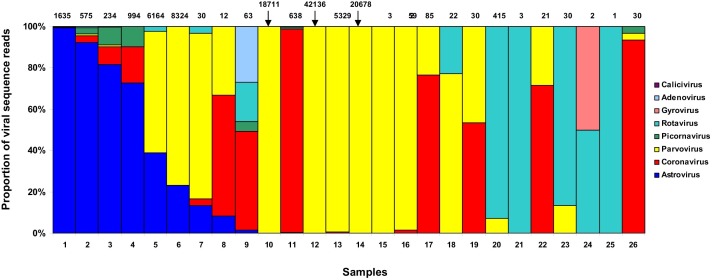
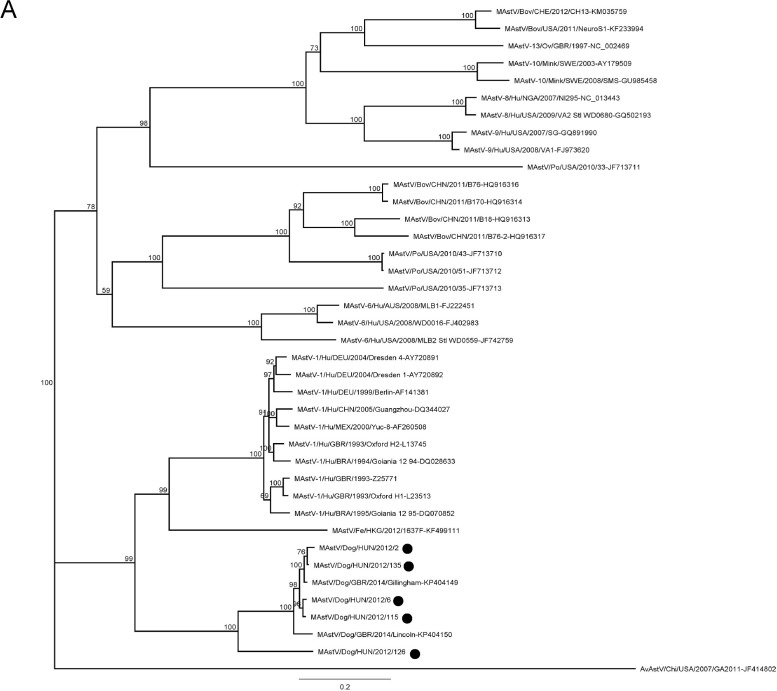
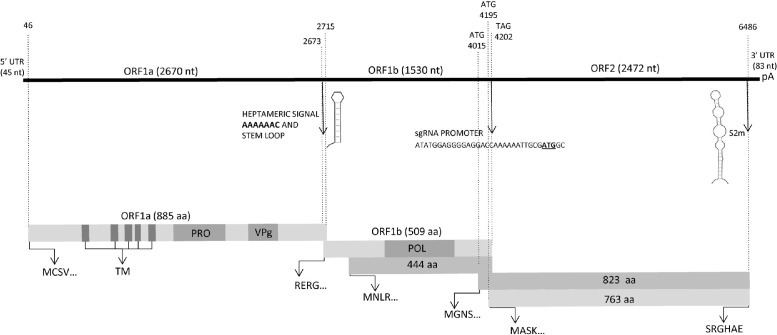
Canine astrovirus RNA was detected in the stools of 17/63 (26.9%) samples, using either a broadly reactive consensus RT-PCR for astroviruses or random RT-PCR coupled with massive deep sequencing. The complete or nearly complete genome sequence of five canine astroviruses was reconstructed that allowed mapping the genome organization and to investigate the genetic diversity of these viruses. The genome was about 6.6kb in length and contained three open reading frames (ORFs) flanked by a 5' UTR, and a 3' UTR plus a poly-A tail. ORF1a and ORF1b overlapped by 43 nucleotides while the ORF2 overlapped by 8 nucleotides with the 3' end of ORF1b. Upon genome comparison, four strains (HUN/2012/2, HUN/2012/6, HUN/2012/115, and HUN/2012/135) were more related genetically to each other and to UK canine astroviruses (88-96% nt identity), whilst strain HUN/2012/126 was more divergent (75-76% nt identity). In the ORF1b and ORF2, strains HUN/2012/2, HUN/2012/6, and HUN/2012/135 were related genetically to other canine astroviruses identified formerly in Europe and China, whereas strain HUN/2012/126 was related genetically to a divergent canine astrovirus strain, ITA/2010/Zoid. For one canine astrovirus, HUN/2012/8, only a 3.2kb portion of the genome, at the 3' end, could be determined. Interestingly, this strain possessed unique genetic signatures (including a longer ORF1b/ORF2 overlap and a longer 3'UTR) and it was divergent in both ORF1b and ORF2 from all other canine astroviruses, with the highest nucleotide sequence identity (68% and 63%, respectively) to a mink astrovirus, thus suggesting a possible event of interspecies transmission. The genetic heterogeneity of canine astroviruses may pose a challenge for the diagnostics and for future prophylaxis strategies.
使用针对星状病毒的广泛反应性共识逆转录聚合酶链反应(RT-PCR)或随机RT-PCR结合大规模深度测序,在63份样本中的17份(26.9%)粪便中检测到犬星状病毒RNA。重建了5种犬星状病毒的完整或近乎完整的基因组序列,这有助于绘制基因组结构并研究这些病毒的遗传多样性。基因组长度约为6.6kb,包含三个开放阅读框(ORF),两侧分别是5'非翻译区(UTR)和3'UTR以及一个聚腺苷酸尾巴。ORF1a和ORF1b重叠43个核苷酸,而ORF2与ORF1b的3'端重叠8个核苷酸。通过基因组比较,四个毒株(HUN/2012/2、HUN/2012/6、HUN/2012/115和HUN/2012/135)在遗传上彼此之间以及与英国犬星状病毒的关系更为密切(核苷酸同一性为88%-96%),而毒株HUN/2012/126的差异更大(核苷酸同一性为75%-76%)。在ORF1b和ORF2中,毒株HUN/2012/2、HUN/2012/6和HUN/2012/135在遗传上与先前在欧洲和中国鉴定的其他犬星状病毒相关,而毒株HUN/2012/126在遗传上与一种差异较大的犬星状病毒毒株ITA/2010/Zoid相关。对于一种犬星状病毒HUN/2012/8,仅确定了基因组3'端的3.2kb部分。有趣的是,该毒株具有独特的遗传特征(包括更长的ORF1b/ORF2重叠和更长的3'UTR),并且在ORF1b和ORF2中与所有其他犬星状病毒都存在差异,与水貂星状病毒的核苷酸序列同一性最高(分别为68%和63%),因此表明可能存在种间传播事件。犬星状病毒的遗传异质性可能对诊断和未来的预防策略构成挑战。