Department of Epidemiology, School of Public Health, University of Michigan, Ann Arbor, Michigan, United States of America.
Department of Biology, University of Florida, Gainesville, Florida, United States of America and Emerging Pathogens Institute, University of Florida, Gainesville, Florida, United States of America.
PLoS Negl Trop Dis. 2023 Aug 8;17(8):e0010831. doi: 10.1371/journal.pntd.0010831. eCollection 2023 Aug.
Transmission models have a long history in the study of mosquito-borne disease dynamics. The mosquito biting rate (MBR) is an important parameter in these models, however, estimating its value empirically is complex. Modeling studies obtain biting rate values from various types of studies, each of them having its strengths and limitations. Thus, understanding these study designs and the factors that contribute to MBR estimates and their variability is an important step towards standardizing these estimates. We do this for an important arbovirus vector Aedes aegypti.
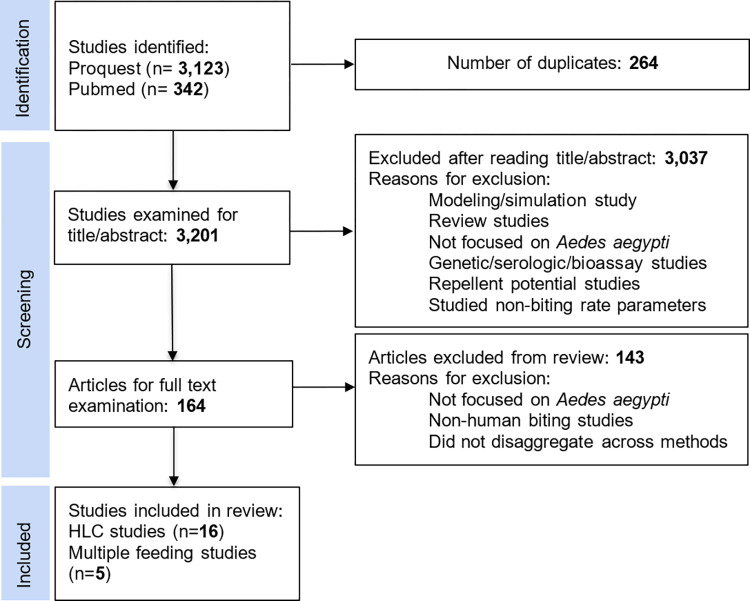
METHODOLOGY/PRINCIPAL FINDINGS: We perform a systematic review using search terms such as 'biting rate' and 'biting frequency' combined with 'Aedes aegypti' ('Ae. aegypti' or 'A. aegypti'). We screened 3,201 articles from PubMed and ProQuest databases, of which 21 met our inclusion criteria. Two broader types of studies are identified: human landing catch (HLC) studies and multiple feeding studies. We analyze the biting rate data provided as well as the methodologies used in these studies to characterize the variability of these estimates across temporal, spatial, and environmental factors and to identify the strengths and limitations of existing methodologies. Based on these analyses, we present two approaches to estimate population mean per mosquito biting rate: one that combines studies estimating the number of bites taken per gonotrophic cycle and the gonotrophic cycle duration, and a second that uses data from histological studies. Based on one histological study dataset, we estimate biting rates of Ae. aegypti (0.41 and 0.35 bite/mosquito-day in Thailand and Puerto Rico, respectively).
CONCLUSIONS/SIGNIFICANCE: Our review reinforces the importance of engaging with vector biology when using mosquito biting rate data in transmission modeling studies. For Ae. aegypti, this includes understanding the variation of the gonotrophic cycle duration and the number of bites per gonotrophic cycle, as well as recognizing the potential for spatial and temporal variability. To address these variabilities, we advocate for site-specific data and the development of a standardized approach to estimate the biting rate.
传播模型在蚊媒疾病动态研究中具有悠久的历史。在这些模型中,蚊虫叮咬率(MBR)是一个重要参数,然而,通过经验来估计其值是复杂的。建模研究从各种类型的研究中获取叮咬率值,每种研究都有其优势和局限性。因此,了解这些研究设计以及导致 MBR 估计值及其变异性的因素是标准化这些估计值的重要步骤。我们以一种重要的虫媒病毒载体埃及伊蚊(Aedes aegypti)为例来完成这项工作。
方法/主要发现:我们使用了诸如“叮咬率”和“叮咬频率”等搜索词,并结合了“埃及伊蚊”(“Aedes aegypti”或“A. aegypti”)进行了系统综述。我们从 PubMed 和 ProQuest 数据库中筛选了 3201 篇文章,其中 21 篇符合我们的纳入标准。确定了两种更广泛的研究类型:人体诱捕(HLC)研究和多次喂食研究。我们分析了提供的叮咬率数据以及这些研究中使用的方法,以描述这些估计值在时间、空间和环境因素方面的变异性,并确定现有方法的优缺点。基于这些分析,我们提出了两种估计蚊虫种群平均叮咬率的方法:一种方法结合了估计每个生殖周期和生殖周期持续时间内所取叮咬次数的研究,另一种方法使用来自组织学研究的数据。基于一项组织学研究数据集,我们估计了埃及伊蚊的叮咬率(泰国和波多黎各分别为 0.41 和 0.35 次/蚊天)。
结论/意义:我们的综述强调了在传播模型研究中使用蚊虫叮咬率数据时,与媒介生物学密切合作的重要性。对于埃及伊蚊,这包括了解生殖周期持续时间和每个生殖周期的叮咬次数的变化,以及认识到空间和时间变异性的潜力。为了解决这些变异性问题,我们主张采用特定地点的数据,并开发一种标准化的方法来估计叮咬率。