Kim Jin-Woo, Kim Jungyeon, Seo Seung-Oh, Kim Kyoung Heon, Jin Yong-Su, Seo Jin-Ho
Department of Agricultural Biotechnology, Center for Food and Bioconvergence, Seoul National University, Seoul, 151-921 Republic of Korea.
School of Life Sciences and Biotechnology, Korea University, Seoul, 136-713 Republic of Korea.
Biotechnol Biofuels. 2016 Dec 9;9:265. doi: 10.1186/s13068-016-0677-9. eCollection 2016.
2,3-Butanediol (2,3-BD) is a promising compound for various applications in chemical, cosmetic, and agricultural industries. Pyruvate decarboxylase (Pdc)-deficient is an attractive host strain for producing 2,3-BD because a large amount of pyruvate could be shunted to 2,3-BD production instead of ethanol synthesis. However, 2,3-BD yield, productivity, and titer by engineered yeast were inferior to native bacterial producers because of the following metabolic limitations. First, the Pdc-deficient yeast showed growth defect due to a shortage of C-compounds. Second, redox imbalance during the 2,3-BD production led to glycerol formation that lowered the yield.
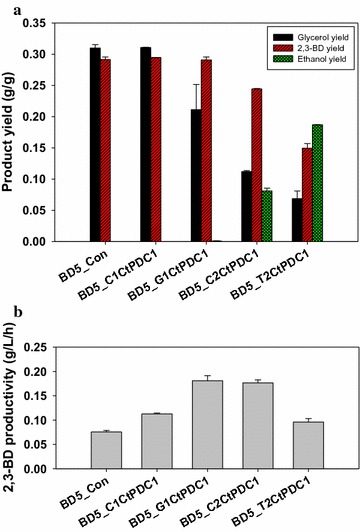
To overcome these problems, the expression levels of Pdc from a Crabtree-negative yeast were optimized in . Specifically, () was used to minimize the production of ethanol but maximize cell growth and 2,3-BD productivity. As a result, productivity of the BD5_G1CtPDC1 strain expressing an optimal level of Pdc was 2.3 folds higher than that of the control strain in flask cultivation. Through a fed-batch fermentation, 121.8 g/L 2,3-BD was produced in 80 h. NADH oxidase from () was additionally expressed in the engineered yeast with an optimal activity of Pdc. The fed-batch fermentation with the optimized 2-stage aeration control led to production of 154.3 g/L 2,3-BD in 78 h. The overall yield of 2,3-BD was 0.404 g 2,3-BD/g glucose which corresponds to 80.7% of theoretical yield.
A massive metabolic shift in the engineered (BD5_G1CtPDC1_nox) expressing NADH oxidase was observed, suggesting that redox imbalance was a major bottleneck for efficient production of 2,3-BD by engineered yeast. Maximum 2,3-BD titer in this study was close to the highest among the reported microbial production studies. The results demonstrate that resolving both C-compound limitation and redox imbalance is critical to increase 2,3-BD production in the Pdc-deficient . Our strategy to express fine-tuned and could be applicable not only to 2,3-BD production, but also other chemical production systems using Pdc-deficient .
2,3-丁二醇(2,3-BD)是一种在化学、化妆品和农业等行业具有多种应用前景的化合物。丙酮酸脱羧酶(Pdc)缺陷型是生产2,3-BD的一种有吸引力的宿主菌株,因为大量丙酮酸可被分流用于2,3-BD的生产而非乙醇合成。然而,由于以下代谢限制,工程酵母生产2,3-BD的产量、生产率和滴度低于天然细菌生产者。首先,Pdc缺陷型酵母因碳化合物短缺而表现出生长缺陷。其次,2,3-BD生产过程中的氧化还原失衡导致甘油形成,降低了产量。
为克服这些问题,对来自克勒克酵母属阴性酵母的Pdc表达水平进行了优化。具体而言,使用()来尽量减少乙醇的产生,但使细胞生长和2,3-BD生产率最大化。结果,在摇瓶培养中,表达最佳水平Pdc的BD5_G1CtPDC1菌株的生产率比对照菌株高2.3倍。通过补料分批发酵,在80小时内生产了121.8 g/L的2,3-BD。来自()的NADH氧化酶在具有最佳Pdc活性的工程酵母中额外表达。采用优化的两阶段曝气控制进行补料分批发酵,在78小时内生产了154.3 g/L的2,3-BD。2,3-BD的总产率为0.404 g 2,3-BD/g葡萄糖,相当于理论产率的80.7%。
观察到在表达NADH氧化酶的工程(BD5_G1CtPDC1_nox)中发生了巨大的代谢转变,这表明氧化还原失衡是工程酵母高效生产2,3-BD的主要瓶颈。本研究中的最大2,3-BD滴度接近已报道的微生物生产研究中的最高水平。结果表明,解决碳化合物限制和氧化还原失衡对于提高Pdc缺陷型中2,3-BD的产量至关重要。我们表达微调的和的策略不仅适用于2,3-BD的生产,也适用于使用Pdc缺陷型的其他化学生产系统。