Brown Sarah, Smith Isabelle L, Brown Julia M, Hulme Claire, McGinnis Elizabeth, Stubbs Nikki, Nelson E Andrea, Muir Delia, Rutherford Claudia, Walker Kay, Henderson Valerie, Wilson Lyn, Gilberts Rachael, Collier Howard, Fernandez Catherine, Hartley Suzanne, Bhogal Moninder, Coleman Susanne, Nixon Jane E
Clinical Trials Research Unit, Leeds Institute of Clinical Trials Research, University of Leeds, Leeds, LS2 9JT, UK.
Academic Unit of Health Economics, Leeds Institute of Health Sciences, University of Leeds, Leeds, LS2 9JT, UK.
Trials. 2016 Dec 20;17(1):604. doi: 10.1186/s13063-016-1703-8.
Pressure ulcers represent a major burden to patients, carers and the healthcare system, affecting approximately 1 in 17 hospital and 1 in 20 community patients. They impact greatly on an individual's functional status and health-related quality of life. The mainstay of pressure ulcer prevention practice is the provision of pressure redistribution support surfaces and patient repositioning. The aim of the PRESSURE 2 study is to compare the two main mattress types utilised within the NHS: high-specification foam and alternating pressure mattresses, in the prevention of pressure ulcers.
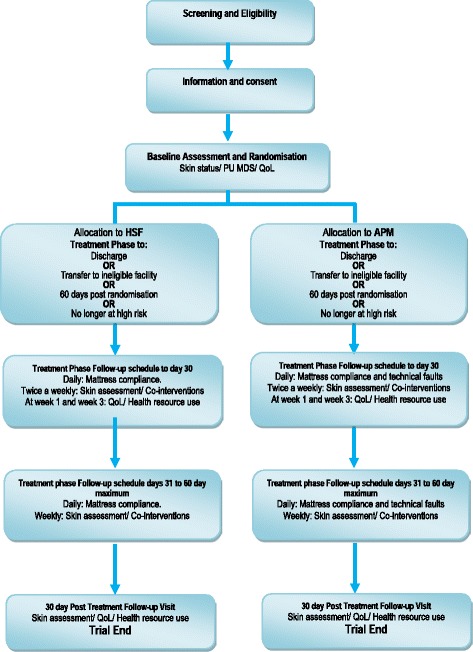
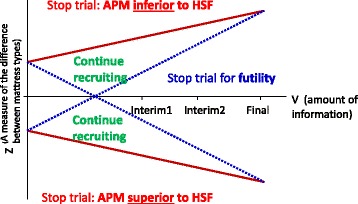
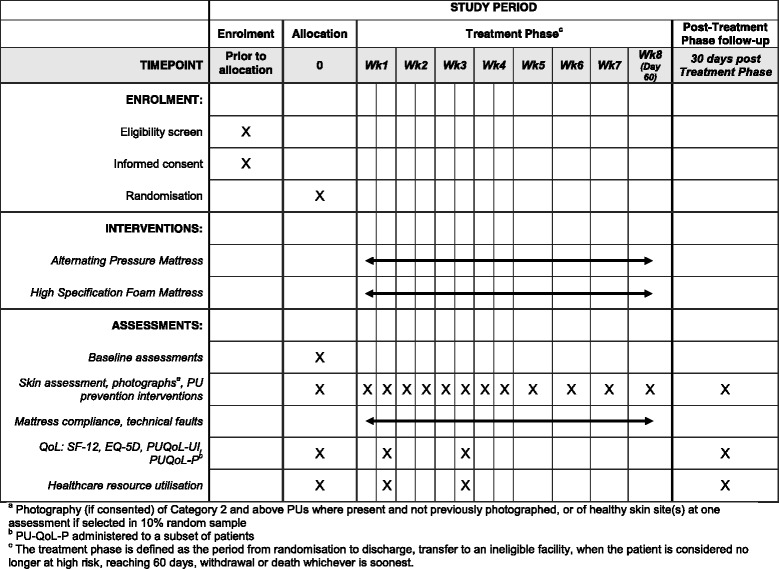
METHODS/DESIGN: PRESSURE 2 is a multicentre, open-label, randomised, double triangular, group sequential, parallel group trial. A maximum of 2954 'high-risk' patients with evidence of acute illness will be randomised on a 1:1 basis to receive either a high-specification foam mattress or alternating-pressure mattress in conjunction with an electric profiling bed frame. The primary objective of the trial is to compare mattresses in terms of the time to developing a new Category 2 or above pressure ulcer by 30 days post end of treatment phase. Secondary endpoints include time to developing new Category 1 and 3 or above pressure ulcers, time to healing of pre-existing Category 2 pressure ulcers, health-related quality of life, cost-effectiveness, incidence of mattress change and safety. Validation objectives are to determine the responsiveness of the Pressure Ulcer Quality of Life-Prevention instrument and the feasibility of having a blinded endpoint assessment using photography. The trial will have a maximum of three planned analyses with unequally spaced reviews at event-driven coherent cut-points. The futility boundaries are constructed as non-binding to allow a decision for stopping early to be overruled by the Data Monitoring and Ethics Committee.
The double triangular, group sequential design of the PRESSURE 2 trial will provide an efficient design through the possibility of early stopping for demonstrating either superiority, inferiority of mattresses or futility of the trial. The trial optimises the potential for producing robust clinical evidence on the effectiveness of two commonly used mattresses in clinical practice earlier than in a conventional design.
ISRCTN01151335 . Registered on 14 May 2013. Protocol version: 5.0, dated 25 September 2015 Trial sponsor: Clare Skinner, Faculty Head of Research Support, University of Leeds, Leeds, LS2 9JT; 0113 343 4897; C.E.Skinner@leeds.ac.uk.
压疮给患者、护理人员及医疗保健系统带来了沉重负担,约每17名住院患者中有1人、每20名社区患者中有1人受其影响。压疮对个人的功能状态及与健康相关的生活质量有极大影响。预防压疮的主要措施是提供压力再分布支撑面并为患者重新摆放体位。“压力2”研究的目的是比较英国国家医疗服务体系(NHS)中使用的两种主要床垫类型,即高规格泡沫床垫和交替压力床垫,在预防压疮方面的效果。
方法/设计:“压力2”是一项多中心、开放标签、随机、双三角、成组序贯、平行组试验。最多2954名有急性病迹象的“高危”患者将按1:1比例随机分组,分别接受高规格泡沫床垫或交替压力床垫,并搭配电动可调节床架。该试验的主要目的是比较两种床垫在治疗阶段结束后30天内出现新的2级及以上压疮的时间。次要终点包括出现新的1级和3级及以上压疮的时间、已有的2级压疮愈合的时间、与健康相关的生活质量、成本效益、床垫更换发生率及安全性。验证目标是确定压疮预防生活质量量表的反应性以及使用摄影进行盲法终点评估的可行性。该试验最多将进行三次计划分析,在事件驱动的连贯切点进行不等间距的评估。无效性界限设定为无约束力,以便数据监测和伦理委员会能够否决提前停止试验的决定。
“压力2”试验的双三角、成组序贯设计将提供一种高效的设计,因为有可能提前停止试验,以证明床垫的优越性、劣势或试验的无效性。该试验比传统设计更早地优化了产生关于两种临床常用床垫有效性的有力临床证据的可能性。
ISRCTN01151335。于2013年5月14日注册。方案版本:5.0,日期为2015年9月25日。试验主办方:利兹大学研究支持系主任克莱尔·斯金纳,利兹,LS2 9JT;0113 343 4897;C.E.Skinner@leeds.ac.uk。