State Key Laboratory of Quality Research in Chinese Medicine, Institute of Chinese Medical Sciences, University of Macau, Taipa, Macau.
Faculty of Arts and Humanity, University of Macau, Taipa, Macau.
Int J Health Policy Manag. 2017 Jan 1;6(1):19-25. doi: 10.15171/ijhpm.2016.72.
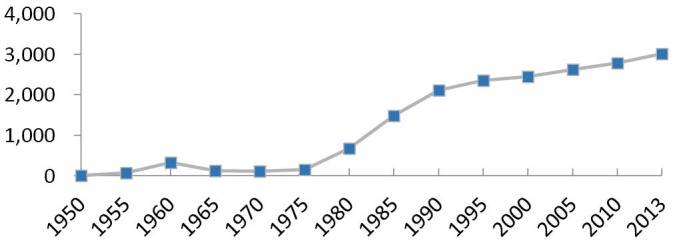
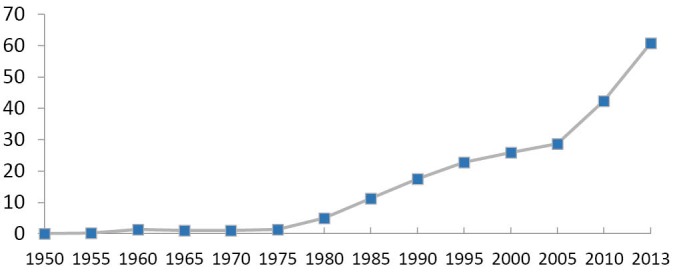
This paper aims to investigate the development trend of traditional Chinese medicine (TCM) hospitals in China and explore their medical service innovations, with special reference to the changing co-existence with western medicine (WM) at TCM hospitals.
Quantitative data at macro level was collected from official databases of China Health Statistical Yearbook and Extracts of Traditional Chinese Medicine Statistics. Qualitative data at micro level was gathered through interviews and second-hand material collection at two of the top-level TCM hospitals.
In both outpatient and inpatient sectors of TCM hospitals, drug fees accounted for the biggest part of hospital revenue. Application of WM medical exanimation increased in both outpatient and inpatient services. Even though the demand for WM drugs was much higher in inpatient care, TCM drugs was the winner in the outpatient. Also qualitative evidence showed that TCM dominated the outpatient hospital service with WM incorporated in the assisting role. However, it was in the inpatient medical care that WM prevailed over TCM which was mostly applied to the rehabilitation of patients.
By drawing on WM while keeping it active in supporting and strengthening the TCM operation in the TCM hospital, the current system accommodates the overriding objective which is for TCM to evolve into a fully informed and more viable medical field.
本文旨在研究中国中医院的发展趋势,并探讨其医疗服务创新,特别关注中医院与西医的共存关系的变化。
宏观层面的定量数据来自中国卫生统计年鉴和中医药统计摘要的官方数据库。微观层面的定性数据通过对两家顶级中医院的访谈和二手资料收集获得。
在中医院的门诊和住院部门,药品费用占医院收入的最大部分。西医医学检查在门诊和住院服务中的应用都有所增加。尽管住院治疗对西药的需求更高,但在门诊中,中药仍然占据优势。定性证据还表明,中医院以中医为主导,西医为辅,为门诊服务提供支持。然而,在住院医疗中,西医占据主导地位,中医主要用于患者的康复治疗。
通过借鉴西医,同时保持其在支持和加强中医院中医运营方面的活力,当前的体系适应了将中医发展成为一个更加全面和可行的医疗领域的总体目标。