Wang Yan, Shi Liuhua, Lee Mihye, Liu Pengfei, Di Qian, Zanobetti Antonella, Schwartz Joel D
From the aDepartment of Environmental Health, Harvard T.H. Chan School of Public Health, Boston, MA; and bJohn A. Paulson School of Engineering and Applied Sciences, Harvard University, Cambridge, MA.
Epidemiology. 2017 Mar;28(2):207-214. doi: 10.1097/EDE.0000000000000614.
Little is known about what factors modify the effect of long-term exposure to PM2.5 on mortality, in part because in most previous studies certain groups such as rural residents and individuals with lower socioeconomic status (SES) are under-represented.
We studied 13.1 million Medicare beneficiaries (age ≥65) residing in seven southeastern US states during 2000-2013 with 95 million person-years of follow-up. We predicted annual average of PM2.5 in each zip code tabulation area (ZCTA) using a hybrid spatiotemporal model. We fit Cox proportional hazards models to estimate the association between long-term PM2.5 and mortality. We tested effect modification by individual-level covariates (race, sex, eligibility for both Medicare and Medicaid, and medical history), neighborhood-level covariates (urbanicity, percentage below poverty level, lower education, median income, and median home value), mean summer temperature, and mass fraction of 11 PM2.5 components.
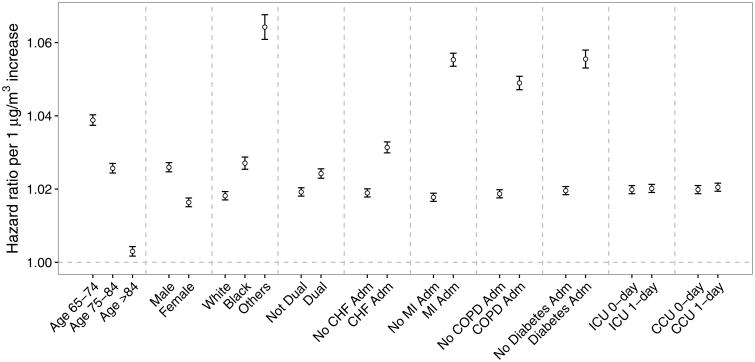
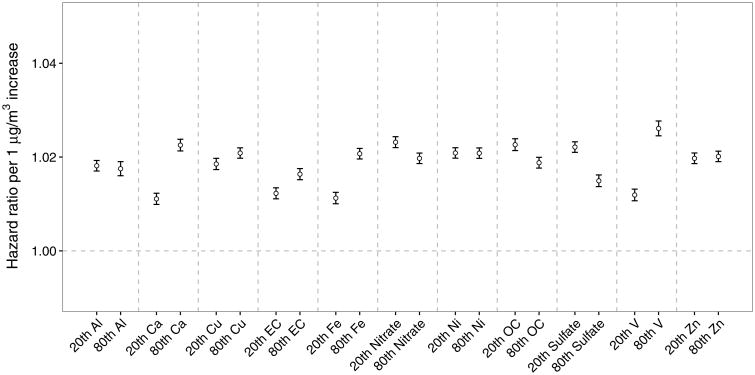
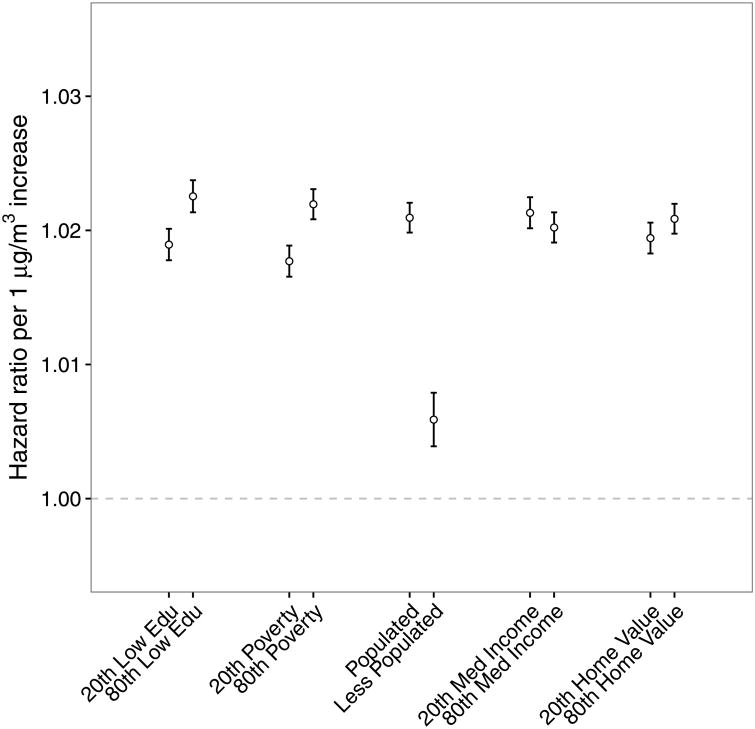
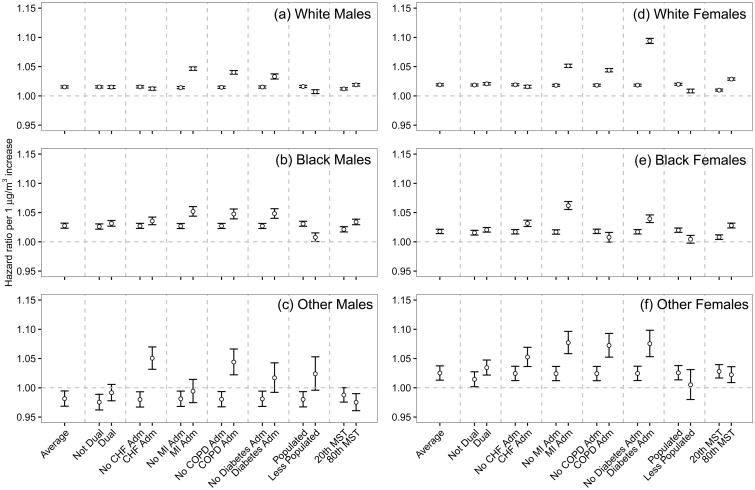
The hazard ratio (HR) for death was 1.021 (95% confidence interval: 1.019, 1.022) per 1 μg m increase in annual PM2.5. The HR decreased with age. It was higher among males, non-whites, dual-eligible individuals, and beneficiaries with previous hospital admissions. It was higher in neighborhoods with lower SES or higher urbanicity. The HR increased with mean summer temperature. The risk associated with PM2.5 increased with relative concentration of elemental carbon, vanadium, copper, calcium, and iron and decreased with nitrate, organic carbon, and sulfate.
Associations between long-term PM2.5 exposure and death were modified by individual-level, neighborhood-level variables, temperature, and chemical compositions.
关于哪些因素会改变长期暴露于细颗粒物(PM2.5)对死亡率的影响,目前所知甚少,部分原因是在大多数先前的研究中,农村居民和社会经济地位(SES)较低的个体等特定群体代表性不足。
我们研究了2000年至2013年期间居住在美国东南部七个州的1310万医疗保险受益人(年龄≥65岁),随访时间达9500万人年。我们使用混合时空模型预测每个邮政编码分区(ZCTA)的PM2.5年平均浓度。我们拟合Cox比例风险模型以估计长期PM2.5暴露与死亡率之间的关联。我们测试了个体水平协变量(种族、性别、同时符合医疗保险和医疗补助资格以及病史)、邻里水平协变量(城市化程度、贫困线以下人口百分比、低教育程度、收入中位数和房屋价值中位数)、夏季平均温度以及11种PM2.5成分的质量分数对效应的修正作用。
PM2.5年平均浓度每增加1μg/m³,死亡风险比(HR)为1.021(95%置信区间:1.019,1.022)。HR随年龄降低。在男性、非白人、双重资格个体以及有过住院记录的受益人中更高。在社会经济地位较低或城市化程度较高的邻里中更高。HR随夏季平均温度升高而增加。与PM2.5相关的风险随元素碳、钒、铜、钙和铁的相对浓度增加而增加,随硝酸盐、有机碳和硫酸盐减少而降低。
长期暴露于PM2.5与死亡之间的关联受到个体水平、邻里水平变量、温度和化学成分的影响。