Aitchison Laurence, Lengyel Máté
Gatsby Computational Neuroscience Unit, University College London, London, United Kingdom.
Computational & Biological Learning Lab, Department of Engineering, University of Cambridge, Cambridge, United Kingdom.
PLoS Comput Biol. 2016 Dec 27;12(12):e1005186. doi: 10.1371/journal.pcbi.1005186. eCollection 2016 Dec.
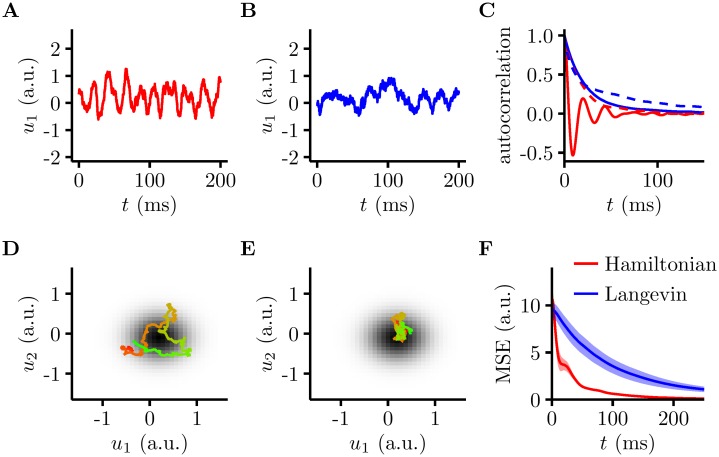
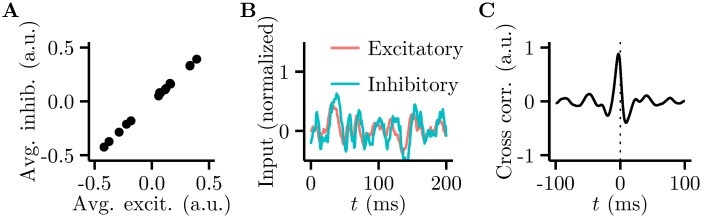
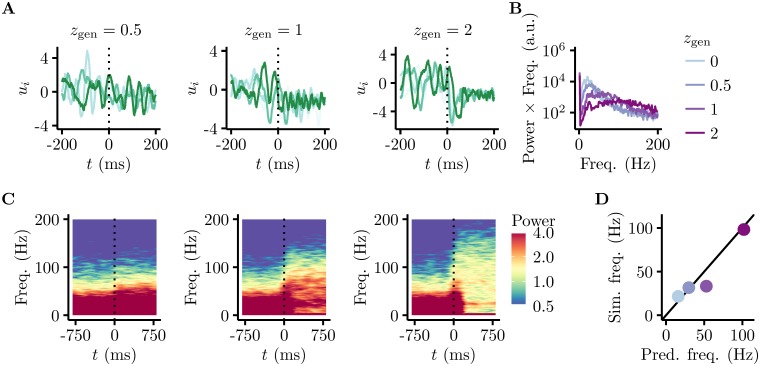
Probabilistic inference offers a principled framework for understanding both behaviour and cortical computation. However, two basic and ubiquitous properties of cortical responses seem difficult to reconcile with probabilistic inference: neural activity displays prominent oscillations in response to constant input, and large transient changes in response to stimulus onset. Indeed, cortical models of probabilistic inference have typically either concentrated on tuning curve or receptive field properties and remained agnostic as to the underlying circuit dynamics, or had simplistic dynamics that gave neither oscillations nor transients. Here we show that these dynamical behaviours may in fact be understood as hallmarks of the specific representation and algorithm that the cortex employs to perform probabilistic inference. We demonstrate that a particular family of probabilistic inference algorithms, Hamiltonian Monte Carlo (HMC), naturally maps onto the dynamics of excitatory-inhibitory neural networks. Specifically, we constructed a model of an excitatory-inhibitory circuit in primary visual cortex that performed HMC inference, and thus inherently gave rise to oscillations and transients. These oscillations were not mere epiphenomena but served an important functional role: speeding up inference by rapidly spanning a large volume of state space. Inference thus became an order of magnitude more efficient than in a non-oscillatory variant of the model. In addition, the network matched two specific properties of observed neural dynamics that would otherwise be difficult to account for using probabilistic inference. First, the frequency of oscillations as well as the magnitude of transients increased with the contrast of the image stimulus. Second, excitation and inhibition were balanced, and inhibition lagged excitation. These results suggest a new functional role for the separation of cortical populations into excitatory and inhibitory neurons, and for the neural oscillations that emerge in such excitatory-inhibitory networks: enhancing the efficiency of cortical computations.
概率推理为理解行为和皮层计算提供了一个有原则的框架。然而,皮层反应的两个基本且普遍存在的特性似乎难以与概率推理相协调:神经活动在对恒定输入的反应中表现出显著的振荡,以及在对刺激开始的反应中出现大的瞬态变化。事实上,概率推理的皮层模型通常要么专注于调谐曲线或感受野特性,对潜在的电路动力学保持不可知论,要么具有既不产生振荡也不产生瞬态的简单动力学。在这里,我们表明这些动力学行为实际上可能被理解为皮层用于执行概率推理的特定表示和算法的标志。我们证明了一类特定的概率推理算法,哈密顿蒙特卡罗(HMC),自然地映射到兴奋性 - 抑制性神经网络的动力学上。具体来说,我们构建了一个初级视觉皮层中执行HMC推理的兴奋性 - 抑制性电路模型,因此固有地产生了振荡和瞬态。这些振荡并非仅仅是附带现象,而是起到了重要的功能作用:通过快速跨越大量状态空间来加速推理。因此,推理比模型的非振荡变体效率提高了一个数量级。此外,该网络匹配了观察到的神经动力学的两个特定特性,否则使用概率推理很难解释。首先,振荡频率以及瞬态幅度随着图像刺激的对比度增加而增加。其次,兴奋和抑制是平衡的,并且抑制滞后于兴奋。这些结果表明,将皮层群体分为兴奋性和抑制性神经元以及在这种兴奋性 - 抑制性网络中出现的神经振荡具有新的功能作用:提高皮层计算的效率。