Fadaei Reza, Moradi Nariman, Baratchian Mehdi, Aghajani Hassan, Malek Mojtaba, Fazaeli Ali Akbar, Fallah Soudabeh
Department of Biochemistry, Faculty of Medicine, Iran University of Medical Sciences, Tehran, Iran.
Department of Clinical Biochemistry, Faculty of Medicine, Tehran University of Medical Sciences, Tehran, Iran.
PLoS One. 2016 Dec 29;11(12):e0168773. doi: 10.1371/journal.pone.0168773. eCollection 2016.
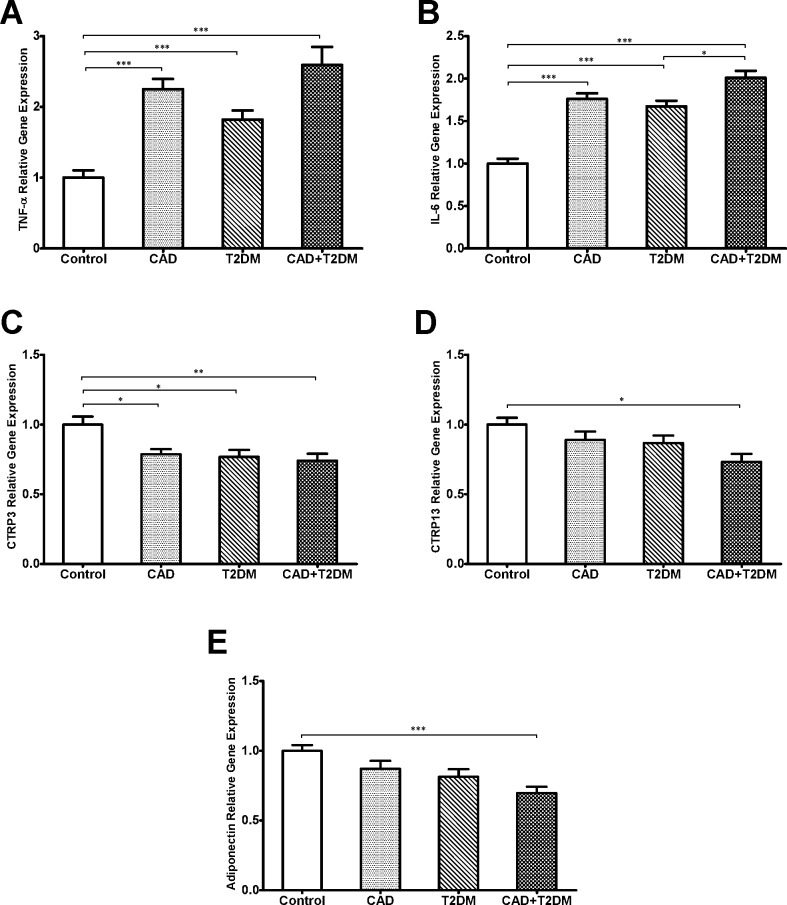
C1q/TNF-Related Protein-3 (CTRP3) and CTRP13 are two newly discovered adipokines regulating glucose and lipid metabolism. But their role in type 2 diabetes mellitus (T2DM) and coronary artery disease (CAD) is still in infancy. The aim of this study was to investigate the associations of gene expression and serum levels of CTRP3 and CTRP13 with CAD, metabolic and inflammatory markers in patients with and without T2DM. Serum levels of CTRP3, CTRP13, adiponectin and inflammatory cytokines and their gene expression in peripheral blood mononuclear cells (PBMCs) were determined in 172 subjects categorized as group I (without T2DM and CAD), group II (with CAD but no T2DM), group III (with T2DM but no CAD) and group IV (with T2DM and CAD). Serum levels and gene expression of CTRP3, CTRP13 and adiponectin in the group I were higher compared to other groups. Inflammatory cytokines in the control group were lower than other groups too. CTRP3 serum levels have an independent association with BMI, smoking and CTRP3 gene expression; also CTRP13 serum levels has an independent association with BMI, HDL-C, insulin, HOMA-IR, HbA1c and TNF-α. Decreased serum levels of CTRP3 and CTRP13 were also associated with CAD. It appears that the decreased levels of CTRP3 and especially CTRP13 were associated with increased risk of T2DM and CAD. These findings suggest an emerging role of these adipokines in the pathogenesis of CAD, but further studies are necessary to establish this concept.
C1q/肿瘤坏死因子相关蛋白-3(CTRP3)和CTRP13是两种新发现的调节葡萄糖和脂质代谢的脂肪因子。但它们在2型糖尿病(T2DM)和冠状动脉疾病(CAD)中的作用仍处于起步阶段。本研究的目的是调查CTRP3和CTRP13的基因表达及血清水平与CAD、有无T2DM患者的代谢和炎症标志物之间的关联。在172名受试者中测定了CTRP3、CTRP13、脂联素和炎症细胞因子的血清水平及其在外周血单个核细胞(PBMCs)中的基因表达,这些受试者分为I组(无T2DM和CAD)、II组(有CAD但无T2DM)、III组(有T2DM但无CAD)和IV组(有T2DM和CAD)。I组中CTRP3、CTRP13和脂联素的血清水平及基因表达高于其他组。对照组中的炎症细胞因子也低于其他组。CTRP3血清水平与BMI、吸烟及CTRP3基因表达独立相关;CTRP13血清水平也与BMI、高密度脂蛋白胆固醇(HDL-C)、胰岛素、稳态模型评估胰岛素抵抗(HOMA-IR)、糖化血红蛋白(HbA1c)和肿瘤坏死因子-α(TNF-α)独立相关。CTRP3和CTRP13血清水平降低也与CAD相关。似乎CTRP3尤其是CTRP13水平降低与T2DM和CAD风险增加相关。这些发现提示这些脂肪因子在CAD发病机制中具有新的作用,但需要进一步研究来证实这一概念。