Dauer Patricia, Nomura Alice, Saluja Ashok, Banerjee Sulagna
Department of Pharmacology, University of Minnesota, MN, USA.
Division of Surgical Oncology, Department of Surgery, University of Miami, FL, USA.
Pancreatology. 2017 Jan-Feb;17(1):7-12. doi: 10.1016/j.pan.2016.12.010. Epub 2016 Dec 23.
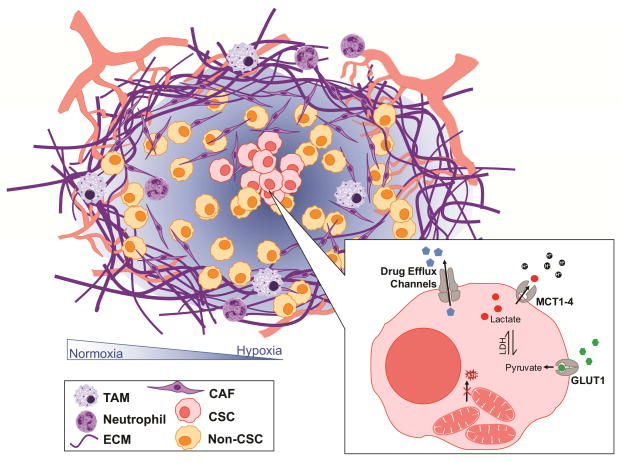
Every year, nearly 300,000 people are diagnosed with pancreatic cancer worldwide, and an equivalent number succumb to this disease. One of the major challenges of pancreatic cancer that contributes to its poor survival rates is the development of resistance to the standard chemotherapy. Heterogeneity of the tumor, the dense fibroblastic stroma, and the aggressive biology of the tumor all contribute to the chemoresistant phenotype. In addition, the acellular components of the tumor microenvironment like hypoxia, stress pathways in the stromal cells, and the cytokines that are secreted by the immune cells, have a definitive role in orchestrating the chemoresistant property of the tumor. In this review, we systematically focus on the role played by the different microenvironmental components in determining chemoresistance of pancreatic tumors.
全球每年有近30万人被诊断出患有胰腺癌,且死于该病的人数与之相当。胰腺癌导致生存率低下的主要挑战之一是对标准化疗产生耐药性。肿瘤的异质性、致密的成纤维细胞基质以及肿瘤的侵袭性生物学特性均促成了化疗耐药表型。此外,肿瘤微环境的无细胞成分,如缺氧、基质细胞中的应激途径以及免疫细胞分泌的细胞因子,在协调肿瘤的化疗耐药特性方面具有决定性作用。在本综述中,我们系统地聚焦于不同微环境成分在决定胰腺肿瘤化疗耐药性中所起的作用。