Vilay Phoutnalong, Nonaka Daisuke, Senamonty Phosadeth, Lao Malayvanh, Iwagami Moritoshi, Kobayashi Jun, Hernandez Paul Michael, Phrasisombath Ketkesone, Kounnavong Sengchanh, Hongvanthong Bouasy, Brey Paul T, Kano Shigeyuki
1Department of Global Health, Graduate School of Health Sciences, University of the Ryukyus, 207 Uehara-cho, Okinawa, 903-0215 Japan.
2Center of Malariology, Parasitology and Entomology, Ministry of Health, Vientiane, Lao PDR.
Trop Med Health. 2019 Jan 25;47:11. doi: 10.1186/s41182-019-0138-9. eCollection 2019.
Malaria is a major health problem in Lao People's Democratic Republic (Lao PDR) with high transmission in remote and forest areas, particularly in the South. The military is at risk of malaria infection especially those deployed in forest areas. This study determined the prevalence of malaria infection and assessed knowledge, perception, and preventive and treatment behavior regarding malaria among military personnel in two southern provinces in Lao PDR.
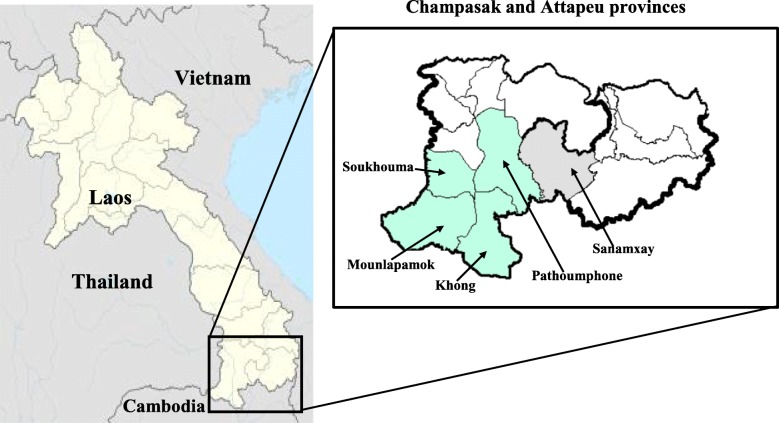
Quantitative and qualitative approaches were undertaken in Champasak and Attapeu provinces in 2017. From 313 military personnel, quantitative data were collected through questionnaire-based interviews and blood samples used for parasite detection by polymerase chain reaction (PCR). Qualitative data were collected through 7 focus group discussions and 17 in-depth interviews among 49 military personnel. Fisher's exact test and Mann-Whitney test were used to assess the association between malaria infection and participant characteristics. Content analysis for qualitative data was performed to explore perception and treatment behaviors regarding malaria.
The prevalence of malaria infection was 11.2% (: 1.3%, : 9.3% and mixed infections: 0.6%). Many participants understood that malaria is transmitted through mosquito bites, although they did not necessarily know the name of vector mosquitoes (). Surprisingly, more than a half also believed that malaria is transmitted through drinking stream water. One-third of the participants used long-lasting insecticidal nets. Due to limited supply, participants were often unable to use mosquito repellent and coils when necessary. Because participants were unable to receive timely diagnosis and appropriate treatment for malaria in their camps, they commonly practiced self-treatment using antibiotics, painkillers, and/or traditional medicines. They only go to a healthcare facility through their supervisor if their conditions worsen.
The prevalence of symptomatic and asymptomatic malaria was conspicuous among military in forest areas. Many participants believed that malaria is transmitted not only by mosquito bites but also from drinking stream water. Preventive equipment was often insufficient. Self-treatment was practiced before referring to healthcare facility. To further prevent military from contracting malaria, the National Malaria Control Program and military body should provide adequate and suitable health education, protective equipment, and on-site malaria case management.
疟疾是老挝人民民主共和国(老挝)的一个主要健康问题,在偏远和森林地区传播率很高,尤其是在南部地区。军队面临疟疾感染风险,特别是那些部署在森林地区的军人。本研究确定了老挝南部两个省份军人疟疾感染的患病率,并评估了他们对疟疾的知识、认知以及预防和治疗行为。
2017年在占巴塞省和阿速坡省采用了定量和定性方法。从313名军人中,通过问卷调查收集定量数据,并采集血样用于聚合酶链反应(PCR)寄生虫检测。通过7次焦点小组讨论和对49名军人进行17次深入访谈收集定性数据。采用Fisher精确检验和Mann-Whitney检验评估疟疾感染与参与者特征之间的关联。对定性数据进行内容分析,以探讨对疟疾的认知和治疗行为。
疟疾感染患病率为11.2%(单一感染:1.3%,混合感染:0.6%)。许多参与者知道疟疾是通过蚊虫叮咬传播的,尽管他们不一定知道传播媒介蚊虫的名称。令人惊讶的是,超过一半的人还认为疟疾是通过饮用溪水传播的。三分之一的参与者使用长效驱虫蚊帐。由于供应有限,参与者在必要时常常无法使用驱蚊剂和蚊香。由于参与者在营地无法及时获得疟疾的诊断和适当治疗,他们通常自行使用抗生素、止痛药和/或传统药物进行治疗。只有病情恶化时,他们才会通过上级前往医疗机构就诊。
有症状和无症状疟疾在森林地区军人中患病率较高。许多参与者认为疟疾不仅通过蚊虫叮咬传播,还通过饮用溪水传播。预防设备往往不足。在前往医疗机构就诊之前,他们会自行治疗。为进一步防止军人感染疟疾,国家疟疾控制规划和军队机构应提供充分和适当的健康教育、防护设备以及现场疟疾病例管理。