Wald Lawrence L, Polimeni Jonathan R
Athinoula A. Martinos Center for Biomedical Imaging, Dept. of Radiology, Harvard Medical School, Massachusetts General Hospital, Charlestown, MA, USA; Harvard-Massachusetts Institute of Technology Division of Health Sciences and Technology, Cambridge, MA, USA.
Athinoula A. Martinos Center for Biomedical Imaging, Dept. of Radiology, Harvard Medical School, Massachusetts General Hospital, Charlestown, MA, USA; Harvard-Massachusetts Institute of Technology Division of Health Sciences and Technology, Cambridge, MA, USA.
Neuroimage. 2017 Jul 1;154:15-22. doi: 10.1016/j.neuroimage.2016.12.057. Epub 2016 Dec 28.
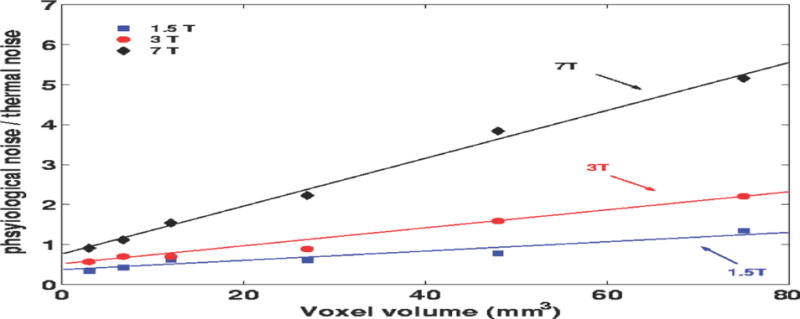
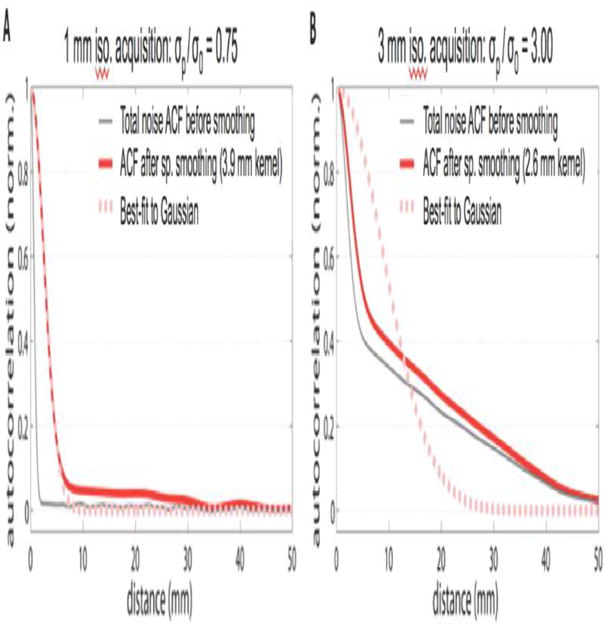
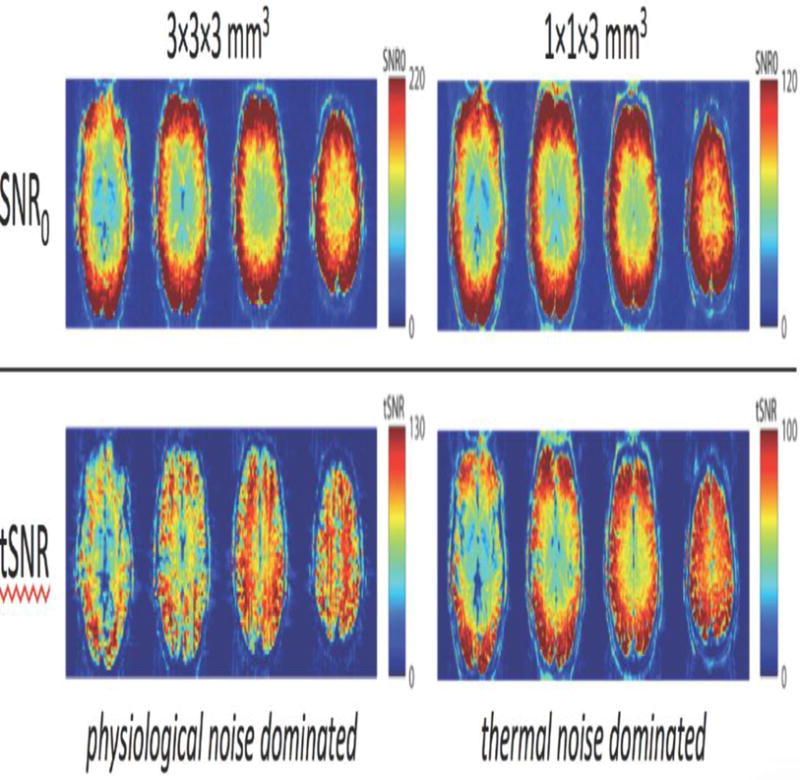
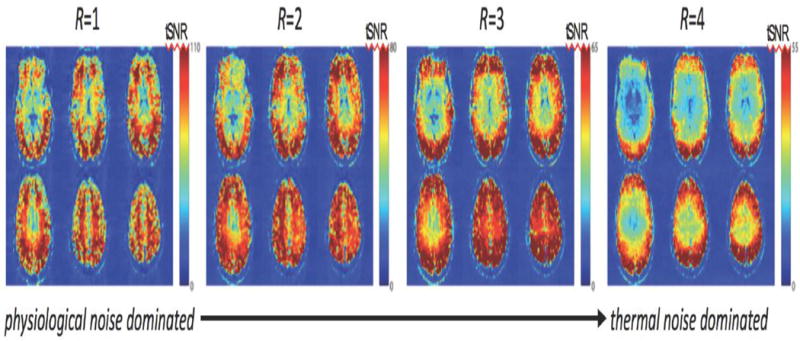
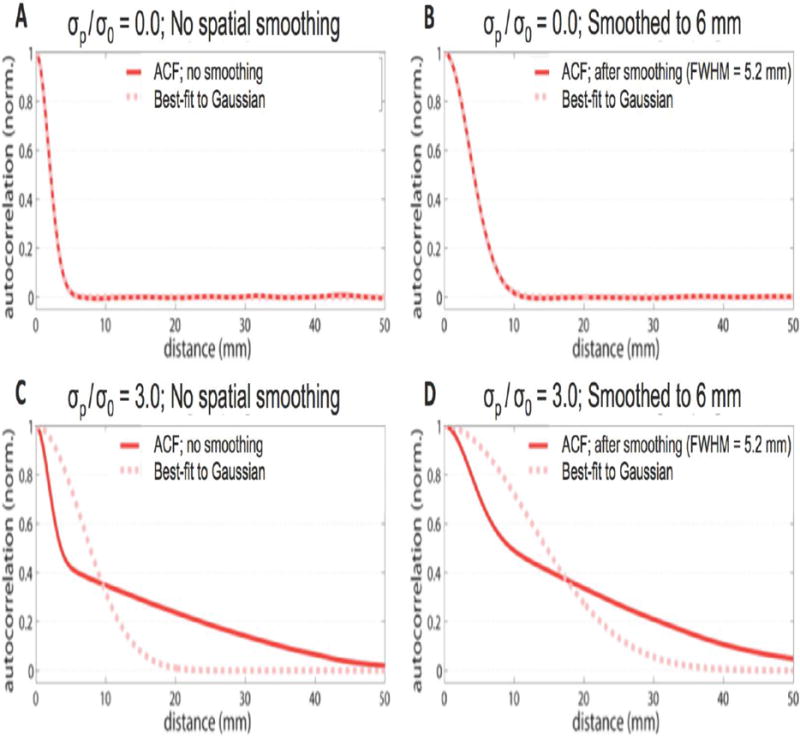
We review the components of time-series noise in fMRI experiments and the effect of image acquisition parameters on the noise. In addition to helping determine the total amount of signal and noise (and thus temporal SNR), the acquisition parameters have been shown to be critical in determining the ratio of thermal to physiological induced noise components in the time series. Although limited attention has been given to this latter metric, we show that it determines the degree of spatial correlations seen in the time-series noise. The spatially correlations of the physiological noise component are well known, but recent studies have shown that they can lead to a higher than expected false-positive rate in cluster-wise inference based on parametric statistical methods used by many researchers. Based on understanding the effect of acquisition parameters on the noise mixture, we propose several acquisition strategies that might be helpful reducing this elevated false-positive rate, such as moving to high spatial resolution or using highly-accelerated acquisitions where thermal sources dominate. We suggest that the spatial noise correlations at the root of the inflated false-positive rate problem can be limited with these strategies, and the well-behaved spatial auto-correlation functions (ACFs) assumed by the conventional statistical methods are retained if the high resolution data is smoothed to conventional resolutions.
我们回顾了功能磁共振成像(fMRI)实验中时间序列噪声的组成部分以及图像采集参数对噪声的影响。除了有助于确定信号和噪声的总量(从而确定时间信噪比)外,采集参数已被证明在确定时间序列中热噪声与生理诱导噪声成分的比例方面至关重要。尽管对后一个指标的关注有限,但我们表明它决定了时间序列噪声中空间相关性的程度。生理噪声成分的空间相关性是众所周知的,但最近的研究表明,基于许多研究人员使用的参数统计方法,它们会导致在聚类推理中出现高于预期的假阳性率。基于对采集参数对噪声混合影响的理解,我们提出了几种可能有助于降低这种升高的假阳性率的采集策略,例如转向高空间分辨率或使用热源占主导的高度加速采集。我们认为,通过这些策略可以限制导致假阳性率问题的空间噪声相关性,如果将高分辨率数据平滑到传统分辨率,则传统统计方法所假设的良好空间自相关函数(ACF)将得以保留。