Feng Jun, Chen Hua-Wen, Pi Li-Juan, Wang Jin, Zhan Da-Qian
Department of Emergency Medicine, Tongji Hospital, Huazhong University of Science and Technology, Wuhan 430030, Hubei, P.R. China.
Oncotarget. 2017 Feb 7;8(6):10161-10170. doi: 10.18632/oncotarget.14328.
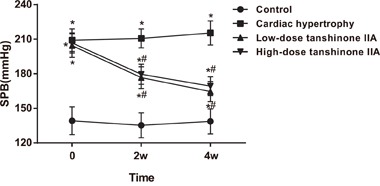
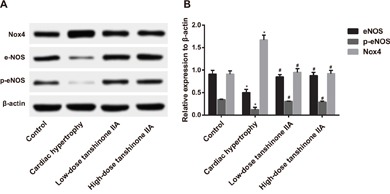
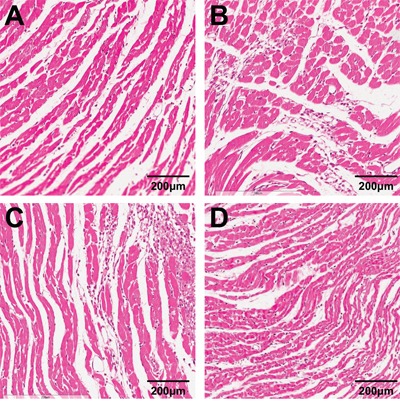
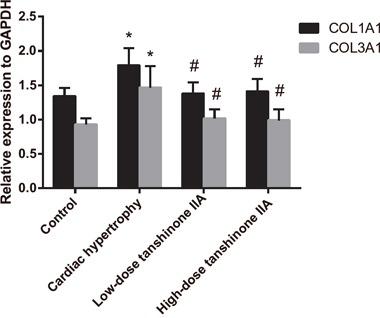
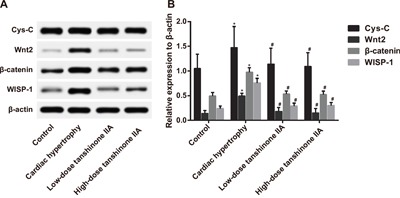
The study aimed to investigate the protective effect of tanshinone IIA against cardiac hypertrophy in spontaneously hypertensive rats (SHRs) through the Cys-C/Wnt signaling pathway. Thirty SHRs were randomly divided into cardiac hypertrophy, low- and high-dose tanshinone IIA groups. Ten Wistar-Kyoto rats were selected as control group. The systolic blood pressure (SBP), heart weight (HW), left ventricular weight (LVW) and body weight (BW) of all rats were recorded. HE staining and qRT-PCR were applied to observe the morphology of myocardial tissue and mRNA expressions of COL1A1 and COL3A1. ELISA and Western blotting were used to measure the serum asymmetric dimethylarginine (ADMA), nitric oxide (NO) and cardiac troponin I (cTnI) levels, and the expressions of the Cys-C/Wnt signaling pathway-related proteins, eNOS and Nox4. Compared with the cardiac hypertrophy group, the SBP, HW/BW, LVW/BW, swelling degree of myocardial cells, COL1A1 and COL3A1 mRNA expressions, serum cTnI and ADMA levels, and the Cys-C/Wnt signaling pathway-related proteins and Nox4 expressions in the low- and high-dose tanshinone IIA groups were decreased, but the endothelial NO synthase (eNOS), phosphorylated eNOS (Ser1177) and NO expressions were increased. No significant difference was found between the low- and high-dose tanshinone IIA groups. Our study indicated a protective effect of tanshinone IIA against cardiac hypertrophy in SHRs through inhibiting the Cys-C/Wnt signaling pathway.
本研究旨在通过Cys-C/ Wnt信号通路探讨丹参酮IIA对自发性高血压大鼠(SHRs)心脏肥大的保护作用。将30只SHRs随机分为心脏肥大组、低剂量和高剂量丹参酮IIA组。选取10只Wistar-Kyoto大鼠作为对照组。记录所有大鼠的收缩压(SBP)、心脏重量(HW)、左心室重量(LVW)和体重(BW)。采用HE染色和qRT-PCR观察心肌组织形态及COL1A1和COL3A1的mRNA表达。采用ELISA和蛋白质印迹法检测血清不对称二甲基精氨酸(ADMA)、一氧化氮(NO)和心肌肌钙蛋白I(cTnI)水平,以及Cys-C/ Wnt信号通路相关蛋白、内皮型一氧化氮合酶(eNOS)和Nox4的表达。与心脏肥大组相比,低剂量和高剂量丹参酮IIA组的SBP、HW/BW、LVW/BW、心肌细胞肿胀程度、COL1A1和COL3A1 mRNA表达、血清cTnI和ADMA水平以及Cys-C/ Wnt信号通路相关蛋白和Nox4表达均降低,但内皮型一氧化氮合酶(eNOS)、磷酸化eNOS(Ser1177)和NO表达增加。低剂量和高剂量丹参酮IIA组之间未发现显著差异。我们的研究表明,丹参酮IIA通过抑制Cys-C/ Wnt信号通路对SHRs心脏肥大具有保护作用。