Zhao Yi-Jiao, Xiong Yu-Xue, Wang Yong
National Engineering Laboratory for Digital and Material Technology of Stomatology, Beijing, PR China.
Research Center of Engineering and Technology for Digital Dentistry, Ministry of Health, Beijing, PR China.
PLoS One. 2017 Jan 5;12(1):e0169402. doi: 10.1371/journal.pone.0169402. eCollection 2017.
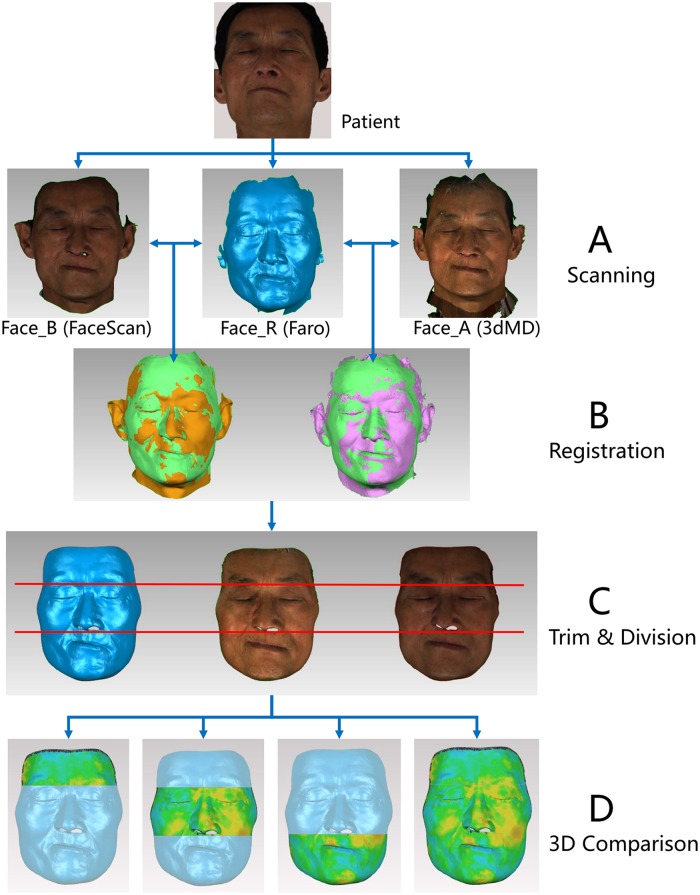
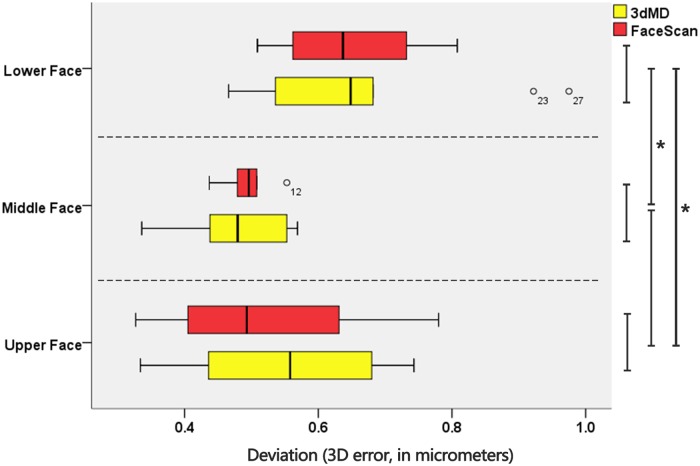
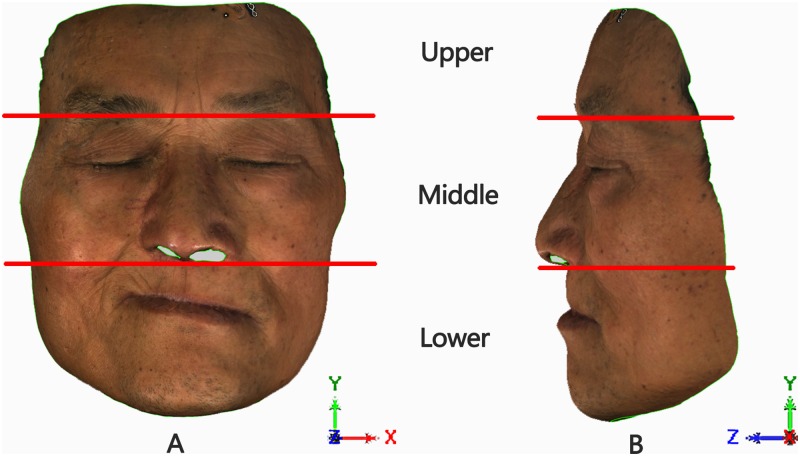
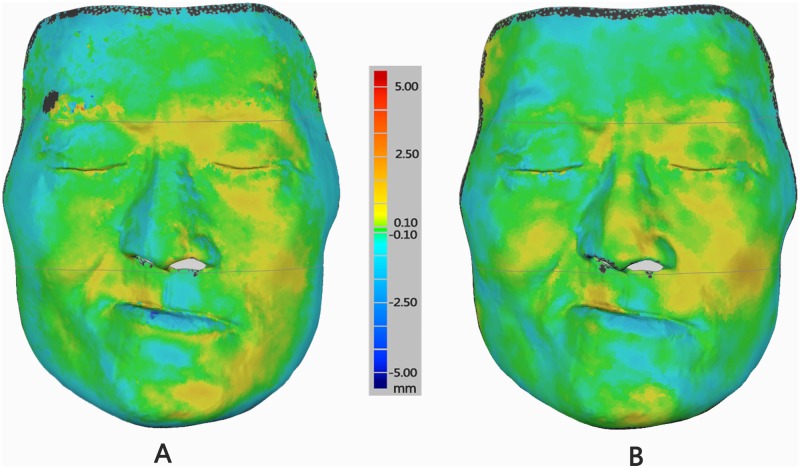
In this study, the practical accuracy (PA) of optical facial scanners for facial deformity patients in oral clinic was evaluated. Ten patients with a variety of facial deformities from oral clinical were included in the study. For each patient, a three-dimensional (3D) face model was acquired, via a high-accuracy industrial "line-laser" scanner (Faro), as the reference model and two test models were obtained, via a "stereophotography" (3dMD) and a "structured light" facial scanner (FaceScan) separately. Registration based on the iterative closest point (ICP) algorithm was executed to overlap the test models to reference models, and "3D error" as a new measurement indicator calculated by reverse engineering software (Geomagic Studio) was used to evaluate the 3D global and partial (upper, middle, and lower parts of face) PA of each facial scanner. The respective 3D accuracy of stereophotography and structured light facial scanners obtained for facial deformities was 0.58±0.11 mm and 0.57±0.07 mm. The 3D accuracy of different facial partitions was inconsistent; the middle face had the best performance. Although the PA of two facial scanners was lower than their nominal accuracy (NA), they all met the requirement for oral clinic use.
在本研究中,对口腔诊所中用于面部畸形患者的光学面部扫描仪的实际精度(PA)进行了评估。研究纳入了10名来自口腔临床的患有各种面部畸形的患者。对于每位患者,通过高精度工业“线激光”扫描仪(法如)获取三维(3D)面部模型作为参考模型,并分别通过“立体摄影”(3dMD)和“结构光”面部扫描仪(FaceScan)获得两个测试模型。执行基于迭代最近点(ICP)算法的配准,以使测试模型与参考模型重叠,并使用由逆向工程软件(Geomagic Studio)计算的“3D误差”作为新的测量指标,来评估每个面部扫描仪的3D全局和局部(面部上、中、下部分)PA。针对面部畸形获得的立体摄影和结构光面部扫描仪各自的3D精度分别为0.58±0.11毫米和0.57±0.07毫米。不同面部区域的3D精度不一致;中面部表现最佳。尽管两种面部扫描仪的PA低于其标称精度(NA),但它们均满足口腔诊所使用的要求。